
News List
Middle Corridor Emerges as Key Eurasian Trade Route

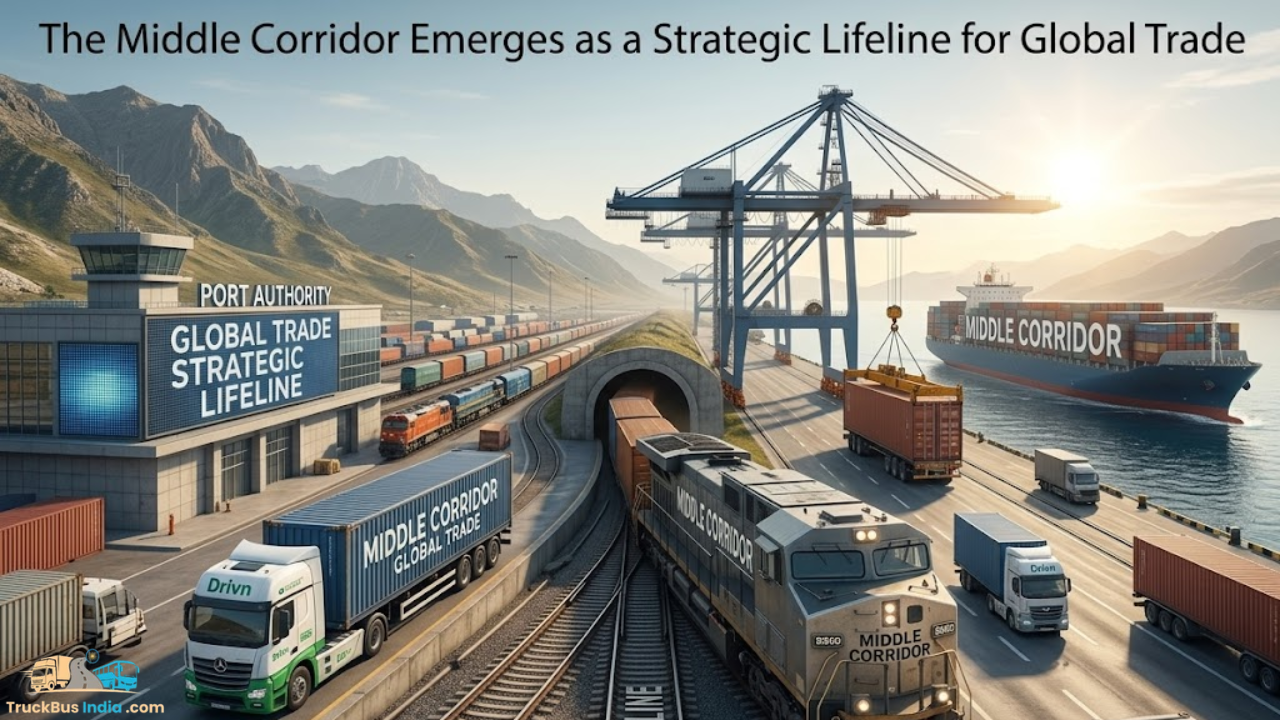
The World Bank has reinforced the strategic importance of the Middle Corridor, a major trade route connecting China and Europe through Central Asia, the Caspian Sea, and Turkey.
Once considered a secondary option to the northern route via Russia, the corridor is now gaining global attention amid rising geopolitical tensions and shifting trade dynamics.
However, experts caution that while demand is increasing, the corridor still faces major structural limitations that must be addressed before it can function at full global scale.
World Bank Commits $3.3 Billion for Key Links
To strengthen the Middle Corridor, the World Bank and its partners have pledged $3.3 billion in investments aimed at improving critical transport infrastructure.
The funding is directed toward eliminating bottlenecks that currently slow down trade movement across the region.
A significant portion has been allocated to Turkey’s Istanbul North Rail Crossing and the reconstruction of Kazakhstan’s Karagandy–Zhezkazgan highway.
These projects are expected to improve connectivity, reduce transit delays, and enhance the overall efficiency of freight movement along the corridor.
Geopolitical Fragmentation Reshapes Trade Flows
The growing importance of the Middle Corridor is closely linked to global geopolitical fragmentation, particularly the disruption caused by the Russia-Ukraine conflict. Traditional northern trade routes have become less predictable, while southern routes are nearing capacity limits.
This has led policymakers and logistics planners to increasingly view the Middle Corridor as a necessary alternative rather than a supplementary option.
Turkish leadership has emphasized that the shifting global environment has made diversification of trade routes essential for long-term stability.
Structural Gaps Limit Immediate Scaling Potential
Despite rising interest and investment, the Middle Corridor is still constrained by infrastructure gaps and operational inefficiencies.
Transport systems across multiple countries require upgrades, while customs procedures and cross-border coordination remain inconsistent.
Experts point out that these limitations make it impossible for the corridor to immediately replace established northern routes.
While demand for diversification is strong, the physical and logistical realities of trade mean that full-scale adoption will take years of coordinated development and sustained investment.
Central Asia Gains Strategic Importance
Central Asia and the Caucasus are increasingly being viewed as stable transit regions amid wider geopolitical instability.
Their relative calm compared to surrounding conflict zones has increased their appeal as platforms for global logistics and transport projects.
Major global players, including China and the European Union, are actively investing in infrastructure and connectivity projects across the region.
The United States has also shown interest, particularly in securing access to critical raw materials and rare earth resources, further raising the region’s strategic importance in global supply chains.
Kazakhstan Strengthens Role as Transit Hub
Kazakhstan is emerging as a central transit hub within the Middle Corridor framework due to its geographic position and expanding infrastructure investments. The World Bank-supported highway and rail projects are expected to strengthen its role in regional logistics.
Beyond large-scale trade benefits, these developments are also expected to generate local economic growth by creating jobs and stimulating services such as transport, hospitality, and maintenance infrastructure. However, experts stress that the long-term impact will depend on governance quality, coordination among stakeholders, and effective execution of infrastructure plans.