
News List
India’s First Swappable Battery Heavy-Duty EV Trucks Inaugurated in Haryana

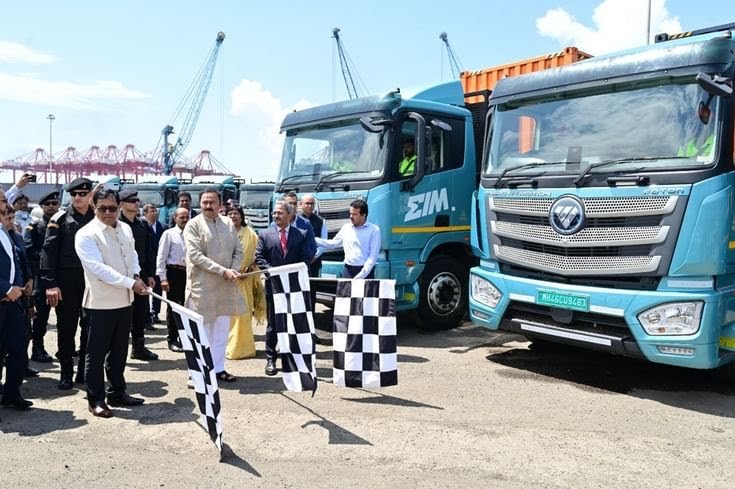
In a landmark moment for India’s green mobility revolution, Union Minister for Heavy Industries H. D. Kumaraswamy and Minister for Road Transport and Highways Nitin Gadkari jointly inaugurated India’s first swappable battery heavy-duty electric trucks and a swap-cum-charging station in Sonepat, Haryana.
The launch marks a major leap forward in India’s efforts to decarbonize its transport and logistics sectors, particularly in the heavy commercial vehicle (HCV) segment, which is among the largest contributors to carbon emissions.
A Game-Changer for Heavy-Duty Electric Mobility
The newly unveiled swappable battery electric trucks represent an innovative step toward resolving two key challenges in the EV ecosystem — long charging times and operational downtime. The battery swapping technology allows truck batteries to be replaced in under seven minutes, compared to the typical two-hour charging window required by conventional fast-charging systems.
This rapid turnaround capability is expected to redefine logistics efficiency, allowing freight operators to maintain continuous operations without lengthy recharging breaks. With each swap station designed for high-volume operation, the model aligns with the government’s vision of creating sustainable and energy-efficient logistics corridors across the country.
Efficiency, Cost Savings, and Cleaner Transport
Beyond speed, the project is expected to bring significant cost and environmental benefits. Battery swapping reduces the need for large-scale charging infrastructure while optimizing battery utilization through shared energy systems.
Key advantages include:
- Reduced operational downtime for fleet operators.
- Lower maintenance and charging costs, contributing to improved total cost of ownership.
- Enhanced energy efficiency, leading to lower electricity consumption per kilometer.
- Substantial reduction in carbon emissions, supporting India’s net-zero vision by 2070.
Industry experts note that adopting swappable battery technology can particularly benefit high-utilization segments such as logistics, e-commerce, construction, and industrial freight — areas where vehicle uptime is crucial to profitability.
Government’s Push for Sustainable Industrial Logistics
The project is part of the government’s National Clean Mobility Mission, which emphasizes the adoption of electric vehicles across public and private sectors.
Speaking at the inauguration, H. D. Kumaraswamy, Minister for Heavy Industries, hailed the initiative as a milestone in India’s clean mobility journey.
“This swappable battery technology represents a major step toward achieving India’s sustainable transport goals. With faster battery replacement and enhanced operational efficiency, this innovation will boost EV adoption and strengthen our industrial logistics ecosystem.”
He added that the initiative aligns with Prime Minister Narendra Modi’s vision of achieving energy independence by 2047 and transforming India into a global hub for green mobility technology.
Nitin Gadkari, Minister for Road Transport and Highways, echoed similar sentiments, emphasizing the economic and environmental significance of the development.
“India’s logistics sector is undergoing a transformation, and innovations like these are key to reducing dependence on fossil fuels. Faster charging and reduced emissions will not only make freight operations more efficient but also more sustainable.”
Accelerating the Shift to Electric Freight Mobility
The deployment of swappable battery technology for heavy-duty trucks opens new opportunities for large-scale electrification of India’s transport infrastructure. Unlike light commercial EVs, which are already gaining momentum, heavy trucks face unique challenges related to battery capacity, range, and recharging downtime. The swapping model effectively addresses these barriers by allowing continuous operation through modular battery replacement.
Moreover, the swap-cum-charging stations unveiled in Haryana are designed to support both battery exchange and conventional charging, enabling flexibility for fleet operators transitioning to electric mobility.
The pilot program in Sonepat is expected to serve as a blueprint for nationwide expansion, with future deployments likely to focus on major freight corridors such as the Delhi–Mumbai Industrial Corridor and other high-density logistics routes.
A Step Towards India’s Carbon-Neutral Future
The introduction of swappable battery trucks is not merely a technological upgrade—it represents a strategic step in India’s long-term sustainability roadmap. By 2030, the government aims for 30% electrification of the transport sector, with freight mobility as a core component.
As battery technology advances and infrastructure investment accelerates, battery swapping is poised to become a cornerstone of India’s EV ecosystem—offering scalability, affordability, and sustainability.
With the launch of these first heavy-duty swappable battery trucks, India sets a global example of innovation-led progress, reinforcing its commitment to creating a carbon-neutral logistics network and advancing toward a cleaner, more efficient mobility future.