
News List
Bidirectional Charging Electric Trucks Demonstration in SPIRIT-E Project

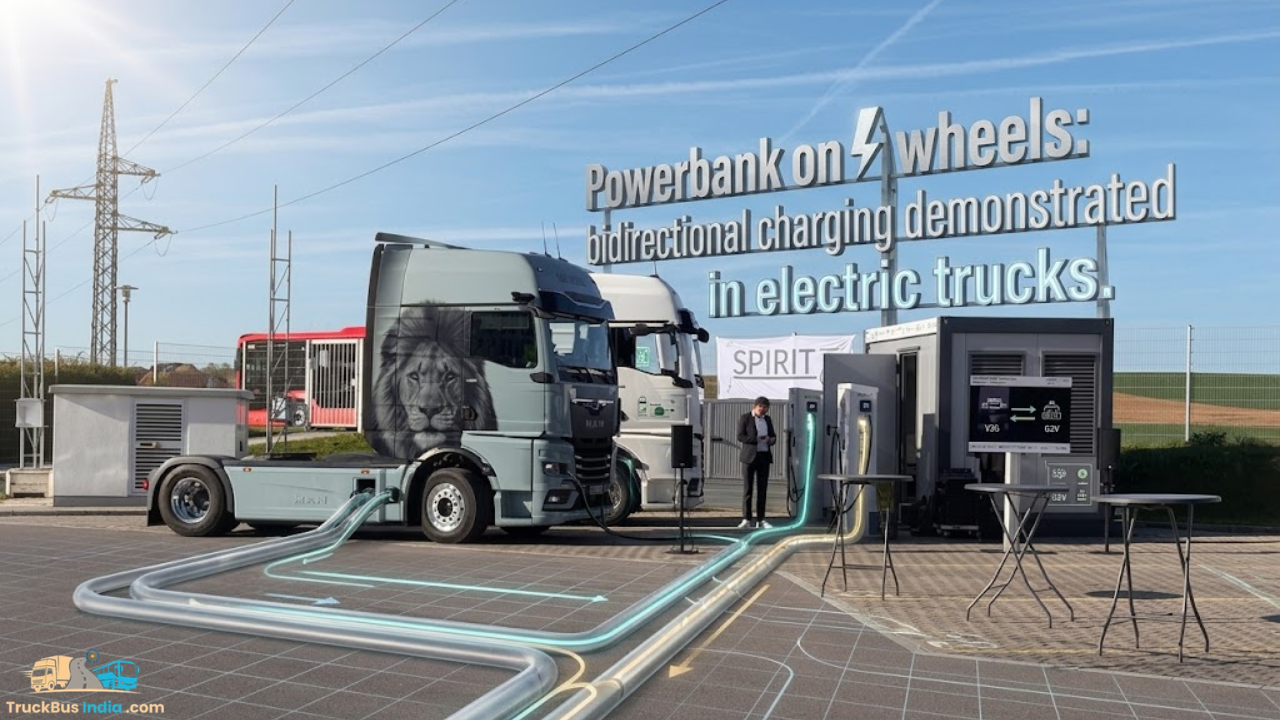
The concept of bidirectional charging electric trucks is moving from theory to real-world testing as the SPIRIT-E research project demonstrates how heavy-duty vehicles can interact with the power grid. In a live trial near Regensburg, Germany, a MAN electric truck successfully fed electricity back into the grid, highlighting new possibilities for fleet energy management.
The bidirectional charging electric trucks initiative aims to solve key electrification challenges in commercial transport while improving grid stability and lowering operating costs.
SPIRIT-E Project and Research Background
The SPIRIT-E project began in 2024 as a three-year federally funded initiative focused on accelerating electrification in heavy-duty transport. A central focus is bidirectional charging electric trucks and their ability to function as mobile energy storage units.
The project is led by the Technical University of Munich and includes partners such as MAN Truck & Bus, Fraunhofer Institute IEE, FfE, SBRS, Hubject, Consolinno Energy, and TenneT. Together, they are exploring how electric trucks can support both transport and energy systems.
MAN eTGX Demonstration with 325 kW Energy Flow
A major milestone for bidirectional charging electric trucks was achieved when a specially equipped MAN eTGX with 480 kWh usable battery capacity was tested under real conditions.
During the demonstration at logistics company Schmid near Regensburg, the truck successfully fed up to 325 kW of power back into the grid using SBRS charging infrastructure. The depot power system also operated without disruption during the process.
MAN highlighted that this marks one of the first functional real-world demonstrations of bidirectional charging electric trucks technology in the commercial vehicle sector.
Vehicle-to-Site and Vehicle-to-Vehicle Applications
The SPIRIT-E project categorizes bidirectional charging electric trucks into three main use cases. Vehicle-to-Site allows fleets to power their own depots or buildings, reducing peak electricity demand and improving use of solar energy.
Vehicle-to-Vehicle enables one electric truck to charge another, improving operational flexibility. Both applications were successfully tested during the Regensburg demonstration using two MAN eTGX trucks and SBRS charging systems.
These approaches show how bidirectional charging electric trucks can support internal energy balancing within logistics operations.
Vehicle-to-Grid Energy and Revenue Potential
The third application, Vehicle-to-Grid, enables bidirectional charging electric trucks to feed electricity back into the public grid during peak demand or high price periods.
This system can create additional revenue streams for fleet operators while supporting grid stability. Project partners believe that by the end of the decade, bidirectional charging electric trucks could become an important part of energy markets, linking transport and electricity systems more closely.
During testing, grid injection reached up to 325 kW, demonstrating the technical feasibility of this model.
Economic Benefits and Cost Savings for Fleets
Research findings suggest that bidirectional charging electric trucks can reduce electricity costs by around 10 to 20 percent for operators.
For a truck traveling 100,000 kilometres annually, this could translate into up to 20,000 kilometres of driving at effectively zero energy cost through optimized charging and discharging cycles.
These savings make bidirectional charging electric trucks an attractive option for fleet operators seeking long-term efficiency improvements.
Limitations and Real-World Applicability
Despite strong potential, bidirectional charging electric trucks are not suitable for all applications. The technology is most relevant for regional transport fleets with lower annual mileage, typically under 100,000 kilometres.
A key limitation is downtime, as trucks must remain parked and connected to charging infrastructure to participate in energy exchange. This can conflict with operators who aim for maximum vehicle utilization.
However, MAN emphasizes its role as the first manufacturer to successfully demonstrate bidirectional charging electric trucks in a functional research setting, including real-world depot and auxiliary power use cases.
Conclusion
The SPIRIT-E project demonstrates that bidirectional charging electric trucks can act as mobile power assets, supporting both fleet economics and energy system stability. With successful grid feed-in, cost-saving potential, and real-world trials completed, the technology is moving closer to practical adoption, particularly in regional logistics operations.
FAQ
What are bidirectional charging electric trucks?
Bidirectional charging electric trucks are electric commercial vehicles that can both draw energy from and feed electricity back into the power grid.
How much power was demonstrated in the SPIRIT-E project?
The MAN eTGX in the bidirectional charging electric trucks test fed up to 325 kW back into the grid during real-world trials.
What are the benefits of bidirectional charging electric trucks?
They can reduce electricity costs by 10 to 20 percent, support grid stability, and allow fleets to use trucks as mobile energy storage systems.