
News List
100 Percent Ethanol Blending India: Challenges and Prospects Explained

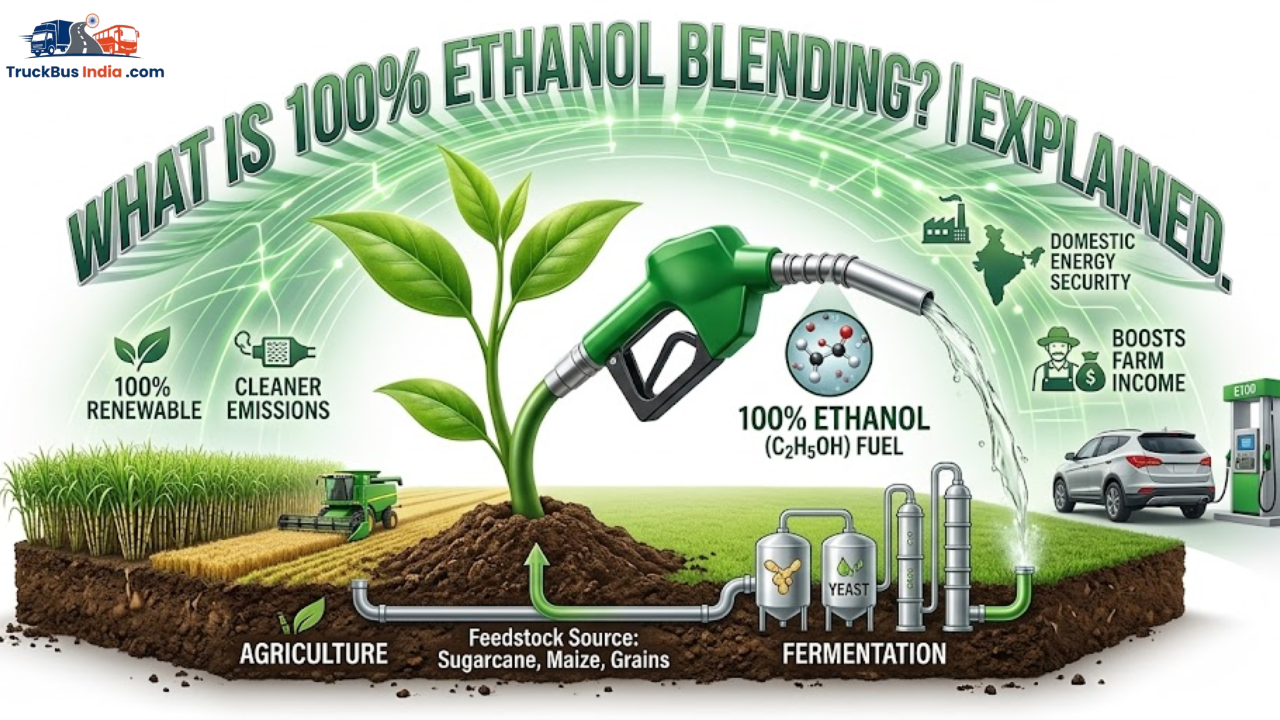
India is accelerating its push towards energy self reliance by promoting 100 percent ethanol blending. The idea, recently supported by the Union Road Transport and Highways Minister, aims to reduce dependence on fossil fuel imports and strengthen domestic energy security.
However, while the vision of 100 percent ethanol blending India offers multiple benefits, it also raises concerns around vehicle compatibility, production capacity, costs, and infrastructure readiness.
100 Percent Ethanol Blending India Meaning and Key Challenges
100 percent ethanol blending India refers to the use of pure ethanol, also known as E100, as a transport fuel. Unlike petrol, ethanol has a lower energy density, delivering nearly 45 to 55 percent less energy per litre. This directly impacts vehicle performance and fuel efficiency.
Need for Flex Fuel Vehicles
To adopt 100 percent ethanol blending India, vehicles must support higher ethanol content. Most existing vehicles in India are designed for E20 or lower blends.
Flex fuel vehicles are required for higher blends like E85 or E100. These vehicles need:
- Corrosion resistant fuel systems
- Advanced sensors and engine control units
- Engine tuning suitable for ethanol combustion
Countries like Brazil have already adopted flex fuel vehicles widely. In India, availability remains limited, although companies like Toyota, Maruti Suzuki, and Hyundai are working on such models.
Infrastructure and Supply Chain Gaps
Achieving 100 percent ethanol blending India requires major upgrades in fuel infrastructure. This includes storage systems, transportation networks, and distribution channels.
Without these improvements, scaling ethanol use across the country will remain a significant challenge.
Ethanol Production in India and Environmental Concerns
Ethanol production in India largely depends on sugarcane. While this supports the ethanol blending programme, it also raises sustainability concerns.
Feedstock Challenges and Second Generation Ethanol
Sugarcane is a water intensive crop and is often grown in water stressed regions. This creates pressure on water resources and may affect food supply and prices.
To address this, the government is promoting second generation ethanol made from crop residues like rice straw. This shift also helps reduce stubble burning, which contributes to air pollution in northern India.
Cost and Environmental Trade Offs
Ethanol production is either costlier or comparable to petrol, requiring policy support and pricing mechanisms.
While ethanol reduces emissions such as carbon monoxide and particulate matter, its environmental impact depends on:
- Land use changes
- Fertiliser and pesticide use
- High water consumption
These factors need careful management to ensure long term sustainability of 100 percent ethanol blending India.
CAFE III Norms and Ethanol Blending in India
India introduced Corporate Average Fuel Efficiency norms in 2017 to reduce vehicle emissions. These norms are becoming stricter with each phase.
Evolution of CAFE Norms
- CAFE I implemented in 2017
- CAFE II enforced in 2022
- CAFE III to be implemented from April 2027 with around 30 percent stricter targets
Link Between CAFE III and Ethanol Blending
Although CAFE norms do not directly mandate ethanol use, CAFE III could encourage automakers to adopt higher ethanol blends like E85 or E100. This can help them meet emission targets.
However, consumer concerns remain due to lower mileage. Even E20 fuel delivers around 6 to 7 percent lower mileage compared to petrol, raising questions about cost efficiency.
Progress and Infrastructure Challenges in Ethanol Blending India
India launched the ethanol blending programme in 2003 and has made significant progress over the years.
Ethanol Blending Milestones
- Around 2 percent blending in 2014
- E10 achieved by 2022
- E20 rollout started in 2023 and expected to replace earlier blends by 2025
The target of nationwide E20 was initially set for 2030 but has been advanced due to strong policy push.
Key Challenges Ahead
Despite progress, major challenges remain:
- Limited vehicle compatibility
- Inadequate fuel storage and distribution infrastructure
- High production costs
- Need for consumer acceptance
These issues must be addressed before scaling to 100 percent ethanol blending India.
India Energy Security Strategy and Future Outlook
India is exploring multiple strategies to reduce dependence on imported fuels. Ethanol blending is one part of a broader approach.
Diversification and Alternative Energy
The country is investing in renewable energy, alternative fuel sources, and domestic production. However, challenges such as geopolitical constraints and limited domestic output persist.
Shift Towards Green Hydrogen
India is also focusing on green hydrogen under the National Green Hydrogen Mission. The goal is to reduce production costs and compete with conventional fuels like diesel.
Hydrogen production using municipal waste and sewage is also being explored as part of a circular economy approach.
Technology and Infrastructure Barriers
Despite policy support, large scale adoption of alternative fuels faces challenges such as:
- Lack of storage and transport infrastructure
- Limited technological readiness
- High initial investment
These factors will influence the pace of transition towards cleaner energy solutions.
Conclusion
100 percent ethanol blending India represents a significant step towards energy independence and reduced emissions. However, achieving this goal requires addressing multiple challenges related to vehicle technology, production capacity, infrastructure, and cost efficiency.
With continued policy support, technological advancements, and industry participation, ethanol blending can play an important role in India’s long term energy strategy.