
News List
Tata Motors Plans 2 Million CV Expansion

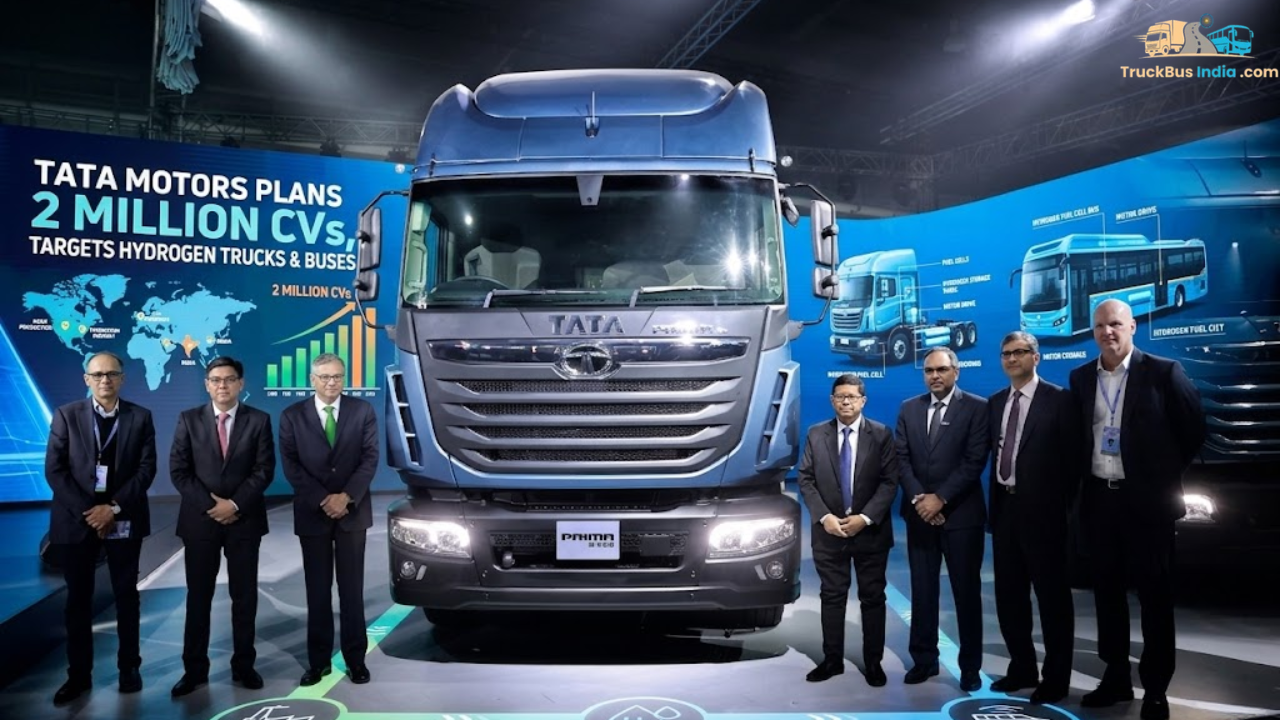
Tata Motors has announced an ambitious five-year expansion plan for its commercial vehicle business, targeting production of two million units. The strategy strengthens its push toward hydrogen-powered mobility, electric vehicles, and multi-energy platforms, with a strong focus on the Lucknow manufacturing facility.
The announcement comes shortly after the company rolled out its one millionth commercial vehicle from the same plant, marking a major milestone in its growth journey.
Lucknow Plant to Become Multi-Energy Manufacturing Hub
The Lucknow facility, operational since 1992, will play a central role in Tata Motors’ expansion strategy. The plant currently produces diesel, CNG, and electric vehicles and is now being positioned as a multi-energy hub for future mobility solutions.
The company plans to introduce hydrogen-powered trucks and buses from this facility in the coming years. With an annual production capacity of over one lakh units, the plant already operates on 100% renewable energy, reinforcing Tata Motors’ sustainability goals while scaling production for future demand.
Strong Market Outlook and Growth Drivers
Tata Motors expects strong growth in the Indian commercial vehicle industry, supported by infrastructure expansion, logistics demand, and fleet modernization. The market is projected to surpass its pre-COVID peak in FY26 and continue expanding steadily over the coming years.
Industry estimates place the CV market at around USD 53–54 billion in 2025, with a projected CAGR of 5–7%. The company’s leadership expects the next production milestone of two million vehicles to be achieved within five years, driven by improving demand conditions.
Market Leadership and Competitive Position
Tata Motors continues to hold a strong position in the Indian commercial vehicle segment with an estimated 39–45% market share in early 2026. The company has also reported improved profitability, supported by a stronger product mix and higher tonnage vehicles.
Despite strong leadership, the company operates in a highly competitive environment with rivals such as Ashok Leyland and BharatBenz. The CV segment remains cyclical, making performance sensitive to freight demand and infrastructure cycles.
Hydrogen Technology and Future Mobility Strategy
Tata Motors is actively advancing hydrogen-based mobility solutions as part of its long-term strategy. The company is developing both hydrogen internal combustion engine vehicles and hydrogen fuel cell electric vehicles for heavy-duty applications.
These initiatives align with India’s National Green Hydrogen Mission and aim to support cleaner freight transport. The Lucknow plant will serve as a key production base for these next-generation hydrogen-powered commercial vehicles.
Financial Outlook and Industry Challenges
Growth and Analyst Sentiment
Analysts remain largely positive on Tata Motors’ commercial vehicle business, citing strong cash flows, cyclical recovery, and long-term expansion potential. Some global brokerages have issued “outperform” ratings with expectations of upside potential.
Key Risks Ahead
Despite the optimistic outlook, challenges remain. Rising input costs, competitive pressure, and execution risks from large investments such as international acquisitions could impact margins. Additionally, hydrogen technology adoption at scale remains uncertain, requiring infrastructure development and cost reductions.
Tata Motors’ five-year plan to double commercial vehicle production highlights a major strategic shift toward multi-energy mobility and sustainable transport solutions. With hydrogen technology, EV expansion, and strong market leadership, the company is positioning itself for long-term growth.
However, success will depend on execution strength, market demand stability, and the pace of infrastructure development supporting next-generation mobility in India.