
News List
Emobi Deploys 100 Electric Scooters in Bengaluru with Musashi and Honda

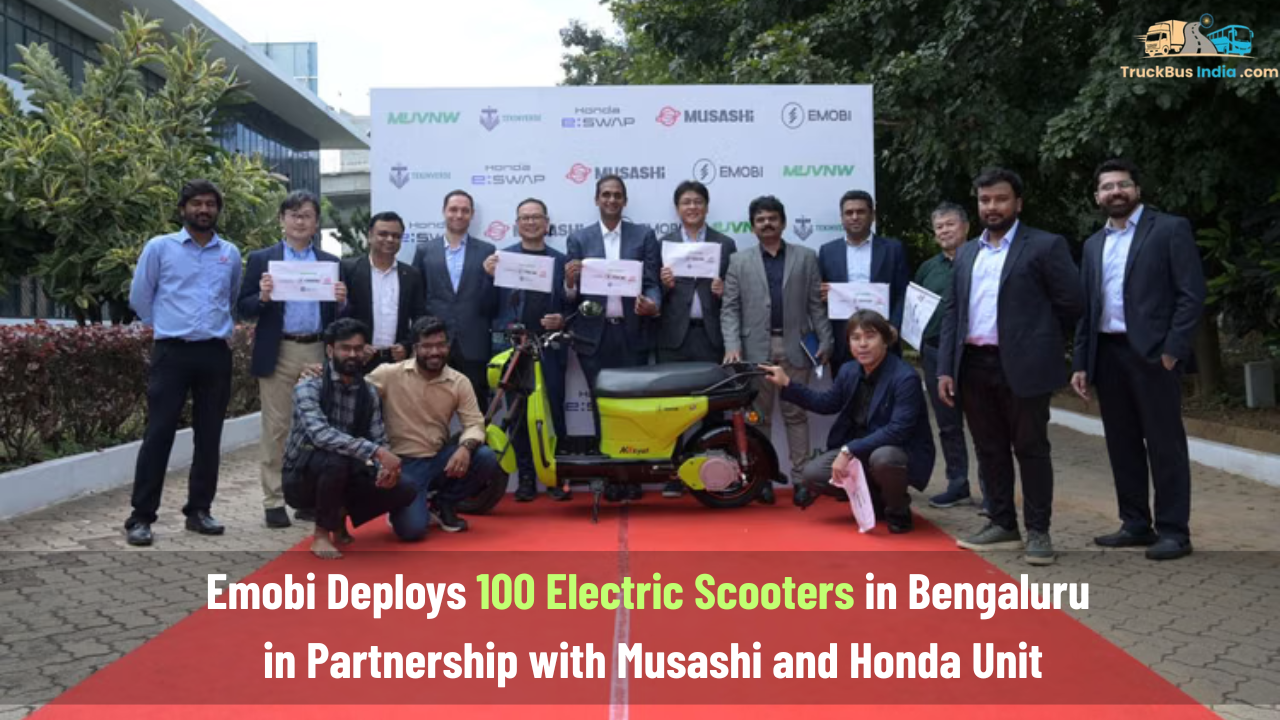
Emobi Manufactury Pvt. Ltd. has deployed 100 AKX Kyari electric scooters in Bengaluru, leveraging Musashi India’s e-axle technology and Honda Power Pack Energy India Pvt. Ltd.’s (HEID) battery-swapping network. The initiative aims to reduce operating costs for last-mile logistics operators while creating income opportunities for individual riders.
The scooters have been manufactured for Tekinverse and leased to rider-partners via the gig logistics platform Muvnw under a micro-fleet model. This setup allows riders to access high-performance EVs without ownership, ensuring fleet availability through service-level agreements, trained maintenance engineers, and roadside support. Lower running costs also allow riders to retain more of their earnings compared to petrol alternatives.
AKX Kyari Electric Scooter: Specs and Performance
The AKX Kyari offers:
- IDC range of 106 km
- Top speed of 80 km/h
- Acceleration 0-60 km/h in 12 seconds
- 3.7 kW peak motor
- 1.5 kWh dual swappable battery packs
- Synchronised braking system
Emobi positions the scooter as a direct alternative to 125cc petrol scooters, making it suitable for last-mile delivery in urban areas.
Battery-Swapping Network: Honda e:Swap
HEID’s battery-swapping service, using Honda Mobile Power Pack e: and Power Pack Exchanger e:, operates under a Battery as a Service (BaaS) model. This separates battery ownership from vehicle purchase, reducing upfront costs, eliminating battery degradation concerns, and cutting downtime compared to conventional charging.
Leadership Insights
Bharath Rao, CEO and Co-Founder of Emobi, said:
“By integrating high-performance EV technology with reliable battery-swapping and local service, we are building an ecosystem where electric mobility becomes the most accessible and profitable choice for riders.”
Naoya Nishimura, CEO of Musashi India and Africa Region, highlighted the role of local engineering:
“Our partnership shows how India-developed e-axle technology, paired with a robust battery-swapping ecosystem, can deliver dependable EV solutions for last-mile logistics.”
Tomohide Haraguchi, VP and CTO of HEID, noted the operational advantages:
“Combining battery swapping with automotive-grade drivetrains cuts charging downtime, lowers upfront costs, and eliminates future battery replacement concerns.”
Scaling Electric Mobility
The Bengaluru deployment comes amid rising pressure on India’s logistics sector to reduce fuel costs and emissions, particularly in urban areas dominated by two- and three-wheelers. Models separating battery ownership from vehicles, like HEID’s BaaS, are seen as key to expanding EV adoption.
Emobi plans to scale its micro-factory and micro-fleet service to other metro cities, starting with Delhi NCR, while continuing product expansion. Founded in Karnataka, the company focuses on last-mile delivery, passenger transport, and utility vehicles, using frugal engineering and lean manufacturing to make EVs accessible at the community level.
Outlook
The collaboration between Emobi, Musashi, and HEID demonstrates how global drivetrain expertise and local assembly can create a scalable, cost-efficient EV model for urban logistics. Success will depend on expanding battery-swapping infrastructure and maintaining low operating costs as fleet sizes grow.