
News List
Tata Motors Brings ECE R29 Cabin Safety To India

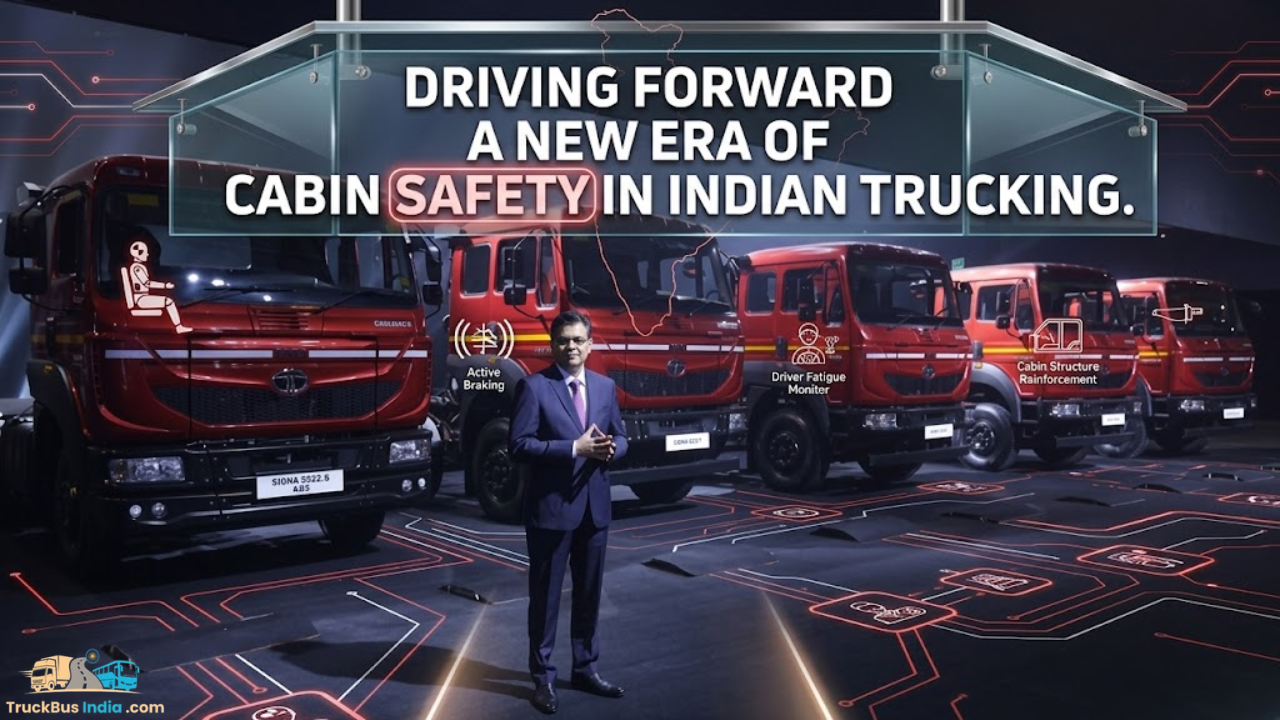
India’s logistics sector depends heavily on highways, but rising accident risks are forcing a shift in priorities. With over 1.77 lakh road accident deaths reported in 2024, averaging nearly 485 fatalities daily, safety has become a pressing concern for the trucking industry.
National highways contribute to more than 30 percent of these deaths, despite covering only about 2 percent of the country’s road network. In response, Tata Motors is upgrading its truck cabins with the globally recognised ECE R29.03 safety standard, aiming to strengthen driver protection across its portfolio.
ECE R29 truck safety standard explained
The ECE R29 truck safety standard is considered a global benchmark for cabin strength and driver protection. It evaluates whether a truck cabin can withstand severe crash conditions while preserving the driver’s survival space.
The testing framework includes frontal impact simulations, roof crush resistance, and rear wall strength checks. These tests ensure that the cabin structure behaves like a protective shell during accidents.
By focusing on structural integrity, the ECE R29 truck safety standard reduces the risk of intrusion into the driver’s space, which is often a major cause of injuries in collisions.
Rising highway risks drive demand for safer trucks
India’s expanding road network and high-speed corridors have increased both efficiency and risk. Trucks now travel longer distances at higher speeds, which raises the impact energy during crashes.
This makes stronger cabin structures essential, especially in rollover scenarios that are common on highways. The ECE R29 truck safety standard addresses these risks by ensuring that key structural elements maintain their integrity under stress.
For fleet owners, this shift signals a move beyond payload and fuel efficiency toward prioritising driver safety and risk reduction.
Tata Motors upgrades entire truck portfolio
Tata Motors Commercial Vehicles has taken a major step by integrating the ECE R29 truck safety standard across its key truck platforms. Models under the Prima, Signa, Ultra, and Azura ranges have been upgraded to meet this global benchmark.
This is not limited to premium offerings but extends across the broader portfolio, bringing advanced safety standards into the mainstream trucking segment. The move is expected to influence industry-wide adoption and raise expectations around cabin safety.
It also reflects a broader transition where safety is no longer treated as an optional feature but as a core requirement.
Engineering approach goes beyond compliance
The company’s approach extends beyond meeting regulatory requirements. Engineers studied real-world accident data from Indian highways to understand collision patterns, deformation behaviour, and intrusion risks.
Internal validation scenarios simulate conditions commonly seen on Indian roads. These tests go beyond standard global requirements to ensure better real-world performance.
This data-driven engineering ensures that cabins are not just compliant structures but robust safety systems designed for actual operating environments.
Impact on drivers and transport businesses
For drivers, the ECE R29 truck safety standard offers improved protection during accidents by maintaining cabin integrity and reducing injury risks.
For fleet owners, safer trucks can lead to fewer disruptions, lower accident-related costs, and better asset protection. Improved safety also builds trust with drivers, helping companies retain skilled workforce and maintain operational efficiency.
This shift reinforces the idea that safer trucks contribute directly to stronger business performance.