
News List
Government Extends PM E-DRIVE Subsidy For E-Rickshaws And E-Carts

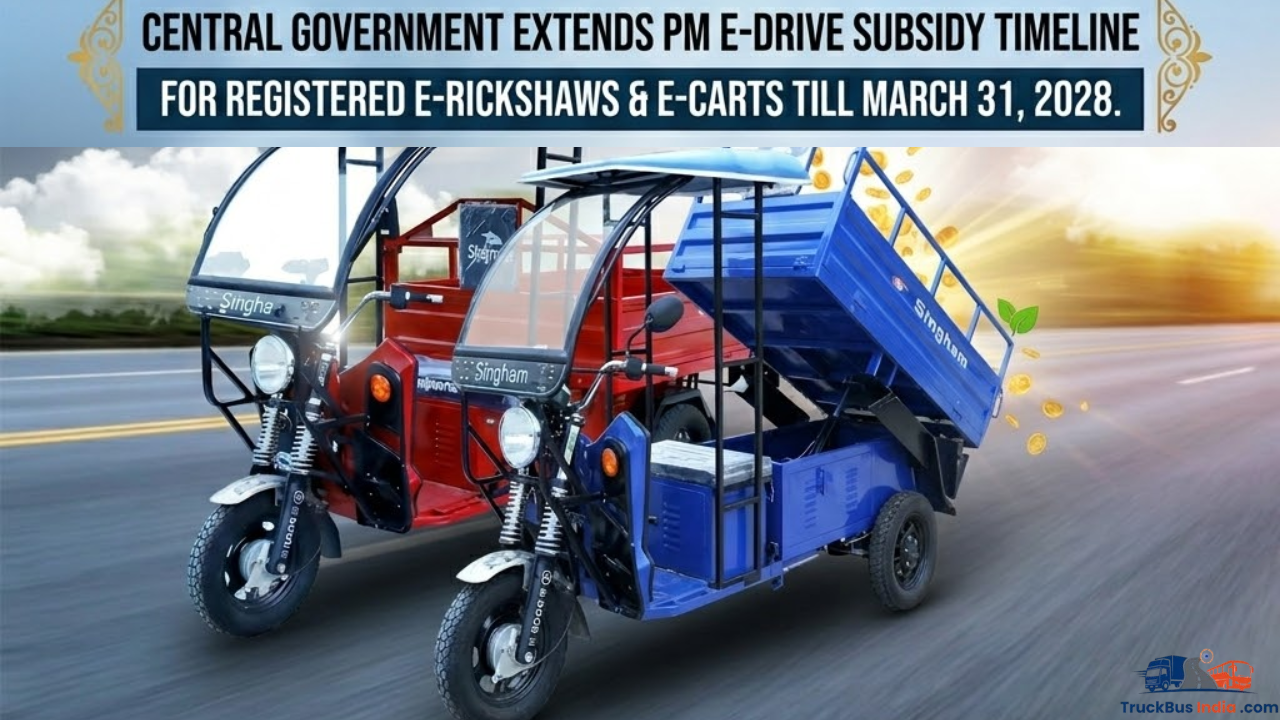
The Union Ministry of Heavy Industries (MHI) has extended the PM E-DRIVE subsidy scheme for registered electric three-wheelers, including e-rickshaws and e-carts, until March 31, 2028. The move aims to boost electric mobility adoption while regulating subsidy allocation through price caps and revised incentive limits.
Key Highlights Of The Extended PM E-DRIVE Scheme
An official notification dated March 27, 2026, confirms that registered electric 3-wheelers (E3Ws) will continue receiving financial incentives under PM E-DRIVE until March 2028. Electric 2-wheelers (E2Ws) are eligible for subsidies until July 31, 2026. Vehicles priced above the set ex-factory limits—Rs 2.5 lakh for E3Ws and Rs 1.5 lakh for E2Ws—will no longer qualify for subsidies.
Incentives for e-rickshaws and e-carts are capped at Rs 25,000 per vehicle and calculated at Rs 5,000 per kWh. Following this, rates drop to Rs 2,500 per kWh, with a maximum subsidy of Rs 12,500. The subsidy will always be limited to 15% of the ex-factory price of the vehicle, whichever is lower.
Government Allocations And Targets
The PM E-DRIVE scheme is a fund-limited initiative with a total budget of Rs 10,900 crore. The allocation for e-rickshaws and e-carts has been reduced to Rs 50 crore, reflecting slower adoption in this segment. The L5 category of electric three-wheelers was closed on December 26, 2025, having already achieved its target.
In parallel, targets for E2Ws have increased from 14 lakh units to 24.8 lakh units, and e-rickshaws along with three-wheeled e-carts have seen targets raised from 36,400 units to over 39,034 units. Subsidy amounts may occasionally vary based on changes in vehicle prices.
About PM E-DRIVE Subsidy Scheme
PM E-DRIVE, replacing the Electric Mobility Promotion Scheme 2024 (EMPS-2024), is a two-year program with an investment of Rs 10,900 crore. It builds on the earlier FAME program, aiming to expand electric vehicle adoption, support domestic manufacturing, and develop charging infrastructure. The program aligns with India’s growing EV ecosystem, expected to reach USD 132 billion by 2030.