
News List
Cities Need Mobility Reform Beyond Budget Spending

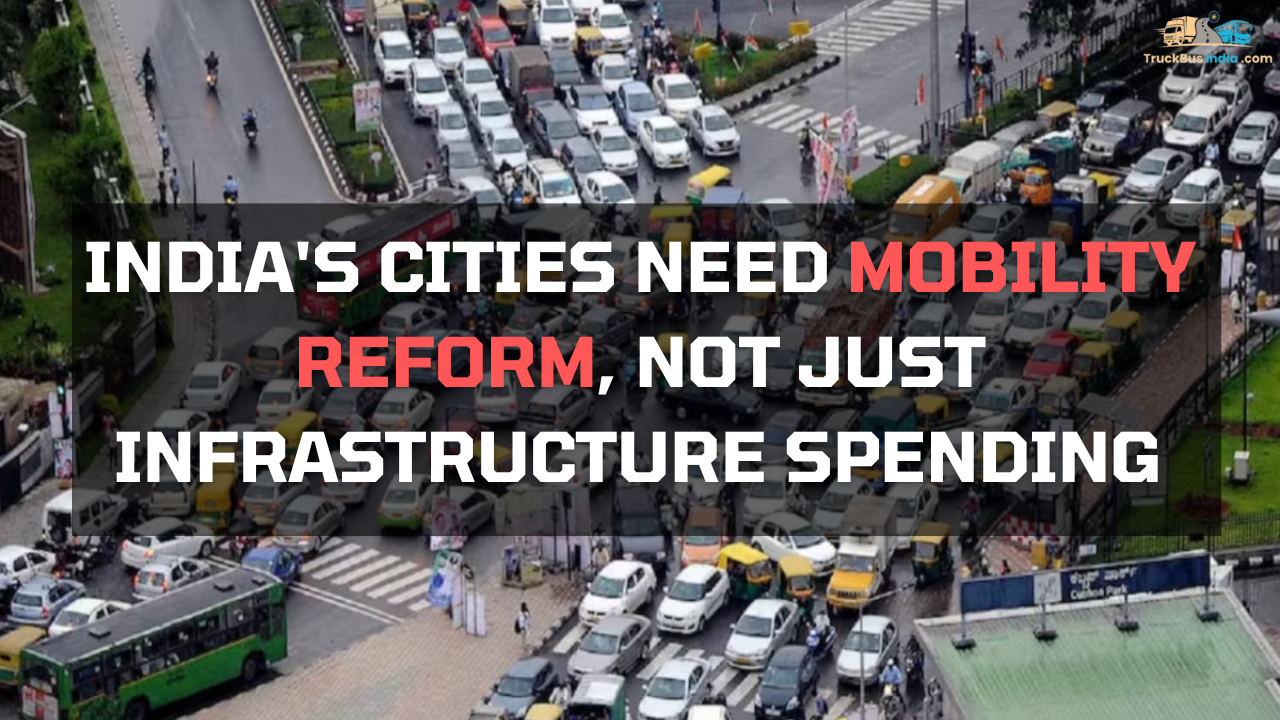
Budget 2026 Puts Cities in Focus, But Mobility Gaps Persist
India’s Union Budget 2026-27 has signalled a clear intent to make cities engines of economic growth through a massive infrastructure push. With ₹12.2 trillion earmarked for public capital expenditure, new high-speed rail corridors, expanding Metro networks, and plans for “city economic regions,” the government has placed urban development at the centre of its economic strategy. However, transport and urban planning experts caution that spending on infrastructure alone will not solve India’s deepening urban mobility crisis.
While the Budget prioritises large-scale projects, analysts argue that India’s cities urgently need systemic mobility reform—particularly in public buses, pedestrian infrastructure, and last-mile connectivity—rather than just more concrete and rail lines.
Urban Transport: The Backbone of City Economies
The Economic Survey 2025-26 describes transportation as the “bloodstream, spine, and muscles” of a city, emphasising its role in enabling the movement of people, goods, and ideas. When urban transport systems fail, cities suffer from congestion, rising pollution, and declining productivity.
Despite continued investment in metros and highways, everyday urban mobility remains inefficient for millions of commuters who rely on buses, walking, or informal transport. Experts say that without strengthening these systems, India’s cities will struggle to function effectively, regardless of new infrastructure.
Congestion Costs Draining Productivity
Multiple studies underline the economic toll of traffic congestion in Indian cities. The Centre for Science and Environment estimates that even an unskilled worker in Delhi loses up to ₹19,600 annually due to time spent in traffic, while skilled workers lose nearly ₹26,000 per year.
Bengaluru’s congestion crisis is even more severe. A study by the Institute for Social and Economic Change found that the city lost around 700,000 productive hours in 2018 alone due to traffic delays. Similarly, an Uber-BCG report estimated that congestion costs India’s four largest metros approximately $22 billion annually.
The TomTom Traffic Index 2025 further highlights the scale of the problem. Bengaluru is now the second-most congested city in the world, while Kolkata and Pune also rank among the slowest. Overall, India stands fifth globally and second in Asia in terms of traffic congestion.
Why Infrastructure Alone Is Not Enough
While metro expansion and high-speed rail are important, urban planners argue that these projects serve only a fraction of daily commuters. The majority of urban residents depend on buses, walking, cycling, and shared mobility for their daily travel.
However, city bus systems remain underfunded and poorly managed in many places. Footpaths are often encroached upon or unsafe, making walking difficult. Last-mile connectivity—such as feeder buses, cycle lanes, and shared transport—remains inconsistent across most Indian cities.
Without addressing these issues, new infrastructure risks becoming underutilised or inaccessible to large sections of the population.
Need for Integrated Mobility Planning
Experts suggest that India needs a shift from infrastructure-centric planning to outcome-based mobility planning. This means prioritising:
- Reliable and well-funded city bus networks
- Safe and continuous pedestrian walkways
- Dedicated cycling lanes
- Seamless last-mile connectivity to metros and railway stations
- Better traffic management and urban design
Some states have begun experimenting with integrated mobility plans, but implementation remains uneven.
Bond Markets and Municipal Reform
The Budget’s proposal to incentivise municipal corporations to raise funds through bonds has been welcomed by urban finance experts. However, they stress that cities must also improve governance, transparency, and transport planning to ensure that borrowed funds translate into better mobility outcomes.
The Road Ahead
India’s urbanisation is accelerating, and its cities are becoming critical drivers of economic growth. While Budget 2026 lays a strong foundation with infrastructure investments, the real test will be whether policymakers can reform urban mobility systems to make daily commuting faster, safer, and more efficient.
Until buses run reliably, footpaths are walkable, and last-mile links are strengthened, India’s urban mobility crisis will continue to choke productivity—no matter how much is spent on infrastructure.