News List
IIT Madras, Daimler Develop Universal Driver Rating System

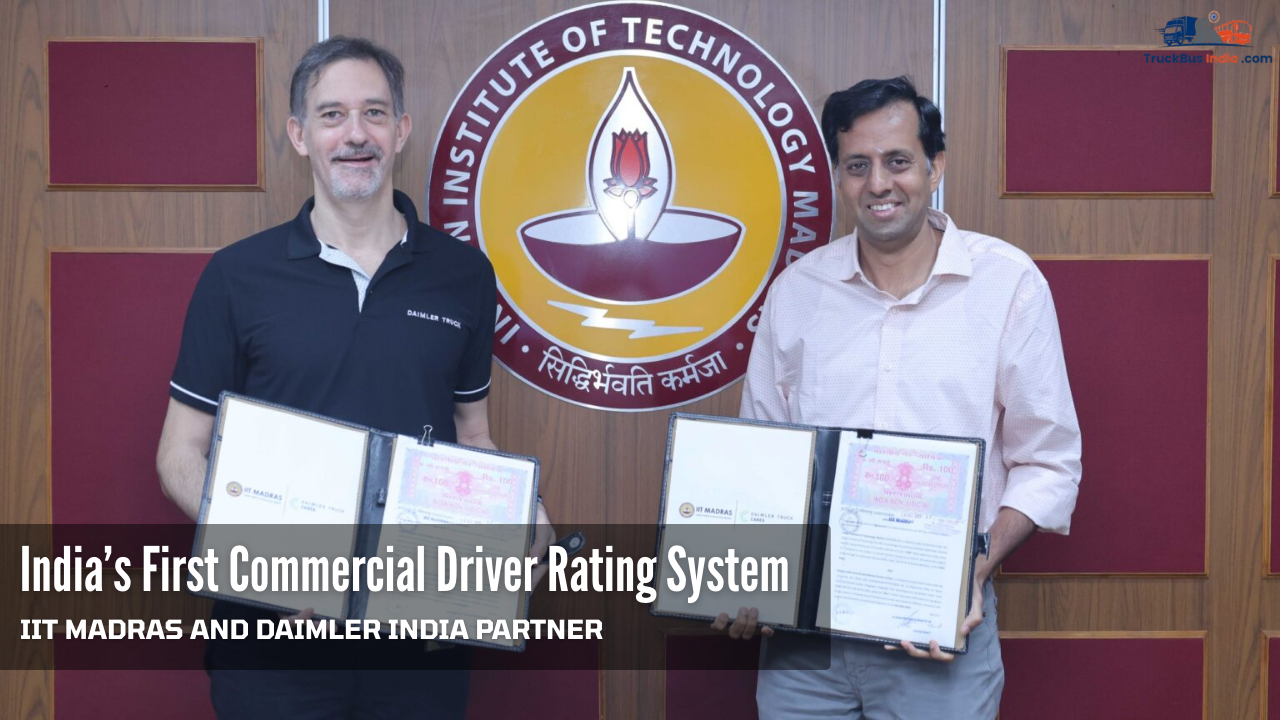
In a major step toward improving road safety and digital governance in India’s commercial transport sector, the Indian Institute of Technology Madras (IIT Madras) has partnered with Daimler India Commercial Vehicles (DICV) to develop a universal driver rating system for commercial vehicle operators. The collaboration, formalised through a memorandum of understanding (MoU) signed in Chennai on 2 February 2026, aims to establish a first-of-its-kind, data-driven framework for evaluating driver performance across the country.
The initiative seeks to create a standardised system that can be used for assessing driving credentials, insurance evaluation, and background verification—areas that currently lack uniform benchmarks in India’s transport industry.
Addressing Gaps in Driver Safety Monitoring
The partnership comes at a time when monitoring driver behaviour and safety has become increasingly challenging due to fragmented regulations and inconsistent enforcement across states. The absence of a unified assessment mechanism has led to varying standards of accountability among commercial drivers.
The proposed rating system aims to bridge this gap by offering a consistent, objective, and transparent method of evaluating driver performance. This, in turn, is expected to enhance road safety, reduce accidents, and promote responsible driving practices across the sector.
A Data-Driven ‘Aadhaar for Drivers’
Prof. Gitakrishnan Ramadurai of IIT Madras, who is coordinating the project, described the initiative as a transformative step for the trucking community. He stated that trucks and truck drivers form the backbone of India’s economy and that the new rating system would act as a form of “Aadhaar for their good work.”
According to him, the system is designed not just to penalise risky driving but to actively reward safe behaviour, ultimately benefiting drivers, fleet operators, insurers, and the broader transport ecosystem.
Technology-Driven and Scalable Solution
The driver rating framework will leverage a combination of smartphone-based inputs and vehicle sensor data to generate continuous, real-time assessments of driving behaviour. The partners also plan to develop a robust technology stack that can support nationwide deployment, effectively positioning the system as a form of digital public infrastructure for the transport sector.
Industry-Academia Collaboration for Safer Mobility
Prof. Ashwin Mahalingam, Dean of Alumni and Corporate Relations at IIT Madras, emphasised the broader significance of the partnership. He highlighted IIT Madras’s longstanding commitment to road safety research and noted that the collaboration with Daimler represents a strong example of how academic innovation can be translated into real-world, scalable solutions.
From the industry perspective, Alexander Schoen, Chief Financial Officer of Daimler India Commercial Vehicles, underscored the alignment of the project with the company’s sustainability and social responsibility goals. He noted that DICV is committed to leveraging technology and data to enhance driver safety, professionalism, and overall well-being within the commercial transport ecosystem.
Potential Impact Across the Transport Ecosystem
If successfully implemented, the universal driver rating system could bring multiple benefits. For drivers, it could improve employability and provide incentives for safer driving. Fleet operators would gain better tools for performance monitoring and compliance tracking, while shippers could benefit from improved delivery transparency.
Additionally, government agencies could use anonymised data from the system to strengthen road safety policies and transport planning. Overall, the initiative has the potential to create a more accountable, transparent, and safety-focused mobility framework in India.
With strong backing from both academia and industry, this project could mark a significant shift toward smarter, safer, and more data-driven commercial transportation in the country.