
News List
Budget 2026 boosts freight corridors and waterways

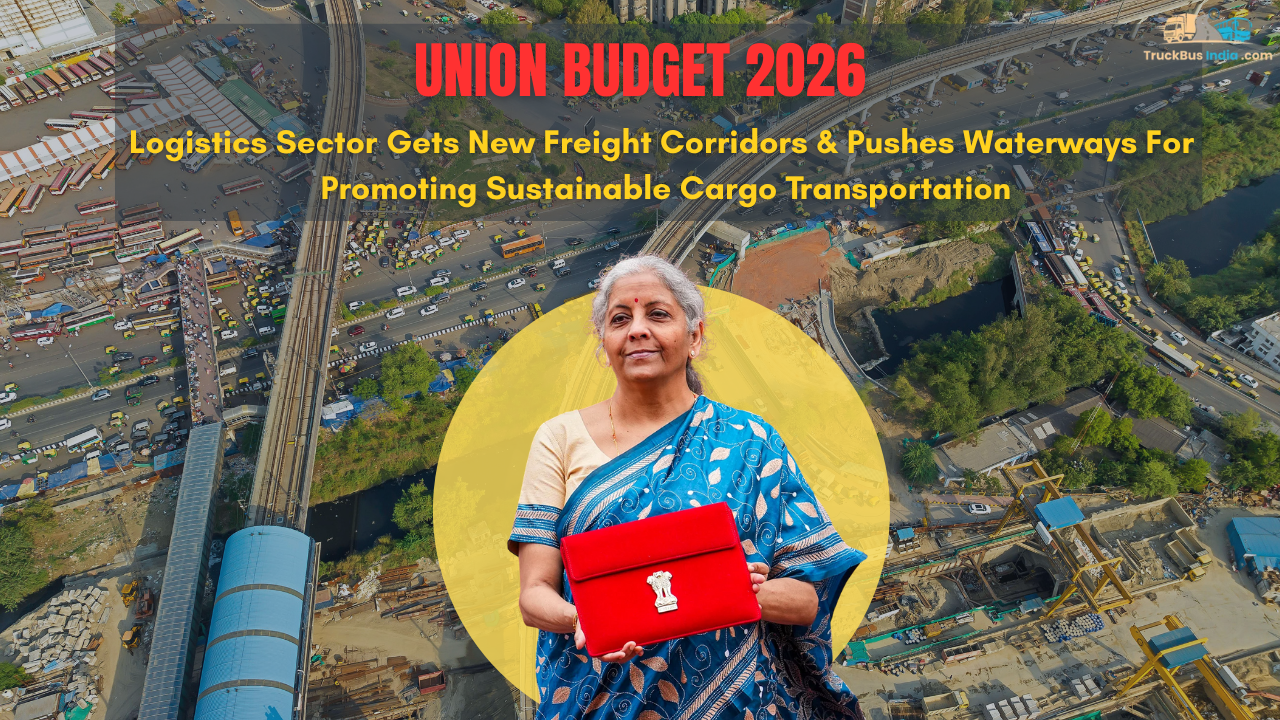
Union Budget 2026–27 has laid out a strategic roadmap for India’s logistics and cargo transportation ecosystem, with a strong focus on sustainability, multimodal connectivity, and efficiency. Presented by Union Finance Minister Nirmala Sitharaman on February 1, 2026—her ninth consecutive budget—the policy framework emphasises reform-driven growth, fiscal discipline, and long-term economic resilience. The Budget positions freight corridors, inland waterways, and digital logistics as key pillars in transforming India’s supply chain infrastructure.
New freight corridors for greener cargo movement
A major highlight of the Budget is the proposal to develop new freight corridors linking Dankuni in the east to Surat in the west. This initiative is aimed at promoting environmentally sustainable cargo movement by reducing dependence on road transport and improving rail-based logistics efficiency. Additionally, the government plans to operationalise 20 new waterways over the next five years, starting with National Waterway 5 (NW-5) in Odisha. This route will connect Paradip and Damra ports to industrial and mineral-rich regions such as Talcher, Angul, and Kalinganagar, strengthening regional trade and industrial connectivity.
Coastal Cargo Promotion Scheme to drive modal shift
To increase the share of inland waterways and coastal shipping from 6 percent to 12 percent by 2047, the government has introduced a Coastal Cargo Promotion Scheme. This initiative will incentivise a shift from road and rail to waterways, making cargo transportation more cost-effective and environmentally friendly. Alongside this, regional training centres of excellence for waterways will be established, and a dedicated ship repair ecosystem for inland vessels will be developed in Patna and Varanasi.
Digital clearance to streamline logistics operations
In a move to enhance efficiency, the Budget proposes a single, integrated digital window for all government agency approvals related to cargo clearance. By April 2026, this system will be fully operational for key categories such as food, pharmaceuticals, plant, animal, and wildlife products—accounting for nearly 70 percent of interdicted cargo. This is expected to significantly reduce delays, improve transparency, and strengthen India’s trade competitiveness.
Seaplanes and tourism-linked connectivity
The Budget also introduces incentives for domestic seaplane manufacturers to improve last-mile connectivity, particularly in rural and tourism-intensive regions. A Seaplane Viability Gap Funding (VGF) Scheme will support operations, while the proposed East Coast Development Corridor aims to promote five tourism hotspots in the Purvodaya region.
University townships in logistics corridors
To build a skilled workforce for the future, the government will support the development of five university townships near major industrial and logistics corridors. These academic hubs will house universities, research institutions, skill centres, and residential facilities, creating opportunities for industry-academia collaboration, particularly in the automotive and logistics sectors.
Infrastructure push in Tier-2 and Tier-3 cities
Public capital expenditure has been increased to Rs 12.2 lakh crore for FY 2026–27, continuing the government’s strong focus on infrastructure development. Special emphasis has been placed on Tier-2 and Tier-3 cities, which is expected to boost demand for tippers, transit mixers, and construction equipment. The Budget also proposes mapping City Economic Regions (CERs), with each region eligible for Rs 5,000 crore over five years based on performance-driven funding.
Revival of industrial clusters and manufacturing schemes
To strengthen manufacturing capabilities, the government plans to revive 200 industrial clusters through technology-driven interventions. A Rs 10,000 crore scheme for container manufacturing over five years has been proposed, along with initiatives to enhance construction and infrastructure equipment production.
Overall, Budget 2026 signals a comprehensive transformation of India’s logistics landscape—integrating freight corridors, waterways, digital systems, and regional infrastructure to create a more efficient, sustainable, and globally competitive supply chain network.