
News List
Two, Three-Wheel EVs Drive India’s Clean Mobility Shift

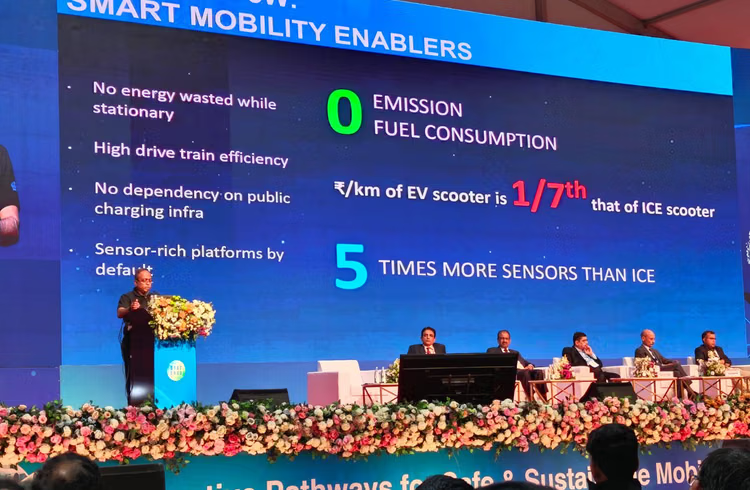
Electric two-wheelers and three-wheelers will play a decisive role in India’s transition to cleaner and more efficient mobility, Bajaj Auto said, citing the country’s dense traffic conditions, space constraints and cost sensitivities as key factors favouring smaller electric vehicles over cars.
Speaking at the Symposium on International Automotive Technology (SIAT) 2026, Abraham Joseph, Managing Director of Bajaj Auto Technology Ltd, said India’s mobility challenge is driven more by congestion than distance. “India’s problem is not distance, it is density. You have far more vehicles than the infrastructure can sustain,” he said.
Two-wheelers and three-wheelers already form the backbone of urban transport in the country. India has nearly 260 million two-wheelers on the road, compared with about 50 million cars, highlighting the dominance of compact vehicles in daily commuting. According to Joseph, two-wheelers occupy roughly a quarter of the road space of cars while costing significantly less, making them more practical for Indian cities.
Joseph noted that India’s operating conditions — including heavy congestion, frequent stop-start traffic, heat, dust and varying road quality — differ sharply from those in Europe and North America. In such environments, electric scooters and three-wheelers deliver clear efficiency gains. Unlike internal combustion engine (ICE) vehicles, electric vehicles consume no energy while idling and recover energy through regenerative braking, improving real-world efficiency and reducing emissions.
He explained that ICE scooters lose energy due to centrifugal clutches and rubber-belt CVT transmissions, particularly in traffic-heavy conditions. Electric scooters eliminate these inefficiencies by delivering power only when needed. As a result, replacing ICE scooters with electric ones can significantly reduce ownership costs. Joseph said the total cost of ownership of an electric scooter is around 38 per cent of that of an ICE scooter, with regenerative braking capable of recovering nearly 70 per cent of energy.
Electric three-wheelers also present strong economic advantages. Compared with diesel-powered models, they offer more than a 15 per cent improvement in cost of ownership, along with lower operating and maintenance expenses. Their suitability for last-mile transport further enhances income potential for operators, Joseph added.
Bajaj Auto said its electric vehicle portfolio has already delivered measurable environmental benefits, with its EVs helping save approximately 230,000 tonnes of carbon dioxide emissions over the past five years. High daily utilisation of two- and three-wheelers amplifies these gains and aligns closely with India’s ESG commitments and regulatory objectives.
India’s EV market continued to grow in 2025, driven largely by mass segments. Electric two-wheeler sales reached about 1.28 million units during the year, while electric three-wheeler volumes were close to 800,000 units. With the government targeting 30 per cent EV penetration by 2030, these segments are expected to lead adoption due to lower upfront costs and faster payback periods.
Joseph said long-term success will depend on engineering-led cost reductions rather than subsidies. Bajaj Auto has focused on platform-based development and in-house manufacturing to cut battery, motor and controller costs by 50–70 per cent over the past five years. Electric vehicles now contribute around 25 per cent of the company’s turnover, and its EV portfolio is profitable, he added.