
News List
India Poised to Lead Global Electric Mobility Revolution

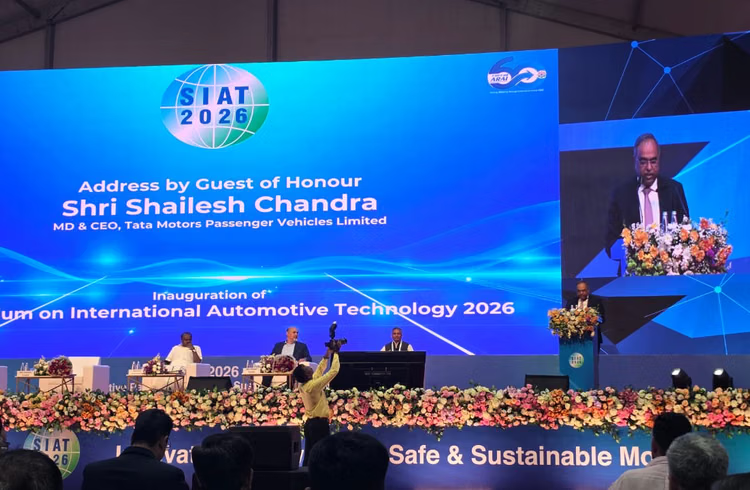
India has a significant opportunity to emerge as a global leader in electric and sustainable mobility, according to Shailesh Chandra, Managing Director of Tata Motors Passenger Vehicles. Speaking at SIAT 2026, hosted by the Automotive Research Association of India (ARAI), Chandra described the country’s ongoing automotive transformation as a platform for innovation, advanced manufacturing, and global competitiveness.
Framing electrification as a strategic opportunity rather than a constraint, Chandra emphasised that India can leverage its growing manufacturing capabilities, policy support, and strong industry-academia collaborations to position itself at the forefront of the global electric vehicle (EV) landscape. He noted that the automotive sector is navigating three critical transitions: sustainability, safety, and rapid technological advancement, which will determine India’s role in future mobility markets.
“Sustainability is no longer optional—it is an urgent national imperative,” Chandra said. He highlighted the need for cleaner technologies, reduced emissions, and a move away from fossil fuel dependence, aligning India’s rapid economic growth and increasing mobility demand with zero-emission solutions. He described the transition to electric mobility as a systemic change requiring participation from manufacturers, suppliers, and technology partners across the ecosystem.
On the topic of safety, Chandra acknowledged the industry’s progress in vehicle design, restraint systems, and adherence to global safety practices. He stressed that the next wave of improvement must focus on accident prevention through active safety systems and driver-assistance technologies. Transparent and locally relevant testing infrastructure, he added, is critical to making safety measurable and meaningful for consumers.
Chandra also highlighted the rapid technological evolution in the automotive sector. Vehicles are increasingly software-driven, shaping user experience and enabling continuous upgrades throughout a car’s lifecycle. He noted that Indian consumers are digitally literate and tech-savvy, expecting advanced connectivity and safety features even in entry-level vehicles.
Looking ahead, Chandra said India’s automotive industry is poised for strong growth, driven by rising aspirations and expanding global relevance. He underscored that electrification, enhanced safety standards, and software-led innovations should be seen as growth opportunities, not challenges. The transformation will require strategic partnerships, capacity building, and intelligent adoption of emerging technologies, including artificial intelligence.
Through these efforts, India is positioned not only to accelerate its domestic EV adoption but also to establish itself as a hub for global electric mobility, innovation, and sustainable automotive manufacturing.