
News List
Government to mandate mechanised covers for trucks

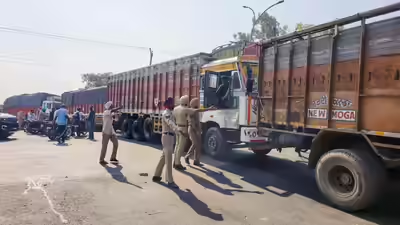
In a significant step aimed at improving road safety and reducing accidents caused by falling debris, the government is set to make mechanised covering systems mandatory for trucks transporting loose materials. The move targets vehicles carrying soil, construction material, municipal waste, and similar cargo, which often spills onto roads due to inadequate or loosely fastened coverings.
The new requirement will be introduced as part of the updated Truck Body Code, which is expected to be notified shortly. Road Transport and Highways Minister Nitin Gadkari has confirmed that the revised code is in its final stages and will be rolled out soon. Officials familiar with the development said the proposed changes have already been cleared by a committee under the road transport ministry, comprising representatives from both the government and the truck-manufacturing industry.
Mechanised covering refers to automated or machine-assisted systems that securely cover truck loads, replacing traditional methods such as loose tarpaulins or manual tying. These older practices have frequently failed to prevent materials from falling onto highways, posing serious risks to other road users.
While the government is keen to implement the new norms within the next year, truck manufacturers have reportedly sought a longer transition period. Industry stakeholders have requested up to two years to fully comply with the updated code, citing the need for design changes and additional manufacturing adjustments.
The move comes against the backdrop of repeated Supreme Court directives calling for strict enforcement of proper covering of trucks carrying loose or protruding loads. Despite multiple court orders, compliance has remained poor, largely due to weak enforcement and the absence of uniform technical standards.
Officials noted that the Automotive Industry Standard AIS-093, which governs the Truck Body Code, has already been published. The standard addresses long-standing issues such as unsafe body-building practices, structural weaknesses, overloading, vehicle instability, and non-uniform dimensions across truck bodies. It lays down minimum safety benchmarks covering structural integrity, dimensional consistency, and overall roadworthiness for truck bodies mounted on approved chassis.
In addition to mechanised coverings, the revised Truck Body Code is expected to introduce several other safety-related upgrades. These include the mandatory provision of air-conditioned driver cabins, the incorporation of advanced driver assistance systems to improve road safety, and updated specifications for under-run protection devices to reduce the severity of collisions.
Once implemented, the updated norms are expected to significantly reduce road hazards caused by falling debris, improve driver comfort, and bring greater uniformity to truck design standards across the country.