
News List
Upfront Truck Pricing Fades as TCO Takes Over

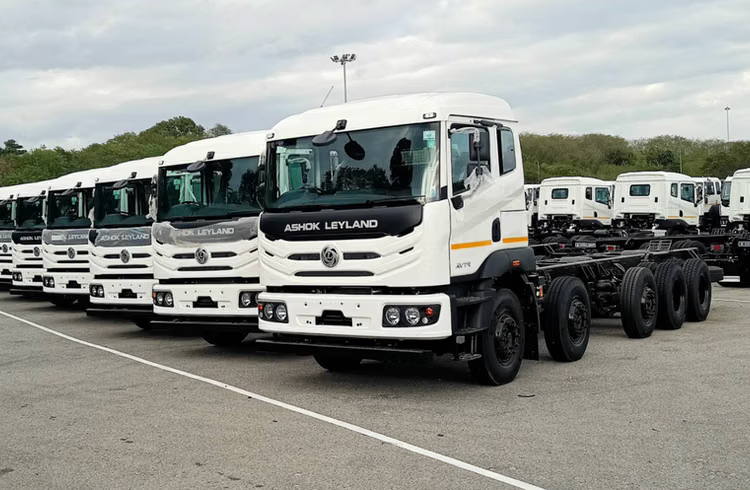
The way commercial vehicles are bought in India is undergoing a fundamental shift, with upfront pricing steadily losing importance as fleet operators focus more on total cost of ownership (TCO), uptime, and earnings potential, according to Ashok Leyland Managing Director and CEO Shenu Agarwal.
Speaking on the sidelines of the relaunch of Ashok Leyland’s iconic Taurus and Hippo trucks, Agarwal said that improvements in road infrastructure and faster highway connectivity are reshaping customer expectations across the trucking ecosystem. With highways enabling higher speeds and smoother movement, transporters and shippers are now demanding quicker turnaround times and better asset utilisation, rather than marginal savings on vehicle acquisition costs.
As road conditions improve, logistical efficiency on major routes has increased significantly. Agarwal explained that this has pushed shippers to expect faster cargo movement, compressing delivery timelines that once took several hours longer. In response, fleet operators are now evaluating trucks based on how efficiently they can run, how much they can earn per trip, and how reliably they can stay on the road.
According to Agarwal, the market is no longer price-led but value-driven. Recent discussions with large fleet buyers indicate that conversations are increasingly centred around alternative fuels such as EV and LNG, along with lifecycle economics. In many cases, vehicle pricing does not even enter the discussion, reflecting how buyer priorities have evolved.
This transition is also visible in the broader shift towards higher-tonnage trucks in the medium and heavy commercial vehicle segment. Over the past decade, gross vehicle weights have increased steadily, supported by better road infrastructure, improved economic viability, and the availability of advanced high-tonnage models from manufacturers. Higher-capacity vehicles allow fleet operators to move more cargo per trip, directly improving profitability.
Agarwal noted that benchmark standards for trucks in India are rising rapidly. With new highways allowing higher average speeds, vehicles now require greater torque and power to operate efficiently. He pointed out that while European markets have long adopted 400–500 horsepower trucks, India is now moving swiftly in the same direction as operating conditions and expectations change.
Beyond performance, service support and uptime have become decisive factors in purchase decisions. Agarwal highlighted that downtime directly impacts operating income, making maintenance efficiency critical. Internal lifecycle cost analysis by Ashok Leyland shows that only about 10% of a truck’s total cost comes from the asset price, while nearly 90% is attributed to running and maintenance costs over its lifespan.
This reality, he said, reinforces why upfront pricing alone no longer defines value. Instead, fleet operators are prioritising trucks that deliver higher productivity, better reliability, and stronger long-term returns—signalling a clear shift in how India’s commercial vehicle market evaluates success.