
News List
CATL Launches Sodium Battery for Light Commercial Vehicles

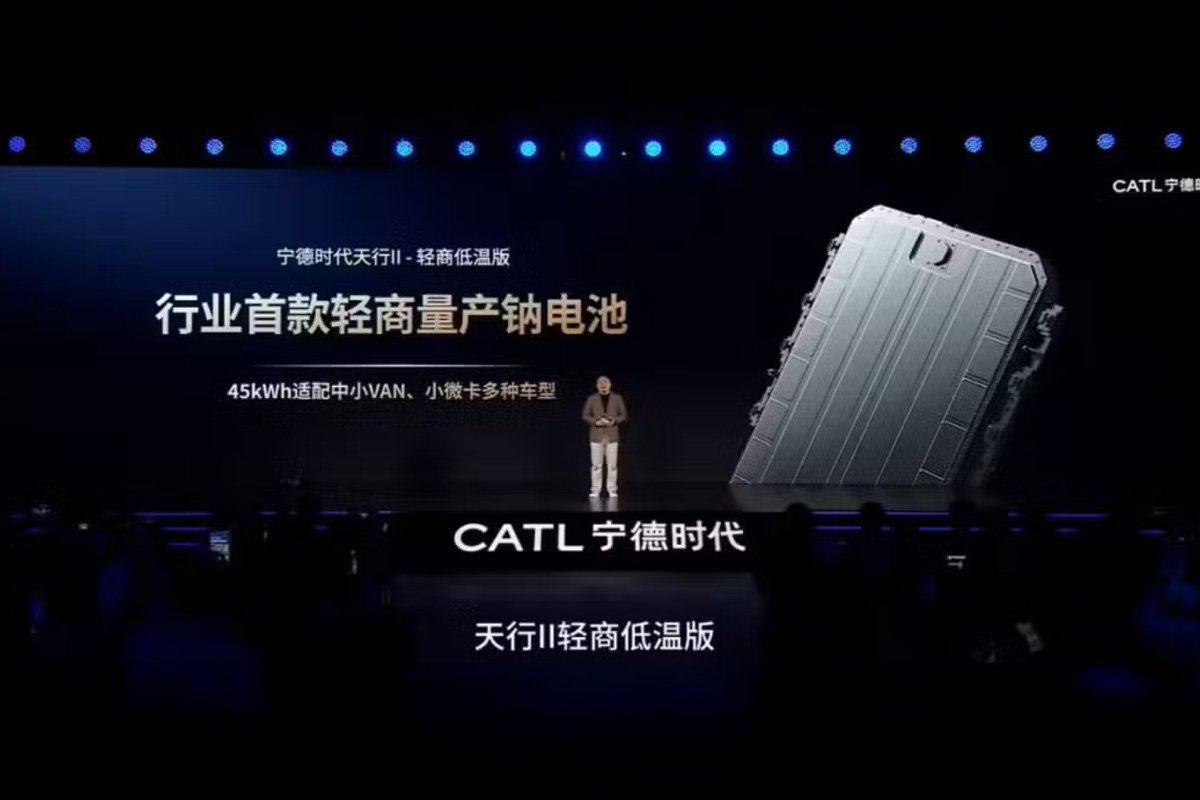
Chinese battery giant CATL has unveiled a sodium-ion battery designed specifically for light commercial vehicles (LCVs), marking a significant step in electrifying small vans and mini-trucks. According to media reports, the company plans to begin mass production later this year, positioning the battery as the industry’s first large-scale sodium solution for LCVs.
The new battery, part of CATL’s Tectrans II series, boasts a 45 kWh capacity and is engineered for extreme cold conditions. It can be charged under temperatures as low as -30 °C and retains 90% of usable capacity at -40 °C, offering reliability for transport operations in harsh winter climates. The sodium battery delivers an energy density of 175 Wh/kg and promises a lifespan exceeding 10,000 charge cycles. It has also received certification under the new national standard GB 38031-2025.
The Tectrans II lineup goes beyond sodium-ion technology, including three lithium-ion variants tailored to different operational needs. One lithium battery targets long-distance travel, offering up to 253 kWh for ranges of approximately 800 km, while another variant is designed for rapid charging, reaching 20% to 80% in just 30 minutes at -15 °C. A high-temperature lithium battery is also part of the series, maintaining up to 5,000 charge cycles at 45 °C.
CATL has simultaneously expanded its portfolio of swappable battery blocks, introducing the #35 pack at 81 kWh. This complements previous swappable batteries, including #20 (42 kWh LFP / 52 kWh NMC), #25 (56 kWh LFP / 70 kWh NMC), and #75 (171 kWh LFP for electric trucks). These packs are now incorporated into the Tectrans II series for LCVs, enabling faster deployment and simplified logistics for fleet operators.
The Tectrans brand, launched in mid-2024, covers commercial vehicle batteries for a range of applications, including medium- and heavy-duty trucks as well as buses. The new series focuses on light commercial vehicles, reflecting rising demand for electrified urban and last-mile transport solutions.
CATL’s move into sodium-ion technology aligns with its broader strategy to mitigate rising lithium costs and diversify battery supply chains. The company recently described a “Dual-Star” approach, pairing lithium-ion and sodium-ion batteries to meet varied operational and environmental requirements. Industry observers note that sodium-ion batteries offer a cost-effective alternative without compromising durability or low-temperature performance.
This is not CATL’s first foray into sodium-ion technology. Its first-generation sodium battery, launched in 2021, achieved 160 Wh/kg, followed by a 200 Wh/kg iteration in 2024. The Naxtra battery, introduced in April 2025 for passenger cars, set the current benchmark at 175 Wh/kg, now adopted for the Tectrans II LCV sodium battery.
With the introduction of Tectrans II sodium batteries, CATL is set to expand its footprint in commercial vehicle electrification, promising reliable, cold-tolerant, and long-life energy solutions for a rapidly growing light electric transport market.