
News List
Excavator vs Motor Grader: Choosing the Right Grading Equipment

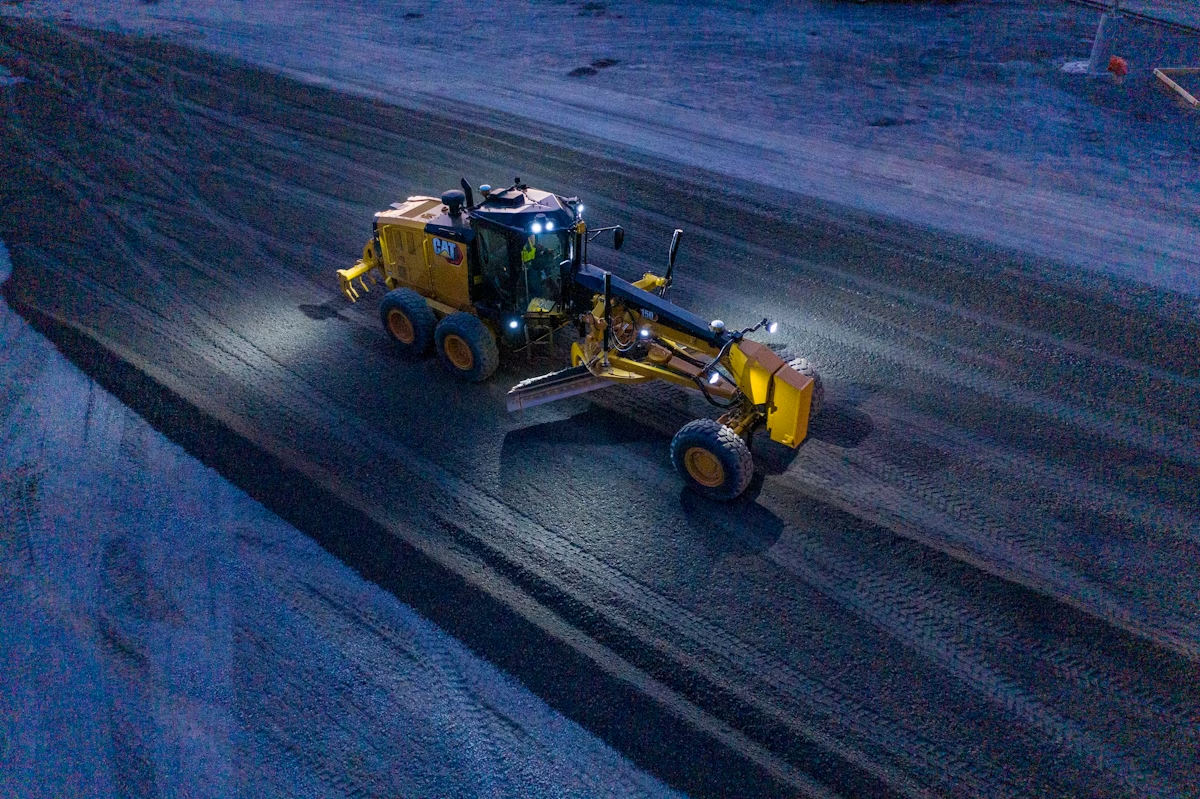
Grading is a critical task on construction sites, ensuring stable foundations, preventing soil erosion, and improving access for workers and vehicles. Contractors often face a key decision: whether to use an excavator or a motor grader for grading operations. Both machines are essential, yet their suitability depends on terrain, project stage, and required precision.
Machine Design and Structure
Motor graders are built with a long, narrow frame and a centrally mounted blade, optimized for continuous forward movement on relatively flat surfaces. Excavators, on the other hand, feature a compact, heavy-duty tracked design with a boom and bucket, allowing flexible movement for digging and lifting. While graders are ideal for smooth, level surfaces, excavators excel on rough or uneven terrain.
Grading Precision
Motor graders are known for high-precision grading. Their long blades allow controlled surface finishing, fine slope adjustments, and efficient drainage management, making them perfect for roads, parking areas, and foundation pads. Excavators offer moderate grading precision and often rely on advanced technology for exact leveling, making them suitable for rough or irregular sites.
Site Preparation Capabilities
Excavators are the go-to machines for initial site preparation. They handle heavy debris removal, digging trenches, and shaping rough terrain efficiently. Once the site is prepared, motor graders take over to level and smooth surfaces, delivering the finishing touches required for a project. Using both machines in sequence often ensures optimal results.
Terrain Suitability
Motor graders perform best on firm, semi-level ground but may struggle on soft or steep surfaces. Certain models, like the CAT 120, offer adjustable blade depth to manage varying soil conditions. Excavators, with their tracked design, remain stable on soft, uneven, or steep terrain and can access confined or irregular areas, as seen in models like the CAT 320D3 GC.
Productivity on Construction Projects
Motor graders are highly productive for grading tasks, requiring fewer passes and reducing fuel consumption while minimizing operator fatigue. Excavators are versatile machines, capable of excavation, lifting, and material handling, but repeated passes may be needed for grading, slightly reducing efficiency. For projects demanding speed and precise leveling, motor graders outperform excavators, whereas excavators excel on multifunctional sites.
Quick Comparison Table
| Parameter | Motor Grader | Excavator |
| Primary Grading Role | Finishing, levelling | Rough grading, debris removal |
| Accuracy | High precision | Moderate |
| Job Suitability | Roads, parking lots, foundation pads | Confined sites, uneven terrain |
| Operating Efficiency | Continuous, high-speed | Slower, multiple passes needed |
| Surface Finishing | Excellent | Fair |
Conclusion
Both excavators and motor graders are indispensable for construction grading. Excavators handle rough terrain, initial site prep, and debris clearing, while motor graders provide precise leveling and smooth surface finishing. Contractors can achieve the best results by evaluating soil conditions, project stage, and accuracy requirements—often using both machines in combination for maximum efficiency.