
News List
Kerala to Launch India’s First State-Led Electric Truck Corridor Under PM E-DRIVE

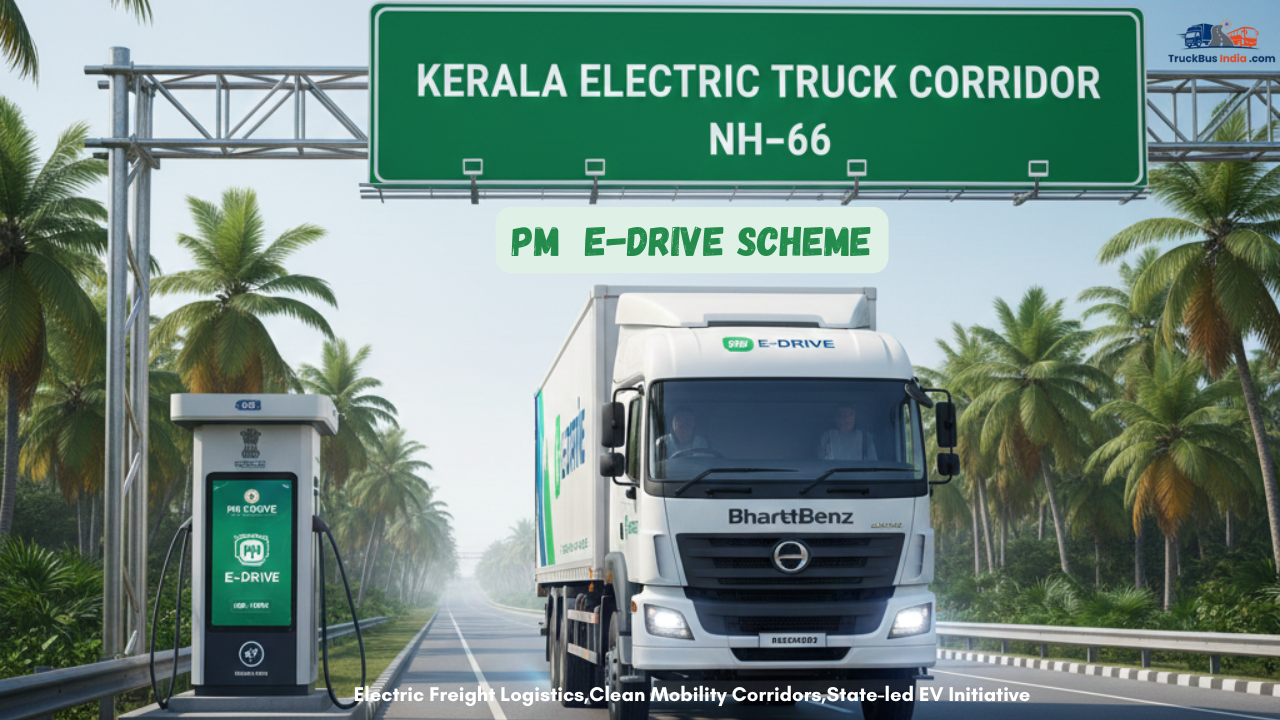
Kerala is set to make a significant move in India’s clean mobility journey with the launch of the country’s first state-led electric truck corridor under the PM E-DRIVE programme. The initiative positions the state as an early adopter of electric freight solutions, focusing on decarbonising logistics while strengthening long-haul and regional cargo movement.
This corridor-led approach marks a shift from vehicle-focused electrification to ecosystem-level planning.
A Strategic Push for Electric Freight in Kerala
The proposed electric truck corridor is designed to support Kerala electric freight movement across key transport routes, aligning with the state’s sustainability and climate action goals. Freight transport contributes a sizable share of transport emissions, and electrifying this segment is viewed as critical for achieving long-term reductions.
By taking a state-led approach, Kerala aims to remove one of the biggest adoption barriers for electric trucks: the lack of reliable charging infrastructure along freight routes.
NH-66 EV Corridor as the Backbone
The corridor is expected to be anchored along the NH-66 EV corridor, one of the state’s most important highways connecting major ports, industrial zones, and logistics hubs. This stretch supports a high volume of freight traffic, making it well-suited for early electric truck deployment.
Planned charging points along NH-66 will enable predictable operations for electric trucks, particularly for medium- and heavy-duty freight vehicles operating on fixed routes. This approach improves operational confidence for logistics operators considering a shift to electric fleets.
EV Charging Infrastructure Designed for Freight Needs
Unlike passenger EV charging networks, electric freight requires high-capacity, fast-charging solutions. The electric truck corridor will focus on EV charging infrastructure tailored for commercial vehicles, including:
- High-power chargers for heavy trucks
- Charging hubs near logistics parks and warehouses
- Dedicated bays to minimise turnaround time
Such infrastructure planning is essential for making electric freight logistics commercially viable, especially for time-sensitive cargo movement.
Role of PM E-DRIVE in Enabling the Corridor
The corridor is being developed under PM E-DRIVE, which emphasises demand incentives, infrastructure development, and ecosystem readiness for electric commercial vehicles. Policy backing under the programme helps reduce early-stage risk for both fleet operators and charging service providers.
PM E-DRIVE support also encourages collaboration between state governments, utilities, and private players, ensuring that corridor development is not limited to isolated pilot projects but scaled with long-term viability in mind.
Advancing Clean Mobility Corridors in India
Kerala’s initiative is expected to serve as a blueprint for future clean mobility corridors across the country. By integrating vehicle deployment with charging, power availability, and route planning, the state-led model addresses multiple challenges simultaneously.
Such corridors can help:
- Accelerate electric truck adoption
- Reduce logistics emissions on high-density routes
- Improve air quality in freight-intensive regions
- Encourage OEMs to introduce more electric truck models
This integrated approach strengthens the overall EV ecosystem rather than relying solely on market-led adoption.
Impact on Electric Freight Logistics and Fleets
For fleet operators, the electric truck corridor offers improved predictability and lower operational risk. Access to reliable charging infrastructure along key routes supports better fleet planning and enables gradual electrification without disrupting operations.
Logistics companies operating in ports, construction materials, FMCG, and regional distribution are expected to be early beneficiaries, particularly those with repeatable routes and high vehicle utilisation.
Setting a Precedent for State-Led EV Initiatives
As a state-led EV initiative, Kerala’s electric truck corridor highlights the growing role of regional governments in shaping India’s EV transition. By focusing on freight rather than just public or personal transport, the state is addressing a critical yet underserved segment of clean mobility.
If successful, the model could be replicated by other states looking to electrify freight corridors and support national decarbonisation goals.