
News List
Tata EXCON showcase hints at next wave of heavy-duty and green haulage

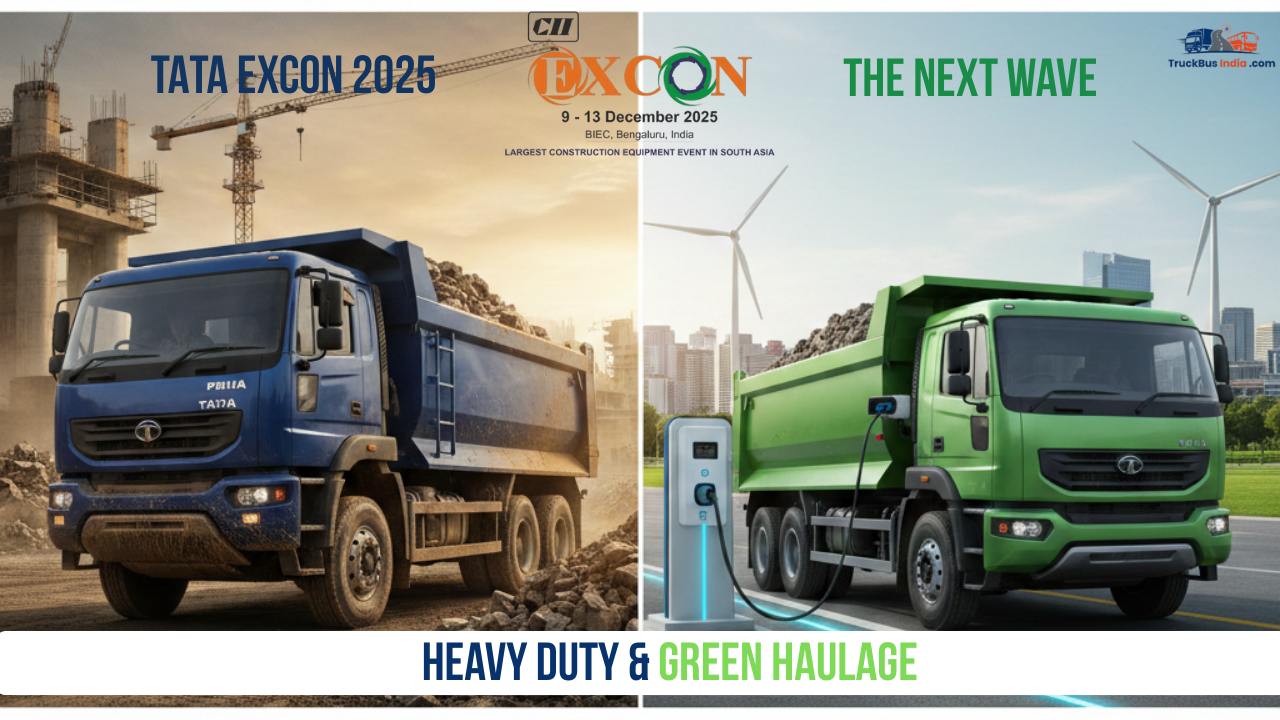
India’s infrastructure build-out is accelerating, and with it the demand for tougher, more efficient haulage. At EXCON 2025, Tata Motors’ showcase points to where heavy-duty trucking is headed next: higher payload capability, better fuel efficiency, and a gradual but visible move toward cleaner powertrains suited for construction and mining use.
Rather than a single headline launch, Tata’s EXCON presence reflects a portfolio-level strategy—strengthening conventional diesel platforms while expanding alternative fuel options for fleet operators under rising cost and emission pressure.
Heavy-duty trucks aligned to infra and mining demand
Construction, mining and large infrastructure projects continue to account for a major share of India’s heavy commercial vehicle demand. Tata Motors’ EXCON display reinforces its focus on high-tonnage tippers, multi-axle haulage trucks and tractor-trailers designed for rough duty cycles.
Key emphasis areas include:
- Higher GVW configurations to move more material per trip
- Reinforced aggregates and chassis for off-road and semi-off-road operations
- Application-specific builds for mining, road construction and bulk logistics
These segments remain largely diesel-led, but OEMs are under pressure to extract more efficiency per litre, especially as fuel costs and compliance expenses rise.
Cleaner tech without compromising payload
A clear theme emerging from Tata Motors’ EXCON positioning is cleaner technology integrated into existing heavy-duty platforms rather than abrupt transitions. For fleet owners, payload and uptime still matter more than anything else.
Tata’s showcase indicates growing emphasis on:
- CNG and LNG-ready configurations for select tipper and haulage applications
- Improved BS-VI compliant engines tuned for lower real-world emissions
- Better thermal and fuel management systems to reduce operating costs
CNG tippers, in particular, are gaining attention where fuel availability permits, offering lower running costs and reduced tailpipe emissions for urban and peri-urban construction fleets.
Focus on total cost of ownership, not just sticker price
Heavy-duty fleet decisions are increasingly driven by lifecycle economics. At EXCON, Tata Motors highlights solutions beyond the truck itself—signalling that OEMs now compete on operating economics as much as hardware.
Areas of focus include:
- Fuel-efficiency optimisation through drivetrain and calibration improvements
- Extended service intervals to reduce workshop downtime
- Telematics and fleet monitoring for preventive maintenance and driver behaviour tracking
For infrastructure contractors running mixed fleets, these factors directly impact project margins and delivery timelines.
Gradual transition toward sustainable haulage
While fully electric heavy haulage remains limited to niche or pilot use cases, Tata Motors’ EXCON narrative aligns with a phased sustainability roadmap. The near-term approach appears to be:
- Cleaner diesel as the backbone for heavy loads
- Alternative fuels like CNG and LNG where feasible
- Continuous efficiency gains to cut emissions per tonne-kilometre
This measured transition suits India’s current infrastructure realities, where charging and alternative fuel networks are still uneven.
What EXCON signals for fleet operators
Tata Motors’ EXCON 2025 showcase suggests that the next wave of heavy-duty trucks will not be about radical disruption, but steady evolution. Fleet operators can expect:
- More application-specific heavy trucks
- Lower operating costs through efficiency and digital tools
- Incremental adoption of cleaner fuels without sacrificing productivity
As infrastructure spending remains strong, the convergence of heavy-duty capability and sustainable haulage is set to define purchasing decisions over the next few years—exactly the direction Tata Motors appears to be signalling at EXCON.