
News List
Apollo Tyres slash ₹300–2,000 prices as GST cut fuels CV replacement rush

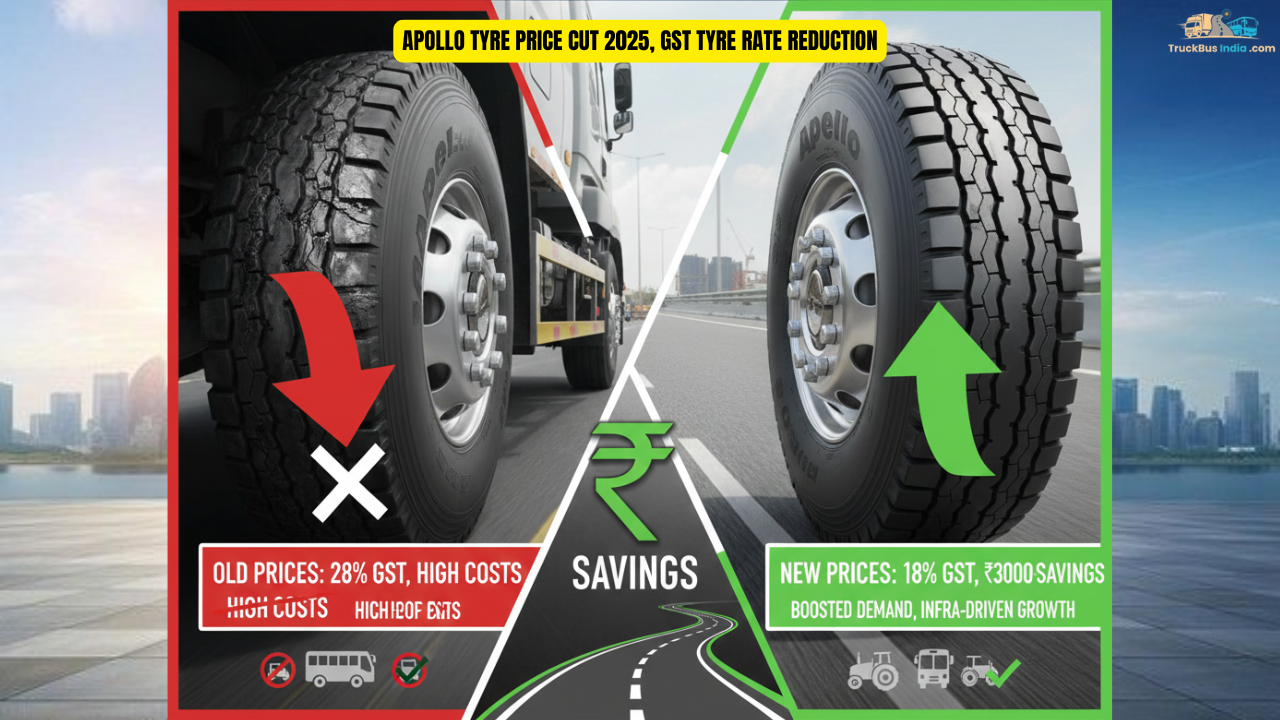
India’s commercial vehicle (CV) aftermarket is seeing a fresh wave of demand after Apollo Tyres announced price cuts ranging from ₹300 to ₹2,000 per tyre, following the GST rate reduction on tyres. By passing on the full tax benefit to customers, the tyre major has triggered a replacement cycle across truck, bus, and tractor segments, just as infrastructure-led freight movement gathers pace.
GST tyre rate reduction reshapes pricing dynamics
The government’s decision to move tyres from the highest GST bracket to a lower tax slab has had an immediate impact on pricing. For fleet operators, tyres represent one of the largest operating expenses after fuel, making even modest reductions meaningful at scale.
Apollo’s move reflects:
- Direct pass-through of GST savings to end customers
- Faster price correction compared to staggered reductions
- A competitive signal to the broader tyre industry
Industry watchers note that the revised tax structure particularly benefits pneumatic tyres used in commercial and agricultural vehicles, where volumes are high and replacement cycles are frequent.
Why Apollo tyre price cut 2025 matters for fleets
The Apollo tyre price cut 2025 comes at a time when fleet utilisation is improving due to steady freight demand from roads, housing, and logistics projects. For operators running multi-axle trucks or buses, a ₹1,000–2,000 reduction per tyre can translate into significant savings across an entire fleet.
Key benefits for fleets include:
- Lower upfront replacement costs
- Improved cash flow for small and mid-sized operators
- Ability to replace worn tyres earlier, reducing breakdown risk
This is especially relevant for long-haul trucks, where tyre condition directly impacts fuel efficiency and safety.
CV tyre replacement demand picks up pace
With prices corrected, CV tyre replacement demand is accelerating across dealer networks. Many fleet owners who had deferred tyre changes amid high costs are now returning to planned maintenance schedules.
Dealers report:
- Strong enquiries from medium and heavy commercial vehicle operators
- Increased demand for radial tyres in trucking applications
- Renewed interest from bus fleets preparing for peak travel seasons
The price reset aligns with rising vehicle utilisation, making replacement an operational necessity rather than a discretionary expense.
Pneumatic rubber savings extend beyond trucking
While trucks and buses dominate volumes, savings on pneumatic rubber are also influencing the agricultural segment. Tractor and farm equipment tyres now fall under a lower GST slab, easing costs for rural buyers ahead of peak farming activity.
For manufacturers like Apollo, this broad-based demand helps balance:
- Cyclical fluctuations in the CV segment
- Seasonal demand from agriculture
- OEM and replacement market exposure
The result is a healthier volume outlook across multiple tyre categories.
Infrastructure push amplifies replacement cycle
India’s ongoing infrastructure build-out — highways, ports, mining, and urban construction — is keeping heavy vehicles on the road for longer hours. Higher utilisation accelerates tyre wear, naturally boosting replacement demand.
Fleet managers increasingly prioritise:
- Timely tyre changes to avoid downtime
- Better grip and durability for loaded runs
- Compliance with safety norms, especially for highway operations
Lower prices remove a key friction point in these decisions, reinforcing the replacement cycle.
Fleet road safety gets a cost boost
Beyond economics, the price cut has a direct road safety implication. Worn tyres are a leading contributor to breakdowns and accidents in the CV segment. More affordable replacements encourage operators to avoid overextending tyre life.
Safety-linked benefits include:
- Better braking performance
- Reduced blowout risk on highways
- Improved stability for heavy loads
In this sense, the GST-led price correction supports both commercial efficiency and public safety outcomes.
What this signals for the tyre market
Apollo’s move is likely to set the tone for the rest of the industry. As competitors respond, the tyre market could see:
- Increased price competition in the replacement segment
- Higher volumes offsetting lower per-unit margins
- Stronger demand visibility through FY25–26
For fleet operators, the timing is ideal — aligning tax relief with rising freight movement and vehicle usage.
In summary, Apollo Tyres’ ₹300–2,000 price cuts, driven by GST reduction, have unlocked pent-up CV replacement demand. With infrastructure activity sustaining vehicle utilisation, lower tyre costs are poised to improve fleet economics, safety, and overall road efficiency.