
News List
Autonomous convoy pilots link 5 trucks cutting driver fatigue costs

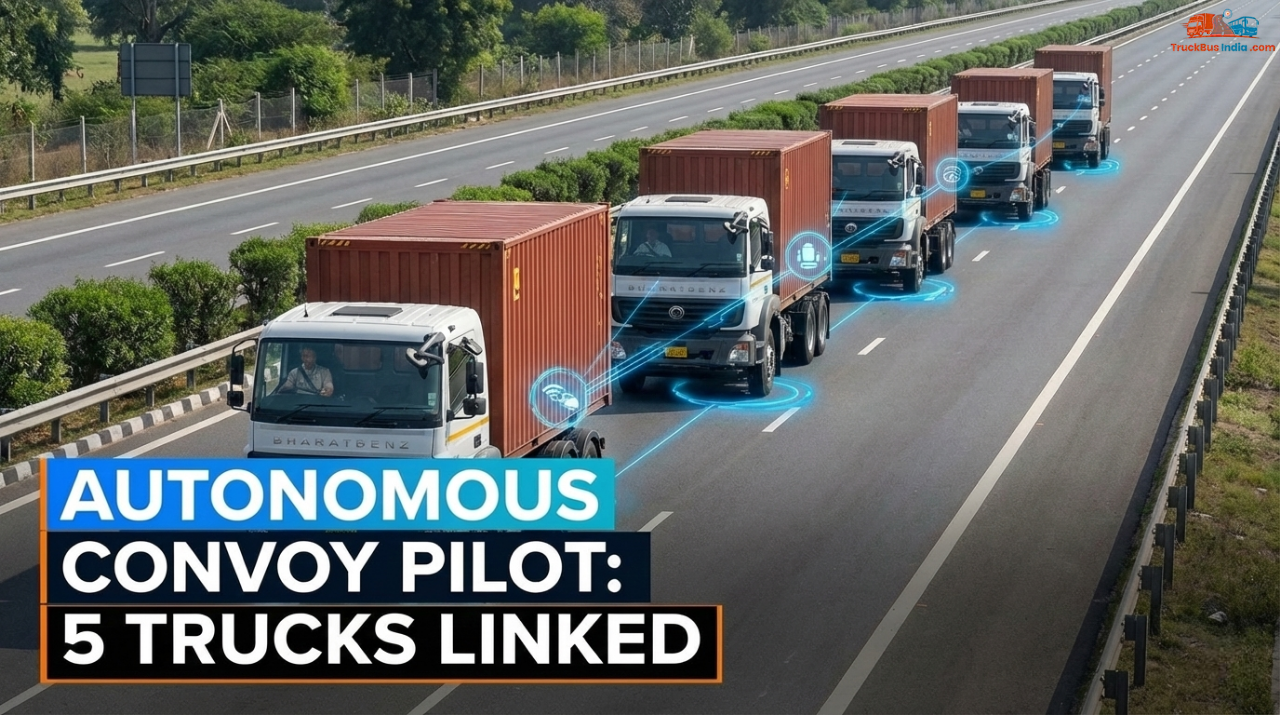
Autonomous truck platooning — where multiple heavy vehicles travel in a connected convoy under the control of a lead truck — is gaining traction as a logistics game‑changer, promising significant autonomous truck convoy India stakeholders reduced operational costs and enhanced safety on fixed highway routes. By applying advanced vehicle‑to‑vehicle communications and partial automation systems, platooning reduces fuel use and helps fleets cut driver fatigue and labor costs on long, repetitive routes.
At its core, platooning links trucks through wireless communication and automated control systems, allowing follower trucks to mirror the lead truck’s throttle, braking, and steering inputs with millisecond precision. The result: vehicles maintain close distances safely, reducing aerodynamic drag and enabling more consistent traffic flow. Such technology does not yet equate to fully driverless trucking but does allow a single operator to manage several vehicles in formation, especially on fixed, long‑haul corridors where road conditions are predictable.
How Platooning Reduces Costs
One of the key advantages of truck platooning is platoon fuel savings. Studies show that when trucks follow closely in a platoon, aerodynamic resistance is significantly reduced, improving fuel efficiency for all vehicles in the convoy. Research indicates fuel savings of roughly 5–10% for follower trucks and around 4–5% for the lead truck compared with solo runs.
Transport analysts emphasize that since fuel accounts for a large portion of haulage operating expenses, even modest percentage reductions can translate to meaningful cost savings over time. Additionally, platooning systems that automate speed and spacing help maintain consistent driving patterns, further improving fuel economy across fleets.
Cutting Driver Fatigue and Labor Costs
Beyond fuel, platooning technology can tackle one of trucking’s longstanding challenges: driver fatigue. Long stretches of highway driving are physically and mentally exhausting, and fatigue is a major risk factor in accidents and regulatory compliance issues. Platooning technologies reduce cognitive load on drivers of the trailing trucks by automating many repetitive driving tasks, allowing them to focus on monitoring and safety rather than constant speed and gap adjustments.
In semi‑automated applications, the lead truck’s driver remains in full control, while drivers in follower trucks can take breaks or perform oversight duties with less exertion — effectively reducing labor strain without eliminating essential human oversight. Trials in other markets have shown that linking demonstration convoys can operate two heavy trucks with only one active driver, offering carriers an opportunity to rethink labor allocations on long fixed routes.
What This Means for India
While autonomous truck platooning is still largely in development in most regions, its potential in India’s fixed route automation context is notable. India’s freight corridors — such as the Golden Quadrilateral and Delhi‑Mumbai Expressway — are ideally suited for platooning trials because they feature long, high‑speed sections with limited traffic complexity. Adopting automated convoy systems on such corridors could help Indian logistics firms cut fuel costs and driver fatigue, addressing both rising diesel prices and workforce constraints.
Furthermore, as global OEMs and tech startups continue to refine platooning software and safety protocols, fleet operators can integrate these systems into existing operations without massive infrastructure changes. Vehicle‑to‑vehicle communication standards are evolving rapidly, and regulatory bodies in multiple countries are already testing frameworks to permit platooning under controlled conditions.
The Road Ahead
Truck platooning isn’t a panacea. It requires investment in automation technologies, reliable connectivity, and regulatory support. But the early evidence suggests that linking five or more trucks under convoy control — especially on fixed route automation corridors — can yield measurable drops in fuel use and driver fatigue costs. For Indian fleets focused on efficiency and sustainability, platooning could soon become an essential strategy in the move toward smarter freight transport.