
News List
STU bus tenders favor ADAS equipped models for urban safety compliance

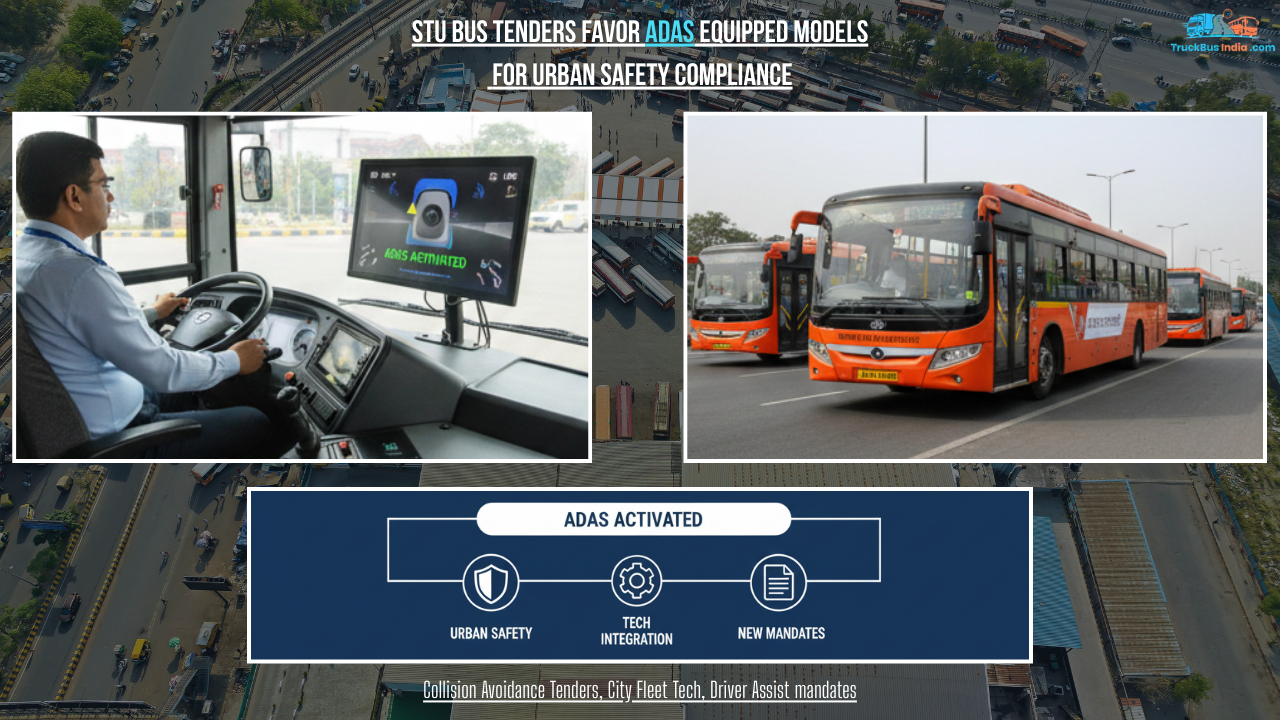
State Transport Undertakings (STUs) across India are redefining urban bus procurement by making Advanced Driver Assistance Systems (ADAS) a core requirement in tenders. What was once considered optional safety technology is now being written directly into eligibility criteria, especially for city and intercity operations with high passenger density. This shift reflects growing concern over road safety, accident accountability, and service reliability in urban transport networks.
Urban safety concerns drive technology adoption
Indian cities face complex traffic conditions with mixed road users, narrow corridors, and frequent pedestrian movement. To address these risks, urban bus safety tenders now call for collision avoidance systems, lane departure warnings, blind-spot detection, and driver fatigue alerts. These driver assist mandates aim to reduce human error, improve reaction times, and ensure safer public mobility for millions of daily commuters.
OEM strategies adapt to ADAS-first tenders
Bus manufacturers responding to ADAS STU buses India tenders are redesigning product portfolios to integrate cameras, radar sensors, and real-time driver monitoring as standard fitments. OEMs are working to balance safety compliance with cost efficiency, ensuring technology additions do not significantly raise vehicle acquisition or lifecycle costs. Partnerships with technology providers are becoming common as OEMs seek faster compliance and scalable deployment.
Data-led benefits for city fleet operators
Beyond safety, ADAS-enabled buses generate actionable operational data. Insights into braking patterns, near-collision events, driver behaviour, and route-level risk zones allow STUs to refine training programmes and improve fleet planning. City fleet tech is increasingly viewed as a management tool that supports evidence-based decisions, service optimisation, and accountability across public transport operations.
Procurement policies outpace formal regulation
While national regulations on ADAS adoption are still evolving, state-level procurement policies are moving ahead decisively. By embedding driver assist mandates into tender documents, STUs are setting higher safety standards without waiting for statutory enforcement. This approach is effectively creating a market-driven safety baseline, accelerating adoption across urban bus fleets.
Cost, insurance, and operational upside
Reduced accident frequency directly lowers maintenance expenses, service disruptions, and insurance claims. Over time, ADAS-equipped STU buses can unlock favourable insurance terms and improve fleet uptime. These tangible benefits strengthen the business case for technology-led procurement, even in budget-conscious government transport bodies.
Training and integration remain key challenges
Successful deployment depends on more than hardware. Drivers must be trained to understand and trust ADAS alerts, while fleet teams need capabilities for calibration and system upkeep. Recent collision avoidance tenders increasingly include OEM-led training, support clauses, and performance monitoring to ensure long-term effectiveness.
A new benchmark for urban bus procurement
The preference for ADAS-equipped buses marks a structural shift in how Indian cities approach public transport safety. As urban mobility expands, intelligent safety systems will define tender competitiveness. For STUs, ADAS is no longer just about compliance—it is becoming central to building safer, smarter, and more resilient city fleets.