
News List
EXCON Spotlight: How New Excavators and Loaders Change Payload Planning

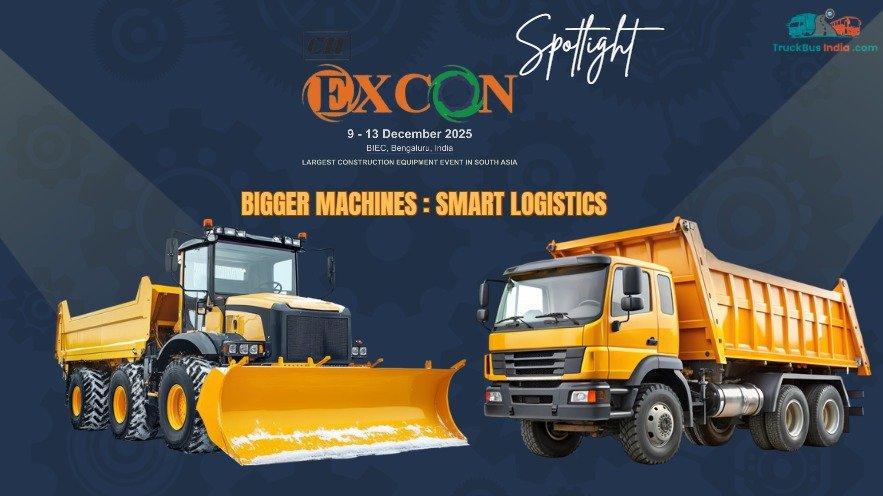
EXCON has always been the stage where India witnesses the next leap in construction machinery. This year, one of the standout conversations across booths and demos revolved around the new generation of excavators and loaders. With faster cycle times, stronger hydraulic systems, and larger buckets, these machines are reshaping productivity benchmarks for construction, mining, and quarrying. But with this surge in equipment capability comes a direct ripple effect on the trucking side. The upgraded machine capacities showcased at EXCON are compelling contractors to rethink tipper payload planning like never before.
In essence, the industry is seeing a shift from machine-driven operations to system-driven operations—where excavators, loaders, and trucks must work in perfect harmony. This synergy is now central to achieving optimal site productivity.
New-Generation Excavators Are Changing the Game
One of the biggest highlights of EXCON was the introduction of high-performance excavators that deliver improved power-to-weight ratios and faster cycle efficiencies. These machines dig faster, lift heavier materials, and complete more cycles per hour.
The EXCON excavators’ impact is clear: if the trucks cannot keep up with the excavators’ speed and output, operational inefficiencies emerge. Idle excavators increase fuel consumption and reduce overall site productivity.
As a result, contractors are recalibrating:
- Number of tippers required per excavator
- Ideal payload per trip
- Haul cycle timings
- Fleet utilisation targets
Higher-capacity excavators naturally demand tippers that can load quickly, haul larger quantities, and withstand tougher site conditions.
Loaders Now Offer Bigger Buckets—And Bigger Expectations
Wheel loaders and backhoe loaders demonstrated at EXCON reinforced the same trend: more throughput. With larger bucket sizes and strong breakout forces, these machines load tippers far faster than previous-generation models.
This has a direct impact on loader capacity trucks, because the tipper body must be sized to match the number of bucket fills the loader delivers. Ideally, 3–5 bucket loads per cycle offer the most efficient loading process. Any mismatch leads to underloading, overloading, or increased loading time.
EXCON has therefore pushed contractors to consider:
- Wider and higher tipper bodies
- Stronger steel grades
- Optimised load volume
- Reinforced underbody structure
These upgrades ensure that trucks can efficiently accommodate the output of modern loaders without compromising on safety or productivity.
Payload Planning Becomes a Strategic Priority
With advanced machines capable of producing more output per hour, payload planning is no longer a routine activity—it has become a critical operational strategy. Contractors today want the perfect synchronization between excavator/loader output and tipper hauling capacity.
Effective payload planning helps achieve:
- Reduced cycle times
- Lower fuel consumption per tonne
- Better equipment utilisation
- Higher daily throughput
- Reduced operational bottlenecks
The new conversation in the industry is clear: “If your machines have upgraded, your trucks must upgrade too.”
Stronger Tipper Designs Are Now in Demand
Matching high-output machinery requires tippers that can endure heavy-duty usage. Contractors are increasingly looking for:
- High-strength steel load bodies
- Reinforced sidewalls
- Optimised load volume based on bucket size
- Improved hydraulic systems for smoother tipping
- Better suspension to handle harsh loading
These design improvements enable tippers to handle the increased force and impact from modern excavators and loaders.
A More Integrated Future for CE and Haulage
EXCON highlighted one message across all major OEMs: productivity is no longer a single-machine metric. It is a system-level outcome. Upgraded excavators and loaders dictate tipper sizes, payload capacities, and fleet configurations.
For contractors, aligning equipment output with haulage capability is the key to maximising returns. As machine capacities continue to rise, tipper payload planning will become increasingly data-driven, precise, and central to overall project efficiency.