
News List
Last Mile Delivery Is Transforming Small Commercial Vehicle Demand Across Tier 2 and Tier 3 Cities

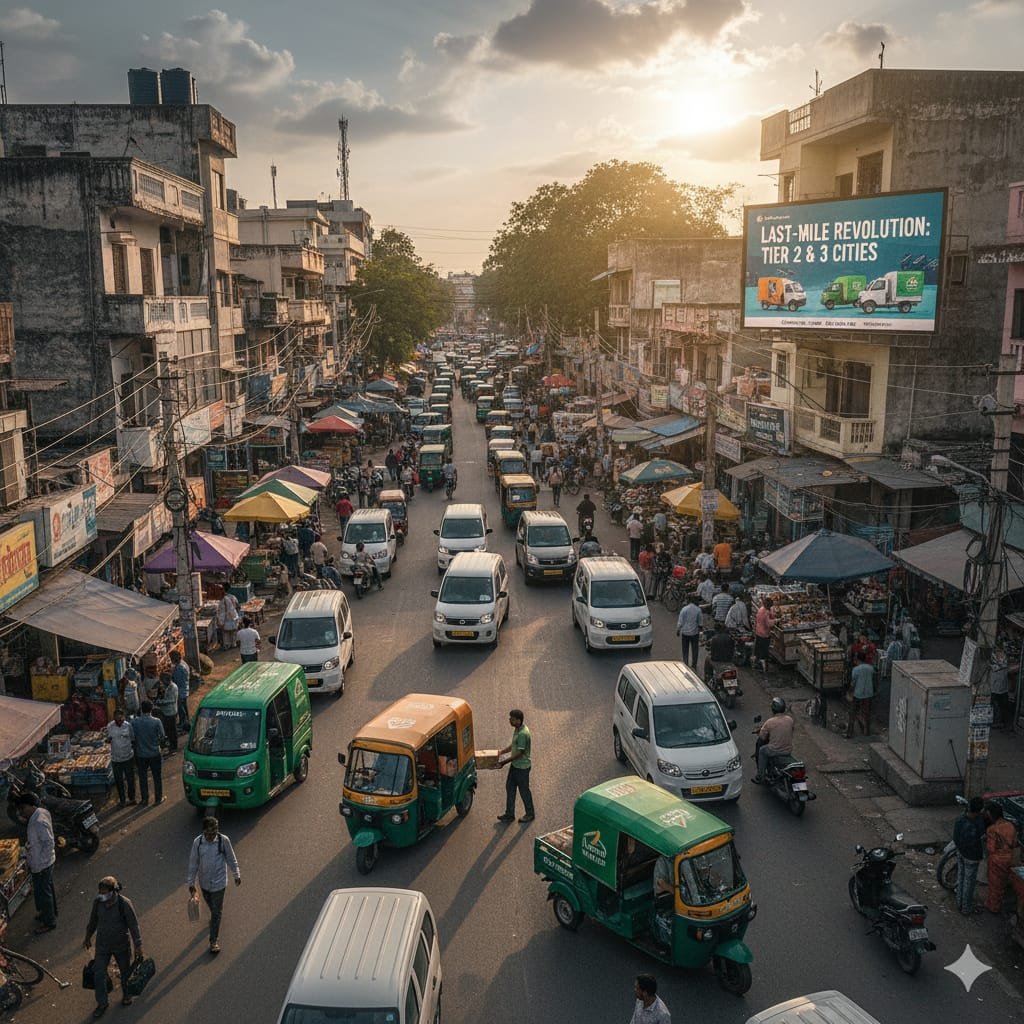
How small towns turned into the new delivery frontier
The landscape of online shopping and logistics in India is changing fast. What was once limited to big metros has now spread deep into Tier-2 and Tier-3 cities — people living in smaller towns are increasingly shopping online, and companies are responding. During the most recent festive season, a large share of online orders came from these smaller cities rather than metros, highlighting a shift in buying behaviour.
This shift isn’t just changing retail — it is transforming logistics. As orders pile up from small towns, businesses need reliable delivery infrastructure to reach customers quickly. That’s where last-mile delivery becomes critical, creating growing demand for small, agile commercial vehicles suited to the unique challenges of smaller cities.
Why SCVs are ideal for last-mile delivery in smaller towns
Enter the realm of a new generation of small commercial vehicles (SCVs) — mini-trucks, cargo three-wheelers, light vans — designed for agility, fuel efficiency, and navigating narrow or congested roads. The rapidly expanding e-commerce and Q-commerce (quick commerce) sectors are driving a surge in demand for such vehicles.
Smaller vehicles make sense where large trucks are impractical: narrow lanes, dense residential areas, often poorly planned roads — features common in many Tier-2 and Tier-3 towns. Light-footprint SCVs allow logistics providers to reach doorsteps efficiently, making them an ideal backbone for last-mile logistics.
Further, with growth in electric and low-cost cargo-three wheelers and small vans — sometimes encouraged by supportive policies — SCVs are becoming an economically viable and sustainable option for many delivery-focused businesses.
Logistics infrastructure evolution in smaller cities
The rise of last-mile delivery in Tier-2 and Tier-3 cities is not just about demand — supply-side infrastructure is catching up too. Many logistics providers are building hyperlocal warehousing and micro-fulfilment centers in smaller cities and suburbs, aimed at enabling faster delivery timelines (same-day or next-day).
Complementing that, advances in technology — route optimisation, address validation, local pickup/drop networks — help overcome logistical challenges common in smaller towns: unpredictable addresses, lack of well-defined roads, and less organised courier networks.
Together, these developments make last-mile delivery in smaller towns practical and cost-effective — boosting demand for SCVs that can reliably service dispersed and less-structured delivery zones.
Market numbers & growth outlook for SCVs
The demand isn’t speculative — the numbers back it up. A recent report estimates that India’s small commercial vehicle market will grow at a CAGR of about 7.6% between FY2025 and FY2032.
This growth is being driven heavily by rising e-commerce activity, expansion of logistics networks, and increased adoption of SCVs for last-mile and intra-city transport.
Moreover, with rising interest and policy support for electric commercial vehicles (e-CVs), many fleet operators are now opting for electric SCVs — especially for short-haul and last-mile delivery operations. This is not only about cost and convenience, but also about sustainability and lower operating costs over time.
What this means for businesses and fleet owners in smaller towns
- Opportunities for small fleet owners and entrepreneurs: For local business owners or SMEs, investing in SCVs becomes a viable way to enter logistics/transport — last-mile demand levels the playing field.
- Cost-effective delivery model: SCVs — especially electric or cargo-three wheelers — offer lower fuel or running costs and are easier to maintain compared to heavy trucks, improving margins and reliability.
- Better service & reach: Firms can reach areas earlier unreachable by larger vans or trucks — narrow lanes, residential enclaves, semi-urban and rural fringes — improving customer coverage.
- Sustainability & future-proofing: With increasing adoption of electric SCVs, fleet owners can future-proof their operations, aligning with growing regulatory and consumer focus on environment and efficiency.
Challenges to watch out for
Of course, the shift comes with hurdles: smaller cities often face infrastructural constraints — poorly maintained roads, inconsistent addresses, limited charging/servicing facilities (especially for e-SCVs). Logistics firms will need to adapt strategies for these constraints — for example, integrating local pickup-point networks, flexible delivery routing, and responsive customer communication.
Additionally, building a scalable and efficient last-mile delivery network requires investment in warehousing (micro-fulfilment centres), route-optimization software, trained delivery staff — which may be challenging for smaller players without adequate capital.
Finally, competition among logistics providers may intensify, and price pressures could squeeze profitability — so fleet owners and businesses must balance cost, efficiency, and service quality carefully.
Conclusion
The rise of last-mile delivery in India’s Tier-2 and Tier-3 cities is transforming how goods move — and reshaping demand for small commercial vehicles. As e-commerce and quick-commerce continue to grow, and infrastructure and logistics networks strengthen, SCVs are emerging as the backbone of delivery in smaller towns. For businesses, entrepreneurs, and fleet owners, this is a substantial opportunity — one that promises scalability, cost savings, wide reach, and long-term growth.
Small towns aren’t just buyers anymore — they’re driving the next wave of logistics growth. And for fleet owners tuned to this wave, SCVs may well be the smartest bet for tomorrow’s delivery-driven India.