
News List
China’s Electric Trucks Surge Reshapes Global Diesel Demand

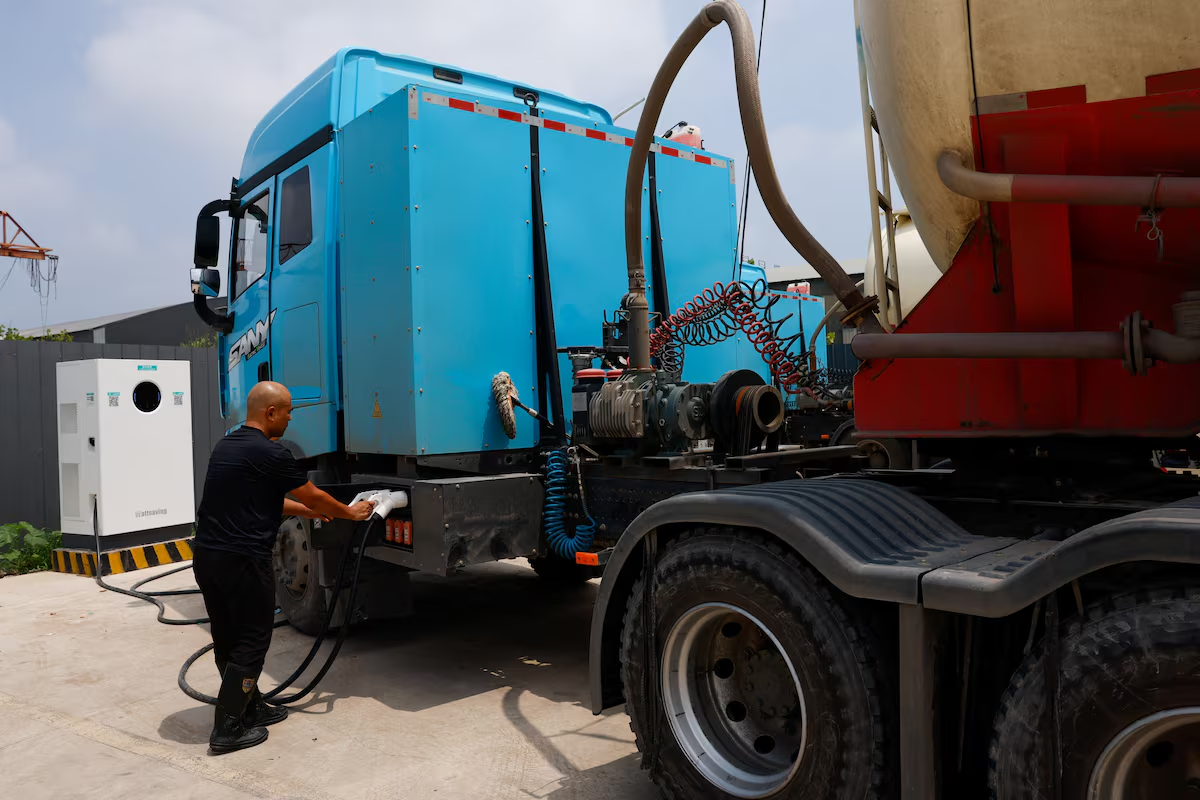
As global climate negotiations at forums like COP30 slow and emissions targets drift further from reach, an unexpected transformation is unfolding on China’s highways. The country is witnessing an explosive rise in electric heavy trucks — a shift so significant that analysts say it is already rewriting global diesel demand projections and could reshape long-term energy trends.
According to the International Energy Agency (IEA), worldwide sales of medium- and heavy-duty electric trucks more than doubled between 2023 and 2024. China accounted for over 80 per cent of these purchases, pushing global sales past 90,000 units in 2024. The pace has only intensified this year.
The change is stark when compared to just a few years ago. In 2020, China’s truck market was almost entirely diesel-driven. By the first half of 2025, battery-powered trucks captured 22 per cent of new heavy-truck sales — up from 9.2 per cent in the same period of 2024, according to data from Beijing-based Commercial Vehicle World. Another report by Sublime China Information (SCI) estimated that sales of “new energy” trucks surged 175 per cent year-on-year to 76,100 units in the first half of 2025.
British research firm BMI projects that electric trucks will make up 46 per cent of new truck sales in China this year and nearly 60 per cent next year. This comes as freight trucks continue to remain one of the biggest contributors to carbon emissions, accounting for nearly a third of transport-related emissions in 2024.
Long seen as hard to decarbonise due to battery weight and cargo limitations, the sector is now undergoing a rapid technological shift. A Reuters report noted that in early 2025, electric and other “new energy” trucks made up roughly a quarter of all new registrations, and in several months, electric models even outsold LNG-powered trucks.
The acceleration is already denting fuel consumption. China’s diesel use dropped to 3.9 million barrels per day in June 2024 — an 11 per cent year-on-year fall — with the US Energy Information Administration pointing to the rise of LNG and electric trucks as a key factor. The Rhodium Group estimates that electric trucks in China are already reducing oil demand by the equivalent of more than one million barrels per day.
Looking ahead, energy consultancy Rystad expects China’s transport sector to cut diesel use by 40 per cent by 2030, reducing national diesel consumption by a quarter compared to 2024 levels. SCI forecasts an 11.3-million-ton (6.3 per cent) drop in diesel demand this year alone.
This rapid transition has been fuelled by strong policy support, including a 2024 incentive scheme offering up to US$19,000 for replacing older diesel trucks. Massive investments in charging infrastructure, battery-swapping networks by companies like CATL, and dedicated charging hubs in major logistics regions have helped accelerate adoption.
With domestic momentum soaring, China is now preparing for a major export push. McKinsey data shows heavy-duty truck exports — including EVs — to regions such as the Middle East, North Africa and Latin America surged between 2021 and 2023. Manufacturers like Sany and BYD are gearing up for larger global entry, with new factories and export plans targeting Europe, India, the UAE and beyond.
China’s rapid electrification of heavy trucking is not only transforming its own freight landscape — it is reshaping the global energy and automotive market in real time.