
News List
India’s HCV vs MCV vs LCV Market in 2025 — which truck segment is growing fastest and why it matters for buyers

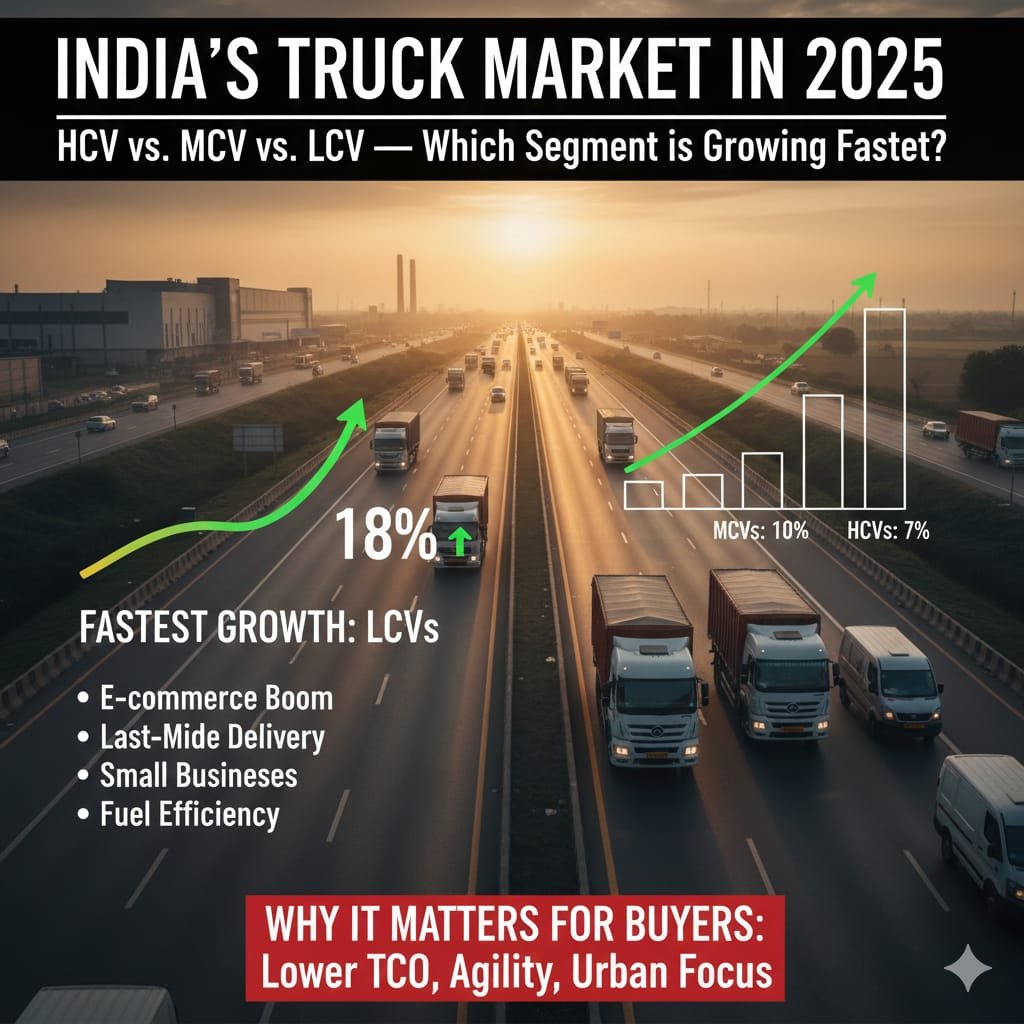
The commercial-vehicle (CV) market in India is shifting — and not all segments are growing equally. As of late 2025, data show clear winners and some laggards among heavy, medium and light commercial vehicles.
What the numbers say
- In October 2025, total CV retail sales hit 1,07,841 units — up 17.7% year-on-year.
- Light Commercial Vehicles (LCV) led the surge: 72,948 units sold — nearly 30% growth YoY.
- Medium Commercial Vehicles (MCV) also posted healthy gains — 7,177 units, about 20% higher than a year earlier.
- Meanwhile, Heavy Commercial Vehicles (HCV) saw a dip: 27,685 units in October 2025, down roughly 5.8% YoY.
- In the first half of FY26, the modest overall CV sales growth (~2%) came mainly on account of LCV and MCV — HCV demand remained soft.
In short: LCV is growing fastest, followed by MCV, while HCV is lagging in retail sales for now.
Why LCV and MCV Are Outpacing HCV
Several structural and demand-side factors are driving this divergence:
1. Surge in last-mile logistics, e-commerce & intra-city freight
Urbanisation, expanding e-commerce and growing demand for small-scale logistics and distribution in tier-2/3 towns have fuelled the need for smaller, more fuel-efficient trucks. LCVs — agile, easier to manoeuvre and cheaper to operate — are the ideal fit.
2. Rural and semi-urban demand, agri and small-business delivery
MCVs are benefitting from increasing regional freight traffic: agricultural produce delivery, building materials, small manufacturing units and trade between towns. These mid-size trucks balance payload capacity and operating cost, making them attractive for small to medium logistics operators.
3. Cost, efficiency and regulatory factors
Rising fuel costs, tightening emissions norms, and higher running cost for heavy trucks make LCV and MCV more attractive, especially for smaller operators. For smaller loads and shorter distances, lighter trucks offer better mileage and lower maintenance costs.
4. Fleet renewal and replacement demand in segments where resale value and financing are friendlier
Smaller CVs typically have lower acquisition cost and easier financing access. Replacement cycles or first-time buyers — small transporters, kirana-store suppliers, rural distributors — are naturally gravitating to LCV/MCV over HCV.
5. Softness in big-ticket, long-haul freight demand
HCV segment — used for bulk cargo, long-haul freight, infrastructure and large-scale logistics — seems to face more uncertainty. Delays in large infrastructure projects, variable demand for bulk freight, and high operating costs could be suppressing heavy-duty truck uptake for now.
What this means for Buyers — Choosing the Right Truck in 2025
If you’re a small transporter, farmer, trader or logistics operator:
- Choose LCV if you are dealing in short-distance delivery, last-mile logistics, local trading, or small-load transport. Their lower capital cost, better fuel efficiency and ease of maintenance make them ideal for first-time buyers or small fleets.
- Go MCV if you need more payload than LCV but don’t need heavy-duty range — for regional transport, construction material delivery, agri-produce distribution, or intra-state freight.
- Opt for HCV only if your business requires heavy-load haulage over long distances, bulk cargo transport or you have contracts needing large volumes — but be wary of higher costs, lower immediate demand, and longer payback periods.
- Keep an eye on market trends — if infrastructure activity picks up and freight demand stabilises, HCV might rebound. But as of now, flexibility + cost-efficiency make LCVs and MCVs seem like the safer bet for smaller businesses.
Why It Matters at a Bigger Level
- The shift toward LCV/MCV reflects changing logistics patterns in India — smaller consignments, more frequent deliveries, and growth of e-commerce, rural trade and micro-businesses.
- It signals democratisation of trucking — more small entrepreneurs can buy and operate trucks; transport business is no longer limited to large fleet owners.
- For manufacturers and financiers, demand shape is shifting — they must prioritise cost-efficient, smaller CV models, provide financing for light/mid-size trucks, and tweak offerings to match evolving buyer needs.
- For policy-makers, growing LCV/MCV adoption means more emphasis on urban and semi-urban infrastructure, last-mile logistics, and supporting small transporters — which could influence road planning, tax structures and emission regulations.
In 2025, India’s CV market isn’t just about big trucks anymore. The fastest growth is coming from light and medium trucks — and that’s a signal that logistics, trade and transport are getting decentralised, localised and more accessible. For anyone looking to enter transport or logistics, or upgrade their fleet, LCVs and MCVs offer the most attractive balance of cost, flexibility and opportunity.