
News List
ABB E-mobility Unveils M-Series Split System Charging Infrastructure

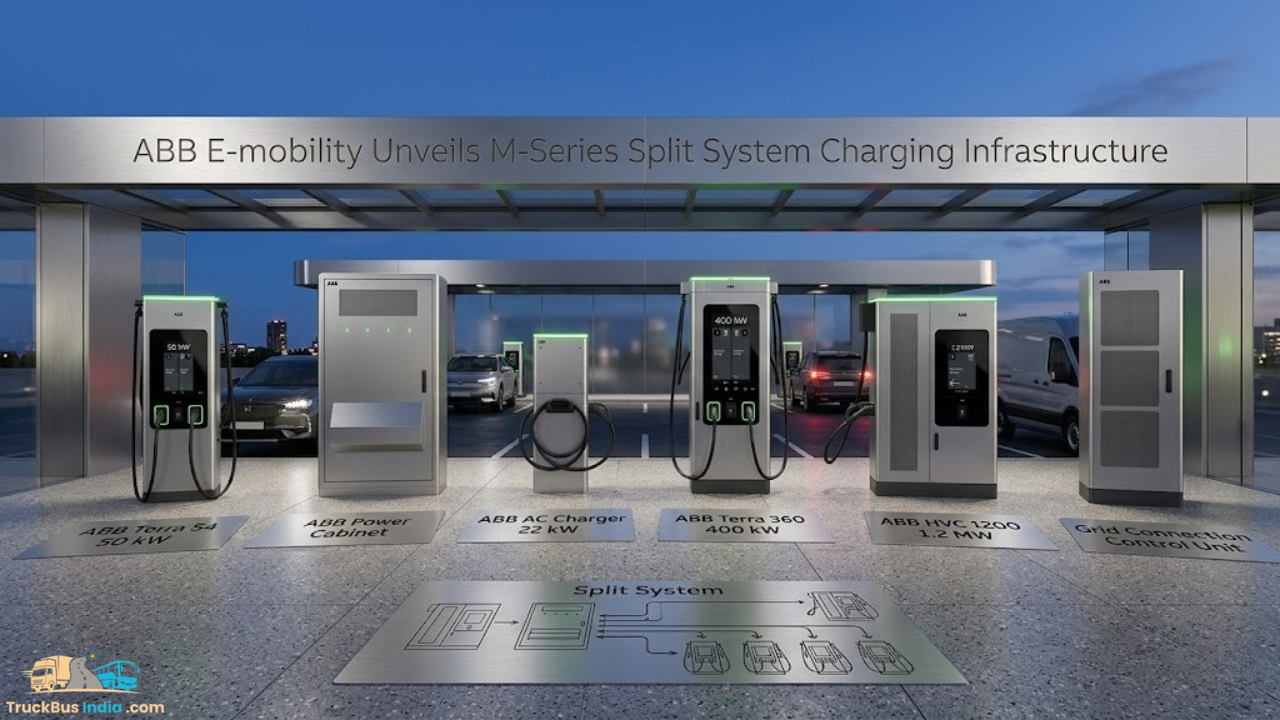
ABB E-mobility has introduced its latest M-Series split system charging infrastructure, marking a significant shift in how electric vehicle charging networks are designed and deployed.
Launched in Zurich on April 23, 2026, the new system focuses on flexibility, scalability, and efficient power distribution across multiple charging points.
Modular architecture redefines EV charging efficiency
The M-Series charging infrastructure is built on a modular, air-cooled split system that separates power generation from power dispensing. This allows operators to customise installations based on real-world usage patterns rather than fixed configurations.
At the core of the system are centralized power cabinets connected to a range of dispensers such as Solo, Duo, Dock, and Ultra. These dispensers support multiple charging standards including CCS1, CCS2, NACS, and MCS, ensuring compatibility with a wide range of electric vehicles.
A key highlight is the system’s ability to dynamically allocate power. Instead of assigning fixed output to each charger, the infrastructure treats total installed capacity as a shared resource. This enables real-time distribution of energy depending on demand, improving efficiency and reducing idle capacity.
Scalable power capacity and compact footprint
ABB’s M-Series system offers scalable power ranging from 200 kW to 1.2 MW, supporting up to 24 charge points simultaneously. Operators can expand capacity in the field with 400 kW increments by connecting up to three cabinets.
Despite its high output, the system maintains a compact design with a power density of 625 kW per square meter. This makes it suitable for locations where space is limited or land costs are high.
Designed for diverse charging environments
The M-Series charging infrastructure targets three key segments: public fast charging corridors, retail and hospitality destinations, and commercial fleet depots.
This flexibility allows operators to deploy the system across various use cases without major redesigns.
The hardware integrates with ABB’s asset operations platform, enabling AI-driven fault detection and efficient field service management.
Additionally, it supports optional AC-coupled battery storage, which helps in peak load management and improves overall site energy flexibility.
Industry shift towards smarter energy delivery
According to ABB E-mobility CEO Michael Halbherr, the industry is moving beyond installed capacity metrics and focusing on the lifetime cost of energy delivered.
The M-Series system is designed to consistently deliver optimal performance across different vehicle types, charging setups, and usage levels.
This approach reflects a broader transition in EV infrastructure, where adaptability and energy efficiency are becoming more critical than raw charging speed alone.