
News List
Gadkari Pushes India Toward 100% Ethanol Blending

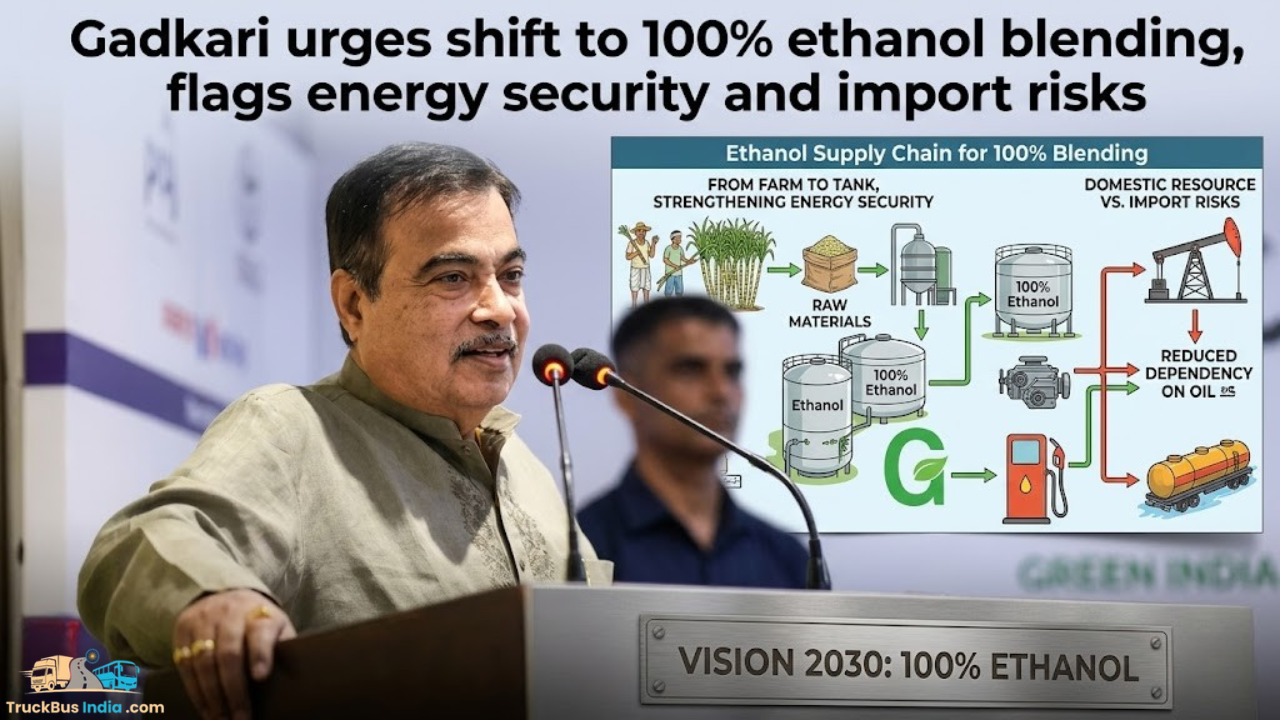
Road Transport and Highways Minister Nitin Gadkari has urged India to move toward 100% ethanol blending in petrol as part of a broader strategy to strengthen energy self-reliance.
Speaking at the Green Transport Conclave, he highlighted that global energy instability, especially the ongoing crisis in West Asia, has exposed India’s dependence on imported fossil fuels. He stressed that accelerating alternative fuel adoption is now essential for both energy security and environmental sustainability.
Energy Security Push Amid West Asia Crisis
Gadkari emphasized that the current geopolitical situation in West Asia has made India’s oil import dependency more vulnerable.
With nearly 87% of crude oil requirements being imported, he said the country must reduce exposure to external supply shocks.
According to him, the energy crisis triggered by global conflicts reinforces the need for India to transition toward domestic fuel alternatives and reduce reliance on traditional petroleum sources.
Ethanol Blending Strategy for Fuel Independence
The minister advocated scaling ethanol blending beyond the current E20 level, where petrol contains 20% ethanol.
He stated that India should aim for 100% ethanol blending in the near future, following examples set by countries like Brazil. The transition would require vehicle compatibility improvements and broader infrastructure readiness, but he noted that it would significantly reduce import costs and strengthen long-term energy independence.
Biofuel Expansion and Farmer Benefits
Gadkari also highlighted the economic and environmental benefits of biofuels, stating that India imports fossil fuels worth around ₹22 lakh crore annually.
He said increasing biofuel production can reduce pollution while supporting rural incomes. Ethanol derived from crops like maize has already helped farmers earn better prices, contributing to gains estimated at ₹45,000 crore.
He emphasized that expanding biofuel production would create stronger links between agriculture and the energy sector.
Green Hydrogen and Circular Economy Focus
Looking ahead, Gadkari pointed to green hydrogen as a key future energy source but acknowledged challenges related to cost and transportation.
He suggested that hydrogen must become more affordable, with production targets of around $1 per kilogram to make India a potential exporter. He also encouraged exploring hydrogen production from waste materials as part of a circular economy model that can generate employment while reducing environmental impact.
Automotive Sector and Fuel Transition Challenges
While promoting cleaner fuels, Gadkari clarified that consumers should not be forced to abandon petrol and diesel vehicles. He noted that industry resistance and concerns around ethanol blending, particularly E20 fuel, continue to be debated within the automotive sector.
He urged manufacturers to focus on quality improvements rather than cost reduction alone to ensure smoother adoption of alternative fuel technologies in the long run.