
News List
Armed Forces Push Biogas And Solar To Cut Fuel Use Amid Global Energy Crisis

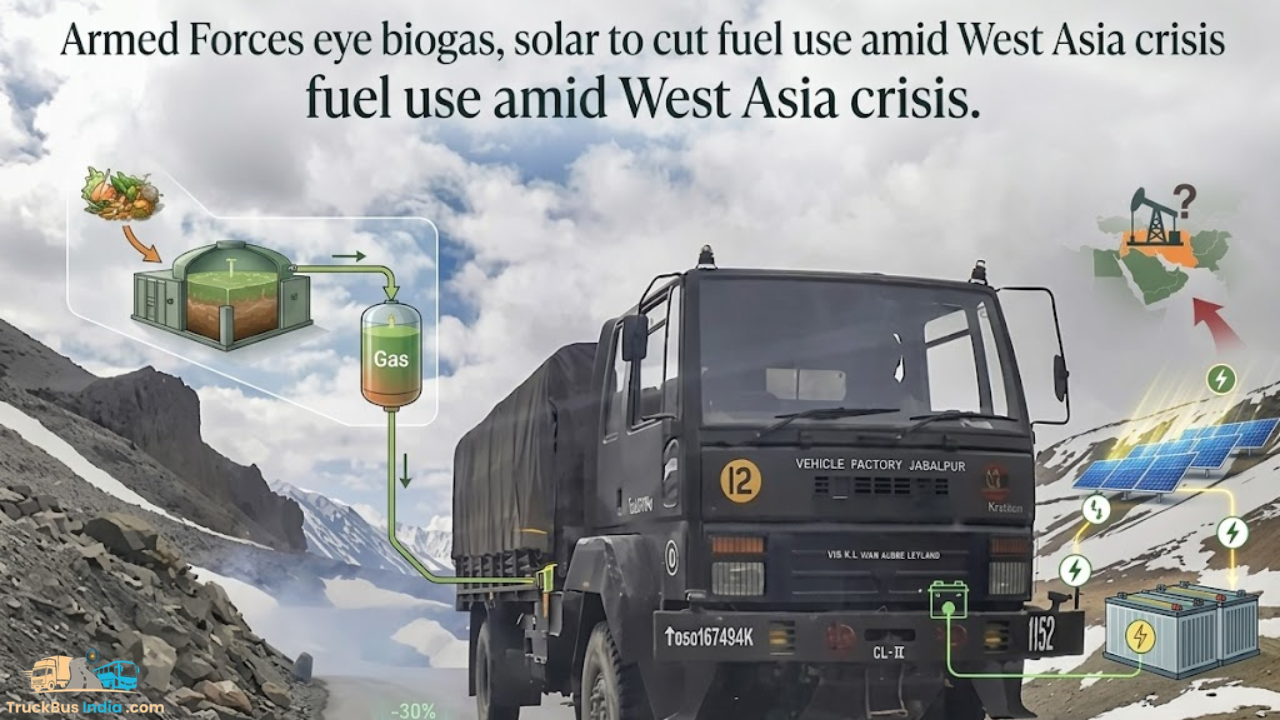
India’s Armed Forces are accelerating plans to reduce dependence on conventional fuels such as LPG and diesel as global energy pressures rise due to ongoing geopolitical tensions in West Asia. The move focuses on adopting biogas, solar, wind energy, and improved logistics efficiency to cut fuel consumption while maintaining operational readiness.
The initiative comes at a time when fuel supply disruptions and price volatility have increased concerns over long-term energy security across sectors, including defence operations.
Biogas And Alternative Energy In Armed Forces India Strategy
The biogas Armed Forces India strategy is being expanded as part of short-term fuel conservation efforts. The Army is preparing to procure biogas stoves, which are expected to reduce dependence on Liquefied Petroleum Gas used in military cookhouses.
Each soldier is currently authorised about 125–135 grams of cooking gas per day, and the Army consumes approximately 156,000 kilograms of LPG daily. Officials estimate that biogas adoption alone could help save nearly 20 percent of this consumption, translating to around 30,000 kilograms per day.
Biogas Stove Procurement Plans Underway
Orders for biogas stoves are in the pipeline and will be initiated soon as part of fuel-saving measures.
LPG Reduction Targets Across Army Units
The Army is focusing on cutting LPG use in cookhouses that serve 125 to 150 personnel per unit across multiple field and peace locations.
Solar And Wind Energy Armed Forces India Expansion Plans
The solar Armed Forces India expansion plans include scaling renewable energy use across defence establishments. Over the next few months, solar and wind energy systems are expected to play a larger role in reducing dependency on conventional fuel sources.
Previously, the Armed Forces have already begun integrating renewable solutions in remote regions, including a solar hydrogen-based microgrid in Ladakh that provides 200kW of round-the-clock power, replacing diesel generator sets at off-grid locations.
Solar Microgrid Projects In Remote Areas
Defence installations in high-altitude regions are being equipped with hybrid renewable systems to ensure continuous power supply.
Green Energy On Defence Land Assets
Around 46,000 acres of unutilised defence land are being explored for solar plants, biogas units, and afforestation projects aimed at generating carbon credits.
Military Logistics Fuel Efficiency India Rail Transport Shift
The military logistics fuel efficiency India rail transport shift is another key focus area. Officials are considering restricting movement of large Army convoys for administrative purposes to within 400 kilometres, while shifting longer-distance transport to rail networks.
This change is intended to reduce fuel consumption from over 200,000 military vehicles used for administration, training, logistics, and troop movement.
Convoy Movement Restrictions Under Review
Limits on routine vehicle movement are being discussed to reduce unnecessary fuel usage without affecting operational readiness.
Rail-Based Transport For Long Distances
Railways may be increasingly used for transporting troops, rations, and equipment beyond 400 kilometres.
Defence Fuel Conservation India West Asia Crisis Response
The defence fuel conservation India West Asia crisis response reflects broader concerns over global energy instability triggered by conflict in the region. While operational military flying will not be impacted, routine missions may be optimised to reduce fuel consumption.
Officials have clarified that critical operations such as reconnaissance, casualty evacuation, and emergency troop deployment will continue without restriction. However, non-essential movement and logistics operations are being reviewed for efficiency gains.
Conclusion
India’s Armed Forces are adopting a multi-layered approach to fuel conservation, combining renewable energy, alternative fuels, and logistics optimisation. The shift towards biogas, solar energy, and rail-based transport reflects a long-term strategy to reduce dependency on conventional fuels while maintaining operational effectiveness during global energy uncertainty.