
News List
India Electric Bus Market Growth, Key Players Rise

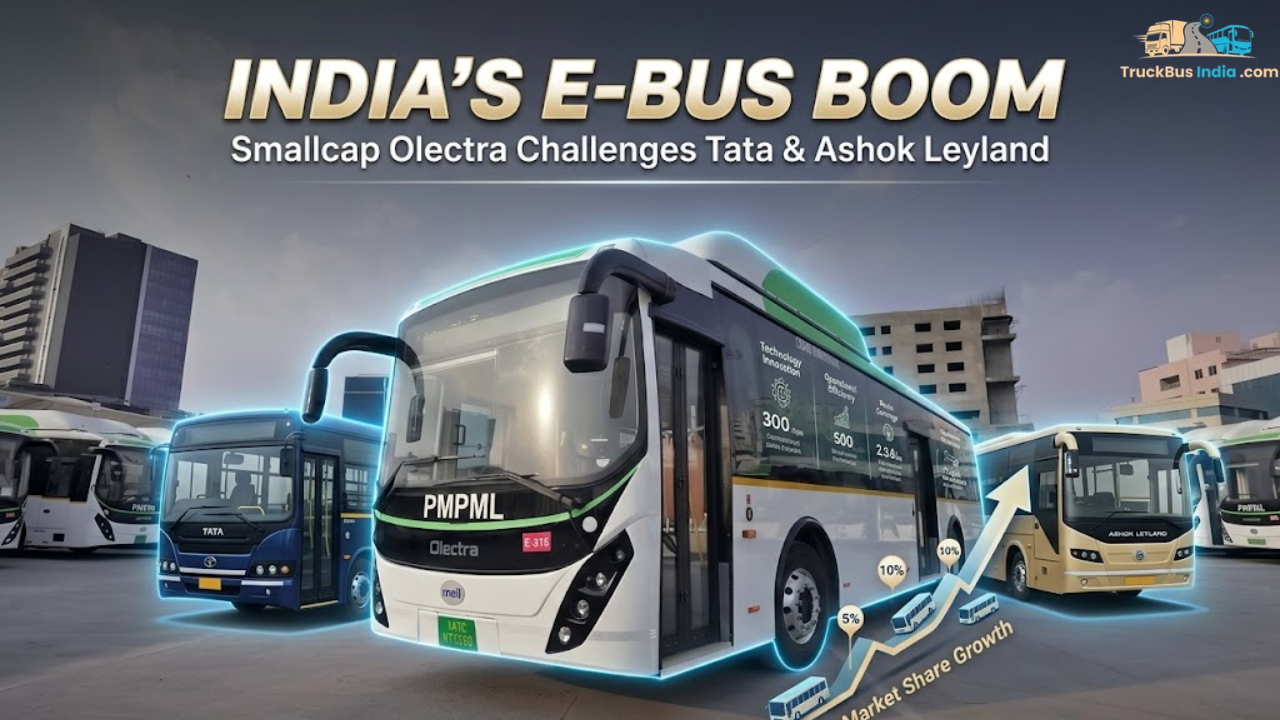
The electric bus market in India is at an early but fast-growing stage, driven by electrification policies, rising urban mobility needs, and increasing adoption by state transport undertakings. The market is estimated at USD 1.41 billion in 2026 and is projected to reach USD 2.4–2.9 billion by 2030, expanding at a CAGR of 14–20%.
India already had over 9,700 electric buses deployed by 2024, with growth momentum exceeding 60% CAGR in early years. Electric buses currently account for around 4.5% of total bus sales in FY26, reflecting steady penetration in the commercial transport ecosystem.
Globally, the electric bus market is much larger, valued between USD 32–62 billion in 2024–2025 and expected to cross USD 200 billion by 2035. China leads the segment, while India, Europe, and Latin America are emerging as strong growth regions.
India Electric Bus Market Growth Outlook
The electric bus market in India is expected to maintain strong expansion but with improving competition and execution challenges shaping future growth. Demand is being driven by government procurement programs, urban fleet electrification, and replacement of diesel buses.
However, the market is still evolving and remains sensitive to supply chain costs, battery pricing, and infrastructure readiness. Despite these challenges, long-term visibility remains strong due to policy support and transport decarbonisation goals.
Olectra Greentech’s Position in Electric Bus Market
Olectra Greentech has emerged as one of the most aggressive challengers in the electric bus market, operating under the MEIL Group. The company focuses on electric buses and polymer insulators, with models including V2, IX, X2, and CX2.
It has also developed India’s first electric tipper under Meghaetron and maintains strong partnerships, including BYD, which has been extended until 2030.
The company’s client base includes major transport undertakings such as TGSRTC, BEST Mumbai, PMPML Pune, Surat Municipal Corporation, and others. In the power segment, it serves large infrastructure clients like Power Grid Corporation of India and Larsen & Toubro.
In FY26, Olectra secured a ₹1,800 crore order from Telangana State Road Transport Corporation for 1,085 electric buses. It also received a ₹497 crore order from Himachal Road Transport Corporation.
To support expansion, the company launched its Seetharampur facility in Telangana with a planned capacity of 2,500 buses in Phase 1.
Financially, Olectra reported ₹664 crore revenue in Q3 FY26, with net profit at ₹47 crore, impacted by rising costs and execution pressures.
Ashok Leyland’s Expansion in Electric Bus Market
Ashok Leyland, part of the Hinduja Group, is one of the strongest incumbents in the electric bus market through its EV subsidiaries Switch Mobility and OHM Global Mobility.
The company has deployed over 2,000 electric buses globally and sold 1,466 units in FY26, achieving a 24.8% market share in the segment. It has also benefited from large State Transport Undertaking contracts, particularly in Tamil Nadu.
The company expanded its EV footprint by launching a manufacturing plant in Lucknow with a capacity of 2,500 buses per year, scalable to 5,000 units.
Ashok Leyland is also expanding internationally, securing orders from Europe and Bhutan while strengthening production through its UAE operations.
Financially, the company reported ₹14,830 crore revenue in Q3 FY26 and ₹862 crore net profit, supported by strong commercial vehicle demand and improving margins.
Competitive Landscape and Investor Outlook
The electric bus market is witnessing clear segmentation between pure-play EV companies and diversified automakers.
Olectra Greentech represents a high-growth but higher-risk investment option, driven by strong order inflows and rapid expansion but facing margin pressure due to rising input and execution costs.
Ashok Leyland offers a more balanced profile with stable cash flows from its core business while gradually scaling its EV operations.
Other players like Tata Motors and JBM Auto remain important but operate at different valuation and efficiency levels, reflecting varied strategies in the evolving market.
Overall, investor focus is shifting toward execution strength, order conversion, and long-term profitability rather than just headline growth.
Conclusion
The electric bus market in India is entering a strong expansion phase with significant long-term potential. While Olectra Greentech is driving aggressive growth through orders and partnerships, Ashok Leyland is building a stable and scalable EV transition model.
The sector offers both high-growth opportunities and execution risks, making it essential for investors to focus on fundamentals, policy support, and operational efficiency rather than short-term momentum.