
News List
India Electric CV Segment Doubles, E3W Market Deepens in FY26

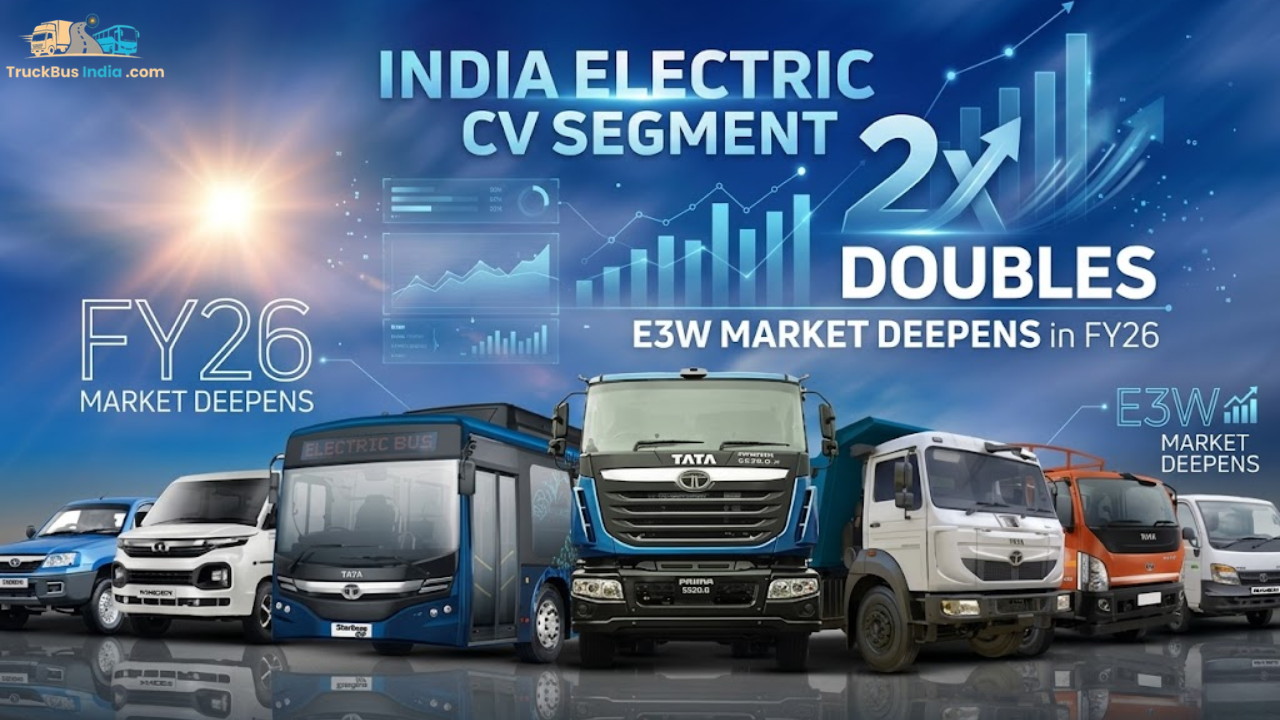
India’s electric commercial vehicle transition gained strong momentum in FY26, with the segment entering a high-growth phase supported by rising adoption, improving infrastructure, and expanding product offerings. Both electric CVs and electric three-wheelers (E3Ws) showed significant expansion, although with differing maturity levels and competitive dynamics.
Electric CV market crosses high-growth milestone in FY26
India’s electric commercial vehicle market more than doubled in FY26, reaching 19,454 retail units, a 120.6 percent year-on-year increase compared to 8,820 units in FY25. EV penetration in the CV segment also improved from 0.93 percent to 1.83 percent, reflecting gradual electrification across cargo and passenger mobility.
Tata Motors maintains leadership in electric CVs
Tata Motors continued to dominate the electric CV segment with 6,023 units in FY26, growing 40.4 percent year-on-year. Its early investments, strong product lineup, and expanding ecosystem in small commercial vehicles helped it retain leadership.
Mahindra Group expands last-mile electric mobility
The Mahindra Group emerged as a strong challenger, recording nearly 5,773 units across its electric mobility businesses. Mahindra Last Mile Mobility contributed 2,885 units, posting over 239 percent growth, driven by rising demand for electrified last-mile transport solutions.
Strong growth from fleet and bus-focused manufacturers
Switch Mobility recorded 2,255 units with 153.7 percent growth, supported by electric bus and fleet solutions. Euler Motors stood out with a sharp rise to 2,093 units, reflecting rapid adoption in urban logistics and e-commerce delivery segments.
PMI Electro Mobility and JBM Auto also posted strong triple-digit growth, reinforcing increasing electrification in public transport. Olectra Greentech reported 903 units with 21.5 percent growth, indicating a more stable phase of expansion.
VECV delivered strong momentum with 701 units and 274.9 percent growth, while Tivolt Electric Vehicles, Pinnacle Mobility, and IPL Tech Electric added further depth to the market. New entrants such as Jaidka Power Systems and Energy In Motion also contributed to the expanding EV ecosystem.
Key takeaways from electric CV market FY26
- Market more than doubled to 19,454 units, showing strong early-stage expansion
- EV penetration improved to 1.83 percent, still low but steadily rising
- Tata Motors remains the clear leader with early ecosystem advantage
- Mahindra and Euler Motors are emerging as strong challengers in last-mile EVs
- Public transport electrification is accelerating through bus-focused players
- Competition is widening with new entrants increasing market fragmentation
Electric three-wheeler market deepens and matures
India’s electric three-wheeler market continues to lead the EV transition, with penetration rising to 60.9 percent in FY26 from 57.2 percent in FY25. Total volumes increased to 8.3 lakh units, growing 18.9 percent year-on-year.
Mahindra leads E3W segment with strong growth
Mahindra Group remained the market leader, crossing 1,01,873 units in FY26. Mahindra Last Mile Mobility alone accounted for over 1 lakh units, reinforcing its dominance in both passenger and cargo electric three-wheelers.
Bajaj Auto strengthens competitive position
Bajaj Auto emerged as a strong challenger with 89,604 units and 76.2 percent growth. Its aggressive expansion strategy has significantly increased its presence in the electric three-wheeler segment.
TVS Motor shows rapid scale-up from low base
TVS Motor Company recorded one of the fastest growth rates, reaching 27,831 units from a low base of 1,696 units. This sharp rise highlights its successful entry and scaling in the E3W market.
Mixed performance among traditional and emerging players
Piaggio and several legacy players such as YC Electric, Saera Electric, and Dilli Electric Auto reported declines, reflecting rising competitive pressure. At the same time, Zeniak Innovation, Hooghly Motors, and Aahana Commerce posted strong growth, indicating increasing fragmentation and new entry momentum.
The “Others” category accounted for over 4.2 lakh units, growing 9.4 percent, underlining the highly fragmented nature of the segment.
India EV CV and E3W markets show diverging maturity levels
The electric CV segment is still in early high-growth expansion, driven by fleet adoption and infrastructure electrification. In contrast, the E3W market has reached a more mature stage, where competition, consolidation, and scale are becoming key differentiators.
Conclusion
India’s electric CV and E3W markets are evolving rapidly but along different trajectories. While electric CVs are scaling from a low base, E3Ws are entering a consolidation phase marked by intense competition. Together, both segments highlight the accelerating transition toward electric mobility in India’s commercial transport ecosystem.