
News List
South Korea Tightens Subsidies On Chinese Electric Buses

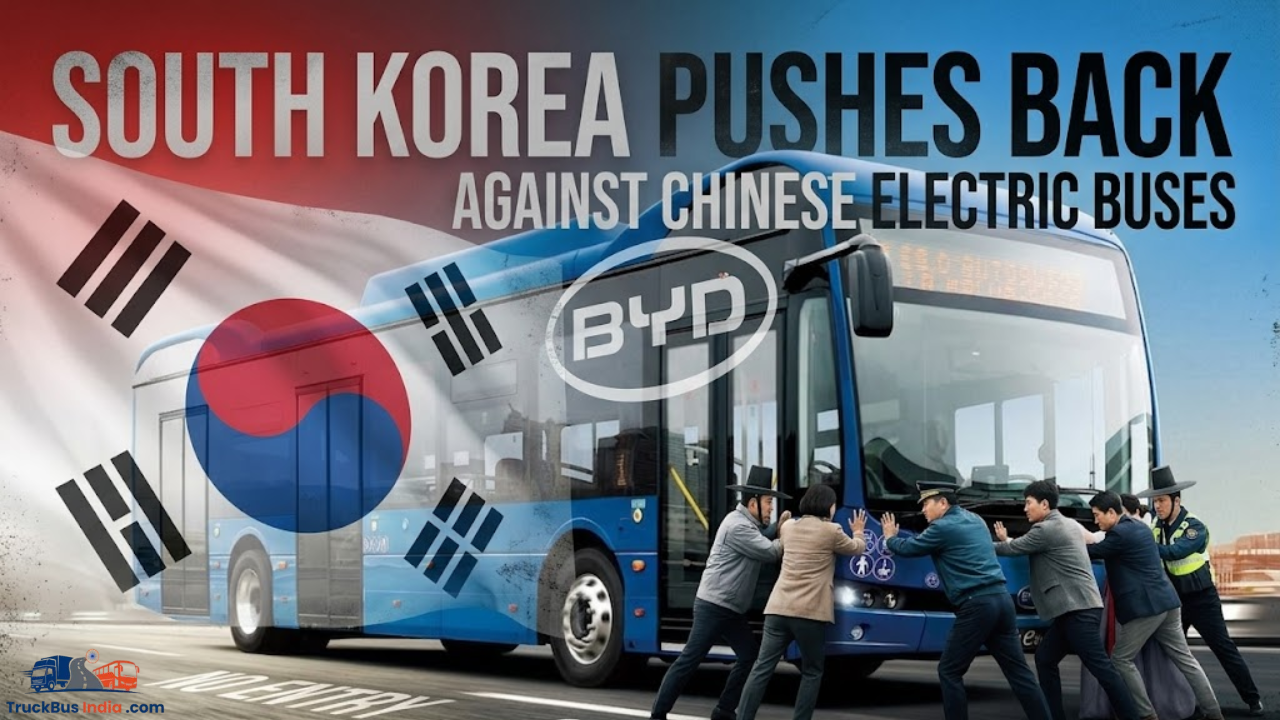
South Korea has introduced stricter subsidy rules for electric buses, making it more challenging for Chinese manufacturers to compete in its public transport market. Instead of imposing a direct ban, the government has revised subsidy guidelines, placing strong emphasis on battery performance.
The updated policy is expected to reshape competition in the electric bus segment while favouring domestic players.
South Korea Electric Bus Subsidy Rules Revised
The Ministry of Land, Infrastructure and Transport has updated subsidy conditions for battery-electric buses purchased by public transport operators. The focus is now on battery energy density, which determines how much financial support a vehicle can receive.
Earlier, a flat subsidy of 87 million Won was offered per low-floor electric bus. Under the new framework, subsidies can go up to 90 million Won per bus. However, this increase comes with stricter eligibility requirements linked to battery performance.
Battery Energy Density Becomes Key Factor
The revised South Korea electric bus subsidy rules introduce a differentiation coefficient that directly impacts funding. Electric buses must now meet a battery energy density of over 500 Wh/L to qualify for full subsidies.
This benchmark is typically achieved by nickel-cobalt-manganese batteries produced by domestic companies such as LG Energy Solution, SK On, and Samsung SDI. Batteries with 365 Wh/L or lower will see subsidies significantly reduced, with only a 0.4 factor applied.
This shift makes battery specifications the deciding factor in subsidy allocation.
Chinese Electric Buses Face Major Setback
The new rules are expected to hit Chinese electric bus manufacturers such as BYD, Higer, and Zhongtong. Most of their vehicles use lithium iron phosphate batteries, which generally fall into the lower energy density range.
As a result, subsidies for these electric buses will effectively be more than halved. This makes them less attractive for public transport operators, despite their earlier strong presence in the South Korean market, where they held around 34 percent share.
Safety Concerns And Market Shift
The policy shift also reflects growing safety concerns around battery technology. In 2024, a fire involving a Mercedes EQE with batteries from Farasis Energy in an underground parking facility in Incheon raised alarms.
Following the incident, authorities urged carmakers to disclose battery suppliers. Since then, consumer sentiment has shifted, with some buyers avoiding vehicles using Chinese batteries.
This trend has influenced automakers as well. Porsche recently announced that it will sell only electric vehicles equipped with South Korean battery cells in the country, as they are perceived as safer by parts of the population.
Conclusion
South Korea’s updated subsidy rules for electric buses signal a strategic push towards higher battery standards and stronger domestic manufacturing. While not a direct restriction, the policy creates significant hurdles for Chinese electric bus makers and is likely to reshape the competitive landscape in the coming years.