
News List
Tyre makers move up value chain via Tamil Nadu

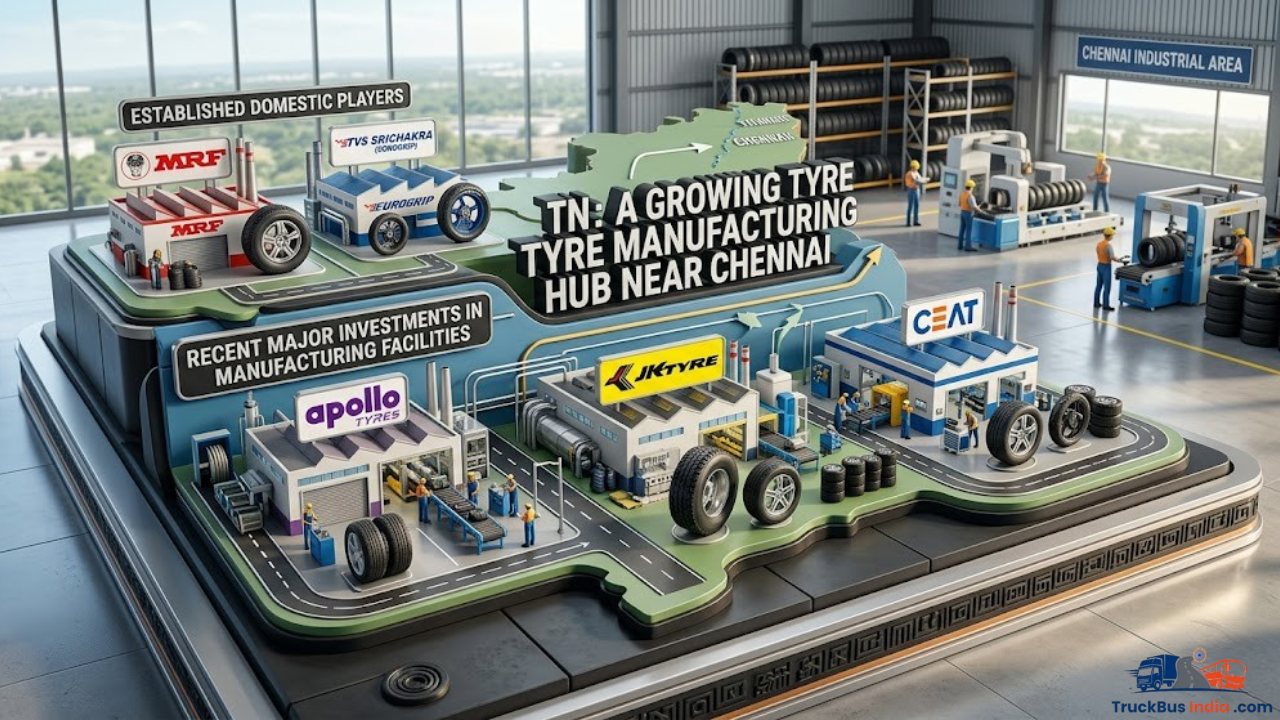
Tamil Nadu has emerged as a dominant force in India’s tyre industry, establishing itself as a strategic hub for both domestic and global players. Over the past few years, particularly in FY26, the state’s tyre sector has seen robust growth, driven by capacity expansion, technological upgrades, and rising exports. Today, Tamil Nadu accounts for nearly a quarter of India’s tyre exports.
Domestic Tyre Leaders Expand in Chennai
While the state has long hosted tyre giants like MRF and TVS Srichakra (Eurogrip), other major Indian manufacturers—including Apollo Tyres, JK Tyre, and CEAT—have significantly invested in Chennai-based facilities. These three companies collectively invested around ₹12,000 crore, with CEAT undertaking a fresh expansion worth ₹1,314 crore.
Apollo Tyres’ Oragadam plant has become a flagship facility, producing premium radial tyres for both passenger vehicles and commercial segments. With investments of approximately ₹5,500 crore, the plant has an annual output of 5.4 million passenger car tyres and 4.4 million truck and bus tyres. The company is now placing greater emphasis on R&D in Chennai to further boost innovation and technological advancements.
JK Tyre’s Chennai facility contributes roughly 26% of the company’s production and revenue. With investments exceeding ₹2,600 crore, the plant has a daily capacity of 350 tonnes for passenger and commercial tyres. Recent upgrades have focused on premium products and sustainability, incorporating up to 80% recycled materials in tyre production.
CEAT is expanding its Chennai operations with a ₹1,314 crore capex plan, set to complete in phases by FY28. This expansion will add capacity for 3.5 million passenger car tyres, along with AI and IoT-driven production for truck and bus radial tyres. The plant’s range has grown from 100 tyre types in 2020 to nearly 350 today.
Global Players Strengthen Presence
International tyre makers are also deepening their investments in Tamil Nadu. Michelin has positioned its Thervoy Kandigai facility as a key global hub, investing around ₹3,400 crore. The plant now produces approximately 54,000 tonnes of tyres annually across passenger, truck, and bus segments, and has expanded both in scale and technological sophistication.
“These facilities are moving up the value chain, producing premium, high-performance tyres demanded by global automakers,” said Neeraj Kanwar, VC & MD of Apollo Tyres.
Premiumisation and Export Growth Drive the Sector
Rising safety awareness, larger rim sizes, and lower rolling resistance are fueling the demand for premium tyres. Indian manufacturers are increasingly catering to overseas markets, establishing dedicated export capacities for high-margin products. According to K Srikumar, Sr VP & Co-Group Head at Icra, premiumisation is now a central trend shaping production strategies.
Homegrown leaders such as MRF and TVS Srichakra continue to strengthen Tamil Nadu’s tyre base. MRF is planning a new facility in the state, while TVS Srichakra has completed a ₹1,000 crore expansion and is exploring brownfield projects, including entry into the tractor tyre segment.
Conclusion
Tamil Nadu’s tyre industry is witnessing a transformative phase, combining domestic expertise, global investment, and technological innovation. With strong growth in exports, premiumisation trends, and a strategic focus on sustainable manufacturing, the state is poised to remain a leading tyre manufacturing hub in India and beyond.