
News List
India’s Automobile Sector Growth to Moderate in FY2027

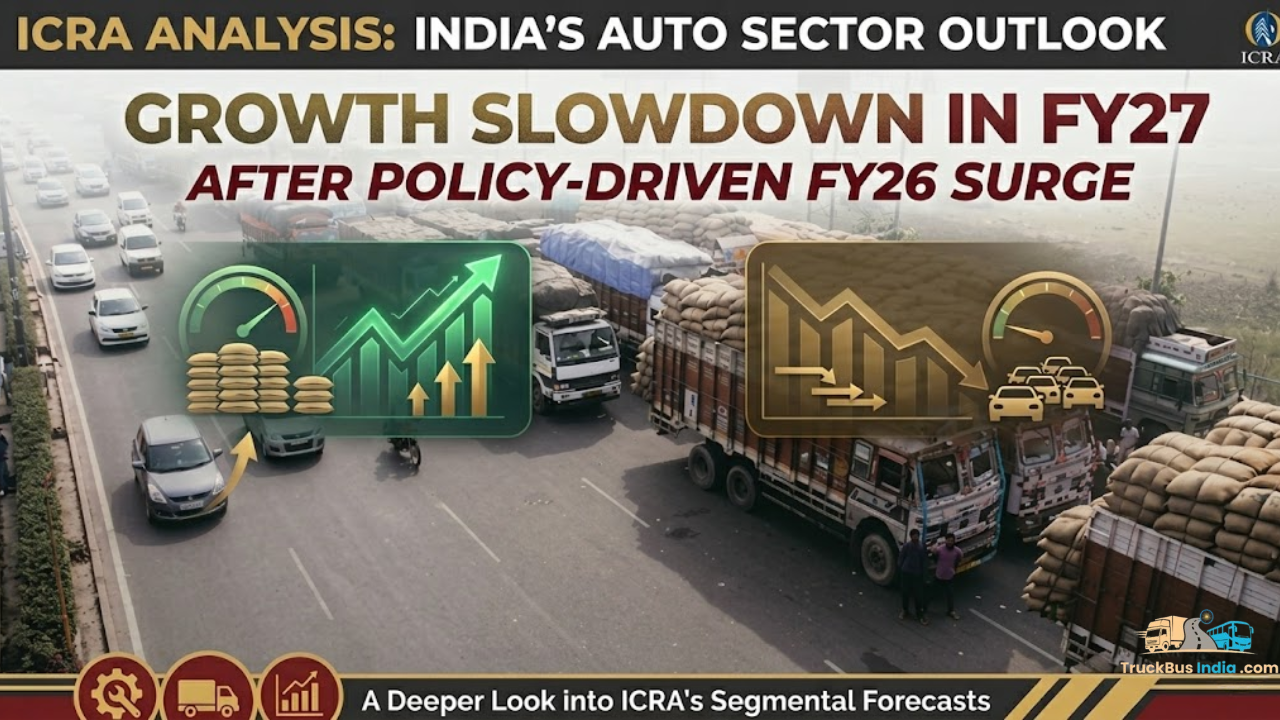
India’s automobile industry, which saw strong, policy-led growth in FY2026, is expected to experience a slowdown in FY2027. According to credit rating agency ICRA, the previous fiscal year’s performance was driven by GST rationalisation that boosted affordability across vehicle segments. While FY2026 benefitted from strong demand, FY2027 growth is expected to moderate due to elevated funding costs, rising preference for pre-owned vehicles, and global uncertainties.
Commercial Vehicles Segment Performs Strongly in FY2026
The commercial vehicle (CV) segment has been one of the top performers in FY2026. Domestic wholesale volumes grew 12.5% year-on-year in the first eleven months, with February 2026 recording a 23.8% increase. Retail volumes also rose 28.9% during this period. Medium and heavy commercial vehicles (M&HCVs) led the growth, while light commercial vehicles (LCVs) benefitted from last-mile freight activity and GST-led cost reductions.
Growth Outlook for FY2027
ICRA expects the CV segment to exceed its previous full-year growth estimate of 7–9% for FY2026. However, growth is projected to moderate to 4–6% in FY2027 due to higher financing costs and increasing demand for pre-owned LCVs.
Two-Wheelers See Recovery Amid Rural Demand
Two-wheelers experienced a broad-based recovery in FY2026, reaching multi-year high volumes. Growth was supported by improved rural demand, better financing availability, and GST rate cuts for vehicles under 350 cc. Retail volumes grew 11.5% in the first eleven months of FY2026, building on a 7% increase in FY2025.
FY2027 Projections
ICRA projects wholesale volumes in the two-wheeler segment to grow approximately 9% in FY2026, before moderating to 3–5% in FY2027 due to a higher base effect. Geopolitical tensions in West Asia could also affect fuel and inflation, impacting affordability.
Auto Components Sector Maintains Steady Growth
The auto components sector is expected to grow at 7–9% in FY2027, driven by replacement demand, premiumisation, and gradual export recovery. Manufacturers plan capital expenditure of ₹28,000–32,000 crore for capacity expansion and electrification.
Challenges and Considerations
Large-scale investments such as battery cell localisation may require increased reliance on debt, though overall debt metrics remain manageable. Supply chain disruptions, energy costs, gas availability, and currency fluctuations are important factors to monitor for the sector.
Conclusion: Normalisation Expected in FY2027
Following strong policy-driven recovery in FY2026, the automobile sector’s growth is likely to normalise in FY2027. Investments in electrification, steady replacement demand, and improving rural incomes will provide medium-term support. However, global market uncertainties and input cost pressures will continue to influence growth dynamics.