
News List
India Eases EV Localisation Rules Amid Shortages

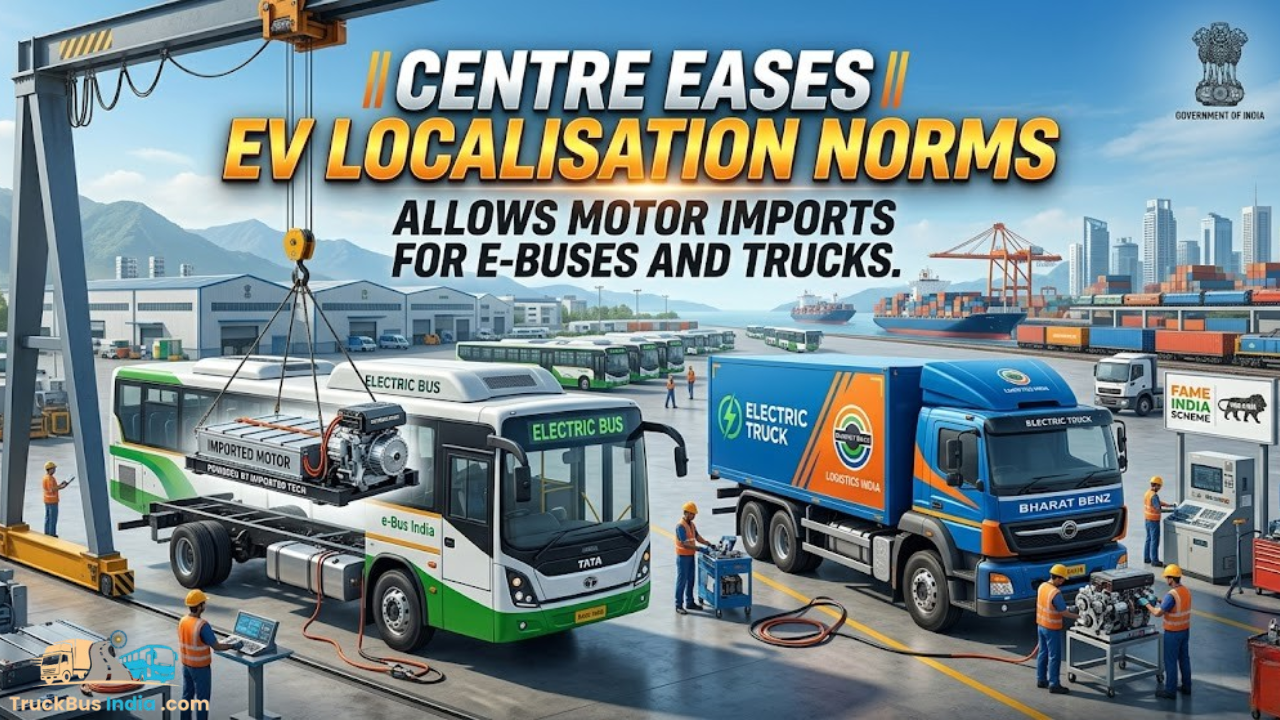
The Centre has announced a key policy relaxation under its PM E-DRIVE Scheme, easing localisation requirements for electric vehicle manufacturers in India. The move provides temporary relief to electric bus and truck makers facing global component shortages, particularly in sourcing critical rare-earth materials used in traction motors.
The decision is aimed at balancing India’s push for domestic EV manufacturing with ongoing global supply chain constraints.
Government Relaxes EV Localisation Norms Under PM E-DRIVE
Under the PM E-DRIVE Scheme, the government has allowed manufacturers of electric buses and trucks to continue importing traction motors that rely on rare-earth magnets until August 31. This relaxation applies to electric trucks in the N2 and N3 categories and electric buses in the M2 and M3 categories.
Extension Provides Relief to EV Makers
This is the second extension granted by the Centre, following an earlier deadline shift to March 2026. With the latest update, full localisation of traction motor manufacturing will now be mandatory from September 1, 2026.
The government said the move will help manufacturers manage ongoing EV supply chain challenges in India while continuing to build domestic production capacity. The phased approach is designed to ensure a smoother transition without disrupting vehicle production timelines.
Phased Manufacturing Programme Still in Focus
Despite the relaxation, the Phased Manufacturing Programme (PMP) under PM E-DRIVE Scheme remains in place. It requires manufacturers to gradually localise key processes such as magnet fitment, rotor assembly, stator integration, shaft installation, bearing assembly, enclosure setup, and electrical connector integration.
The long-term goal is to increase domestic value addition and reduce dependency on imported components.
Rare-Earth Magnet Dependence Remains Key Challenge
A major factor behind the policy relaxation is the continued global shortage of rare-earth magnets, which are essential for traction motors used in electric vehicles. These materials are also widely used in electronics, aerospace, and renewable energy sectors.
Import Dependency Creates Supply Pressure
India continues to rely heavily on imports, particularly from China, which dominates the global rare-earth supply chain. This dependency has created bottlenecks for EV manufacturers, prompting the government to adopt a more flexible approach under the PM E-DRIVE Scheme.
Government Push for Domestic Production
To reduce long-term dependence, the Centre has launched a Rs 7,280 crore scheme aimed at boosting domestic manufacturing of sintered rare-earth permanent magnets. This initiative is expected to strengthen India’s EV ecosystem and improve resilience in critical technology supply chains.
Conclusion
The latest easing of localisation norms under the PM E-DRIVE Scheme reflects India’s attempt to balance rapid EV growth with real-world supply chain constraints. While the relaxation offers immediate relief to manufacturers of electric buses and trucks, the long-term focus remains on building a self-reliant ecosystem for critical EV components. The transition period until 2026 is expected to be crucial for stabilising production and scaling domestic capabilities.
FAQ
Q1: What changes were made under the PM E-DRIVE Scheme?
The PM E-DRIVE Scheme now allows temporary import of traction motors for electric buses and trucks until August 31, with full localisation extended to September 1, 2026.
Q2: Which vehicles are affected by this relaxation?
The rule applies to electric trucks in N2 and N3 categories and electric buses in M2 and M3 categories.
Q3: Why did the government relax localisation rules?
The relaxation addresses global shortages of rare-earth magnets and broader EV supply chain challenges in India.
Q4: What are rare-earth magnets used for?
They are critical components in traction motors used in electric vehicles and are also used in electronics and renewable energy systems.
Q5: Is India working on domestic production of EV components?
Yes, the government has launched a Rs 7,280 crore scheme to promote local manufacturing of rare-earth permanent magnets under the PM E-DRIVE Scheme.