
News List
India Three Wheeler Sales Surge 29 Percent February 2026

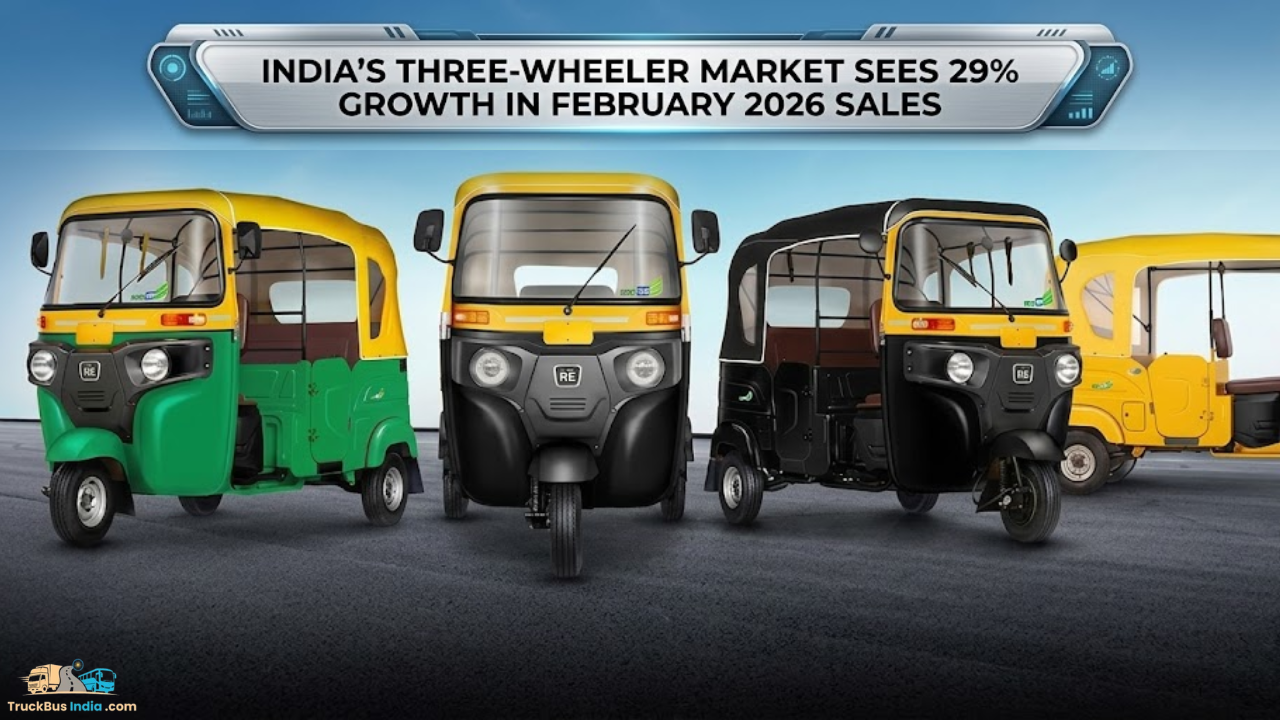
India’s three wheeler market recorded strong momentum in February 2026, reflecting rising demand across passenger and cargo segments. The latest data shows a sharp increase in both domestic sales and exports, highlighting improved market activity and growing adoption of electric variants.
According to the Society of Indian Automobile Manufacturers, the industry witnessed a 29 percent year over year growth in February 2026, with multiple segments contributing to the expansion.
India Three Wheeler Sales Growth February 2026
The India three wheeler sales performance in February 2026 remained robust, driven by higher demand in urban and semi-urban mobility.
A total of 74,573 units were sold domestically, compared to 57,788 units in February 2025. Production also saw a notable rise, reaching 1,08,154 units, up from 83,252 units in the same period last year. This marks a 29.9 percent increase in production, indicating strong supply-side activity.
The consistent growth in India three wheeler sales highlights improving market confidence and increased mobility needs.
Passenger Carrier Segment Drives India Three Wheeler Sales
The passenger carrier segment emerged as the primary driver of India three wheeler sales growth in February 2026.
Production in this category reached 92,514 units, reflecting a 29 percent increase compared to 71,693 units in February 2025. Domestic sales also climbed significantly to 60,013 units, up 30.1 percent from 46,111 units in the previous year.
Exports of passenger carriers recorded strong growth as well, rising 48.9 percent to 38,451 units. The segment continues to dominate the market due to its widespread use in daily commuting and last-mile connectivity.
Goods Carrier Segment Expands Steadily
The goods carrier segment also contributed notably to India three wheeler sales growth, supported by rising demand in logistics and small cargo transport.
Production increased by 31.4 percent to 13,751 units, compared to 10,465 units in February 2025. Domestic sales reached 13,271 units, marking a 25.2 percent rise from 10,603 units last year.
Exports in this segment saw an even sharper jump, growing 57.3 percent to 313 units from 199 units in February 2025. The steady growth reflects expanding use in small business logistics and last-mile delivery.
Electric Three Wheeler Segment Gains Momentum
The electric segment showed significant traction within the India three wheeler sales ecosystem, particularly in the e-rickshaw category.
E-rickshaw production surged by 110.8 percent year over year, reaching 1,370 units compared to 650 units in February 2025. Domestic sales also increased by 20.1 percent to 890 units.
The battery-operated e-cart segment, though smaller, maintained positive growth. Production rose 16.9 percent to 519 units, while domestic sales increased 19.8 percent to 399 units.
This growth indicates a gradual shift towards cleaner mobility solutions in the three wheeler market.
India Three Wheeler Exports Growth and Outlook
Exports played a crucial role in boosting overall India three wheeler sales performance in February 2026.
Total exports rose 49 percent year over year to 38,766 units, compared to 26,024 units in February 2025. When combined with domestic sales, total dispatches reached 1,13,339 units, surpassing the production figure for the month.
Both passenger carriers and goods carriers contributed to this export growth, highlighting India’s increasing presence in global three wheeler markets.
The latest data suggests continued expansion across segments, supported by demand for passenger mobility, cargo transport, and electric vehicles.
Conclusion
The India three wheeler sales growth in February 2026 reflects a strong recovery and expansion across key segments. Passenger carriers led the surge, while goods carriers and electric vehicles added to the overall momentum.
With exports rising significantly and production levels increasing, the industry is showing signs of sustained growth. The performance indicates a balanced demand across domestic and international markets, positioning the sector for continued progress in the coming months.