
News List
Mahindra RoadMaster G80 vs G90 vs G100: Motor Grader Comparison

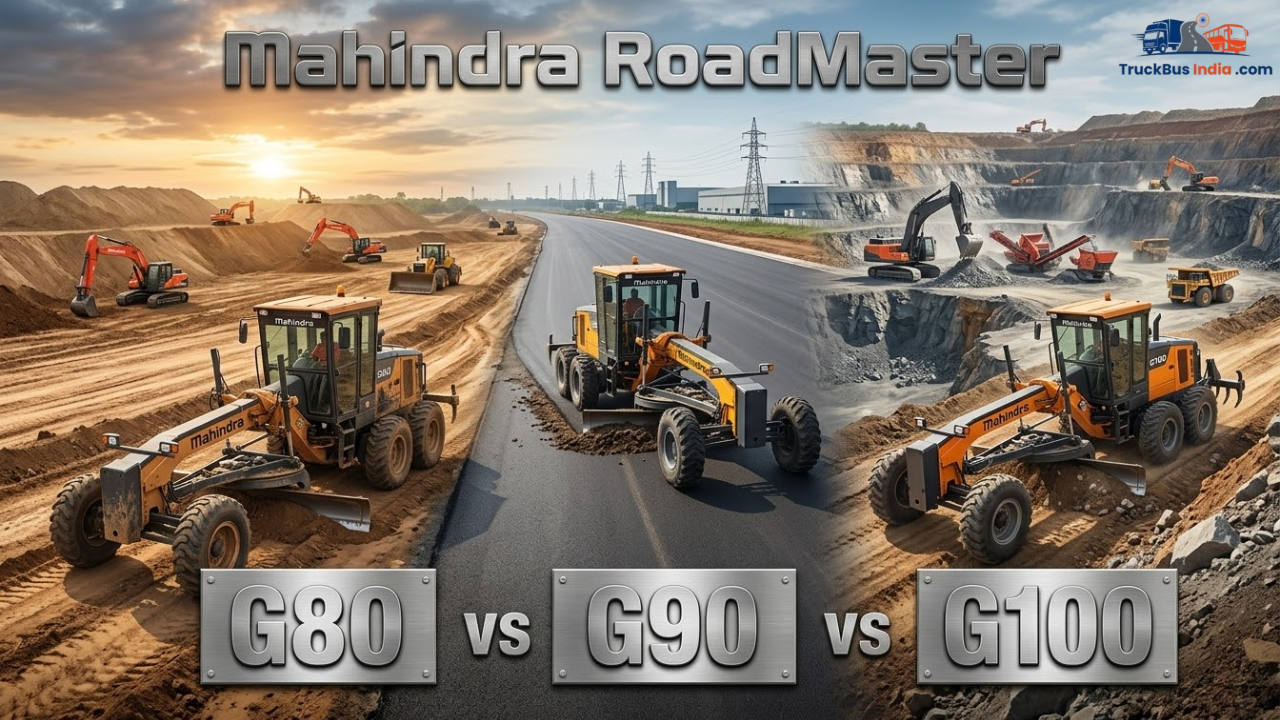
For every road construction and maintenance project, a motor grader is essential. These machines remove ruts, fill potholes, and create smooth surfaces for roads of all sizes. Mahindra RoadMaster motor graders are known for reliability and efficiency. The series includes three models: G80, G90, and G100. Each is designed for different construction requirements, ranging from rural roads to national highways.
While the graders may appear similar in design, their engine power, weight distribution, hydraulics, and attachments vary. Understanding these differences is crucial for contractors looking to choose the right machine for specific projects.
Engine and Performance
Power and Torque
All three Mahindra RoadMaster models are powered by a turbocharged four-cylinder engine. The G80 and G90 generate 74 horsepower with peak torque of 400 Nm, making them suitable for general grading, surface levelling, and smaller road projects. They perform efficiently on controlled construction sites and smaller road networks.
The G100 offers a more powerful engine with 102 horsepower and 440 Nm of torque, allowing it to handle heavier material and tougher ground conditions. This higher power ensures stability during deeper cutting, faster material movement, and better performance for larger highway or infrastructure projects. Contractors working on challenging terrains or high-volume projects will benefit from the G100’s superior engine capacity.
Blade, Weight, and Operating Capabilities
Blade and Surface Finishing
All three models feature a 3000 mm moldboard with 16 mm thickness and a blade height of 516 mm. This ensures consistent surface finishing, whether spreading soil, levelling gravel, or shaping road surfaces. Since the blade dimensions remain identical across G80, G90, and G100, the quality of grading is consistent. Performance differences come mainly from engine power, weight distribution, and traction capabilities.
Vehicle Weight and Traction
The G80 is the lightest, weighing around 7,738 kilograms, making it easier to manoeuvre on smaller sites and tight construction areas. The G90 weighs approximately 8,596 kilograms, and the G100 is the heaviest at 9,010 kilograms. The higher rear axle weight of the G90 and G100 provides better traction when pushing heavy material or cutting deeper layers, reducing wheel slip on uneven or loose surfaces. Despite the differences in weight, all models maintain the same top speed of 32.5 km per hour.
Dimensions and Ground Clearance
The G80 has a shorter wheelbase and transport length, allowing it to operate efficiently on compact sites. In contrast, the G90 and G100 offer longer wheelbases and higher ground clearance, which enhances stability during heavy grading work and improves performance on rough or uneven terrain. Contractors working on highways, larger roads, or infrastructure projects will find the G90 and G100 more suitable due to their superior handling on challenging sites.
Price Comparison and Project Suitability
Cost and Investment
The Mahindra RoadMaster G80 is the most competitively priced at ₹35–36 lakh, making it suitable for smaller contractors and local road maintenance. The G90 is priced between ₹45–47 lakh and offers more capability for mixed construction work, including urban roads and railway projects. The G100, at ₹54–56 lakh, is the premium option, designed for high-volume projects like national highways and large-scale earthwork.
Choosing the Right Grader
For routine grading and compact site work, the G80 is ideal. The G90 is better suited for mixed infrastructure projects, including road expansion and railway construction. Contractors handling challenging terrains or large highway projects should consider the G100, which offers higher power, better traction, and enhanced operational efficiency.
Conclusion
The Mahindra RoadMaster series provides graders for a wide range of construction needs. While all three models offer the same blade size and surface finishing capability, their engine power, weight distribution, and ground clearance determine their suitability for different projects. Choosing the right grader depends on project scale, terrain, and budget. The G80 is ideal for smaller sites, the G90 for medium-sized infrastructure projects, and the G100 excels in demanding highway and large-scale earthwork operations. Contractors can rely on this series to improve efficiency, achieve high-quality results, and meet project deadlines.