
News List
PM-eBus Sewa Scheme Approves 10,000 Electric Buses

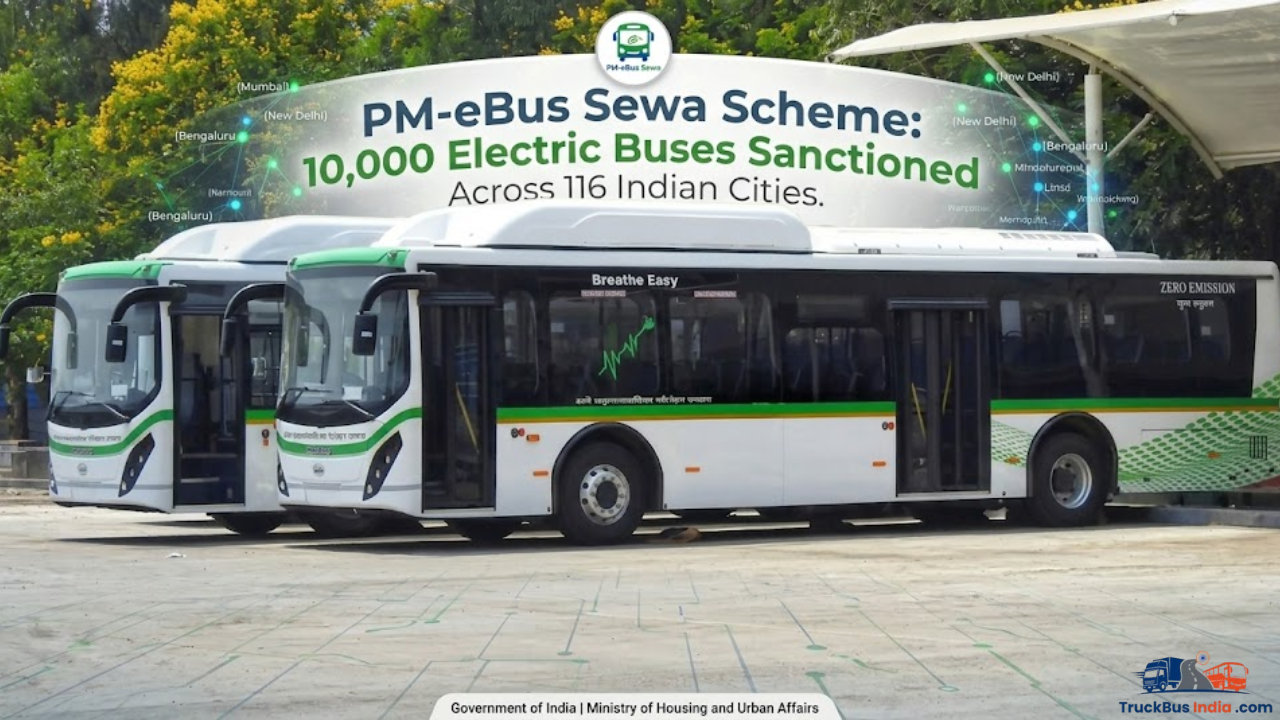
The Government of India has sanctioned 10,000 air-conditioned electric buses under the PM-eBus Sewa Scheme, covering 116 cities across 20 states and six Union Territories. Announced through a written reply in the Lok Sabha by Minister of State for Heavy Industries Bhupathiraju Srinivasa Varma, the initiative is part of the national effort to expand organised urban bus transport and accelerate the adoption of electric mobility in Indian cities. The scheme is implemented by the Ministry of Housing and Urban Affairs (MoHUA) and focuses particularly on mid-sized cities that are yet to develop robust public transport systems.
Objectives of the PM-eBus Sewa Scheme
Expanding Organised Transport
The PM-eBus Sewa Scheme is designed to strengthen urban transport networks by deploying 10,000 air-conditioned electric buses in cities with populations ranging from three lakh to 40 lakh. It also covers clusters of smaller towns, state capitals, and capital cities in the North-Eastern and hilly regions with populations below three lakh. Around 30 percent of participating cities are introducing organised public transport for the first time, while nearly 80 percent are transitioning to electric mobility for the first time.
Accelerating Electric Mobility
The scheme addresses critical gaps in city bus services while supporting India’s environmental goals. By combining electric bus deployment with funding for charging and depot infrastructure, the programme lowers the financial barriers that cities face in adopting clean public transport, encouraging a shift away from fossil fuel-powered vehicles.
Infrastructure Development and Funding
Behind-the-Meter Power Infrastructure
The PM-eBus Sewa Scheme provides 100 percent financial support for Behind-the-Meter (BTM) power infrastructure necessary for electric bus operations. As of December 2025, ₹1,254.38 crore has been sanctioned for infrastructure, out of which ₹483.70 crore has already been spent. Over 200 infrastructure proposals have been approved, including civil depot construction and high-tension power lines spanning more than 500 circuit kilometres. More than 300 acres of land have been sanctioned for depot development.
State-Wise Sanctions and Spending
Maharashtra has received the highest allocation for infrastructure at ₹370.49 crore, with ₹200.18 crore spent so far. Other states with significant sanctioned amounts include Bihar, Rajasthan, Andhra Pradesh, and Odisha. Some regions, such as Haryana, Karnataka, Meghalaya, Puducherry, and Uttarakhand, have yet to record expenditures, indicating that work is still in the early stages.
City-Wise Bus Allocations
Major State Allocations
Under the scheme, Maharashtra has been sanctioned 1,609 buses across 22 cities, Rajasthan 1,150 buses across nine cities, and Andhra Pradesh 1,050 buses across 11 cities. Other notable allocations include Madhya Pradesh with 972 buses and Karnataka and Gujarat with 750 buses each. Among Union Territories, Chandigarh has received 428 buses, one of the highest allocations for a single city.
Example of Jabalpur Implementation
Jabalpur in Madhya Pradesh illustrates the scheme’s rollout at the city level. The city has been sanctioned 200 electric buses, and a concession agreement was signed on February 12, 2026. Infrastructure funding for the city totals ₹10.48 crore, including ₹6.3 crore for BTM infrastructure and ₹4.18 crore for civil infrastructure. While no buses are operational yet, deployment preparations are underway.
Strategic Significance
Bridging Urban Transport Gaps
Many mid-sized Indian cities currently lack organised public transport networks. The PM-eBus Sewa Scheme aims to fill this gap while promoting environmentally sustainable mobility. By providing full support for infrastructure, the programme ensures cities can deploy electric buses without facing financial constraints.
Supporting Long-Term Sustainability
The initiative not only increases public transport capacity but also advances India’s transition to cleaner urban mobility. Each electric bus reduces emissions and dependence on fossil fuels while providing a reliable, comfortable, and air-conditioned travel option for commuters.
Conclusion
The PM-eBus Sewa Scheme represents a major step in India’s urban mobility strategy, combining the deployment of 10,000 electric buses with comprehensive infrastructure support across 116 cities. By targeting mid-sized cities and regions new to organised transport, the scheme promotes equitable access to public transport, reduces congestion, and strengthens the country’s transition to sustainable electric mobility. With careful planning and ongoing implementation, the programme is poised to transform city commuting while supporting India’s environmental and urban development goals.