
News List
CBG Key to India’s Energy Security, Says Nitin Gadkari

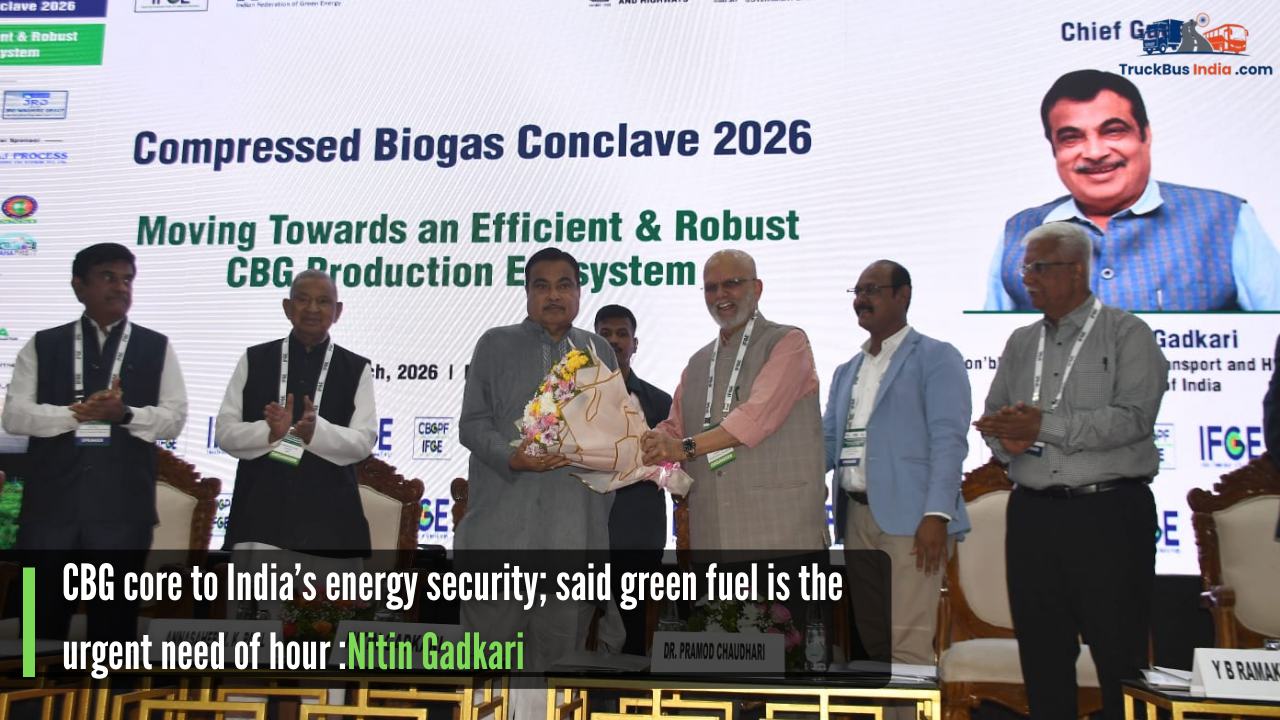
India must accelerate the adoption of green and alternative fuels to strengthen energy security and reduce import dependence, said Union Minister Nitin Gadkari at the Compressed Biogas Conclave 2026.
Speaking at the event titled “Compressed Biogas Conclave 2026: Moving Towards an Efficient & Robust CBG Product Ecosystem,” the minister highlighted that India remains highly dependent on imported energy. He noted that the country imports nearly 80 percent of its energy requirements, resulting in an annual import bill of around ₹22 lakh crore.
According to Gadkari, such heavy reliance on external energy sources makes the country vulnerable to global price fluctuations and geopolitical uncertainties. He stressed that accelerating the adoption of cleaner and domestic energy solutions such as compressed biogas could help India improve long term energy security.
Compressed Biogas Can Strengthen Energy Independence
Compressed biogas, often referred to as CBG, is emerging as a crucial component of India’s alternative energy strategy. The fuel is produced from organic waste such as agricultural residue, municipal waste and animal manure, making it both renewable and environmentally friendly.
Gadkari said the CBG ecosystem in India is expected to grow significantly as infrastructure expands and technologies improve. With better efficiency and a stronger production network, CBG can become an important fuel for transportation and other energy intensive sectors.
He also encouraged industry players to focus on proven technologies and utilise the country’s abundant raw materials to scale up production. According to him, innovation and practical solutions will be essential in converting knowledge and research into economic value.
Auto Industry Supporting the Shift to Green Fuels
The Union Minister also highlighted the role of the automobile industry in supporting the transition to cleaner fuels. Companies such as Toyota Motor Corporation are already working on technologies that support alternative fuels.
These include vehicles capable of running on ethanol based fuels as well as flex fuel and dual fuel technologies. Such innovations could significantly boost the use of biofuels and reduce dependence on conventional fossil fuels in the future.
Gadkari also emphasised that alternative fuels are becoming increasingly important as India’s population grows and vehicle ownership continues to rise.
Key Areas Gadkari Wants to Focus On
- Expansion of compressed biogas production and infrastructure
- Wider adoption of ethanol and flex fuel vehicles
- Increased use of CNG in transport systems
- Promotion of electric tractors and agricultural machinery
- Encouraging research and innovation in sustainable energy solutions
Gadkari added that the economics of alternative fuels is gradually becoming more favourable, making the transition easier than before. As demand for energy rises in India, expanding the use of fuels like CBG, ethanol and electricity will play a crucial role in building a cleaner and more secure energy future.