
News List
Electric Tractors Drive India’s Agricultural Transformation 2026

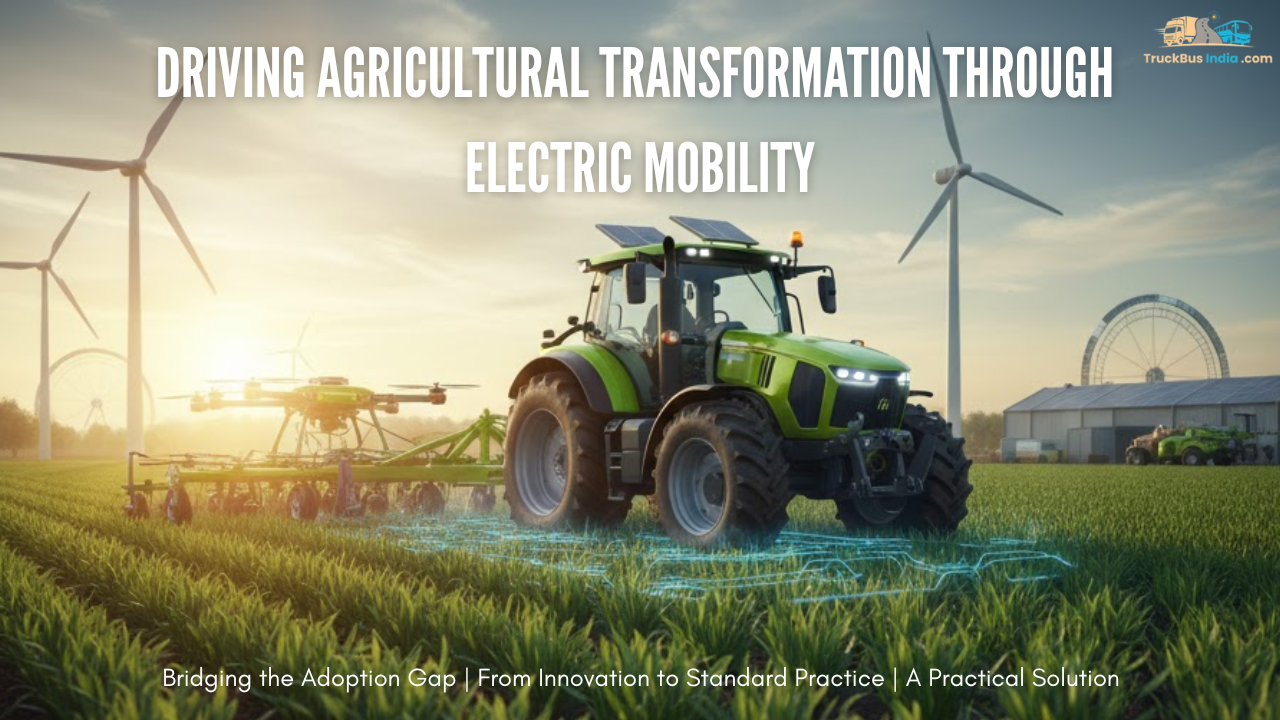
Agriculture at a Critical Crossroads
Agriculture remains a cornerstone of India’s economy, sustaining nearly 42 percent of the population and contributing around 18 percent to the nation’s GDP. Beyond economic output, farming supports livelihoods, ensures food security, and underpins stability in rural India. Yet, Indian agriculture faces critical challenges as mechanization, largely driven by diesel-powered tractors, grows. While tractors have historically boosted productivity, their rising fuel consumption and emissions are increasingly at odds with India’s sustainability ambitions.
Tractors alone consume an estimated 7.4% of India’s annual diesel usage and account for 60% of total agricultural fuel consumption. Projections suggest that PM2.5 and NOx emissions could increase four- to five-fold over the next two decades if conventional internal combustion engine (ICE) machinery continues to dominate. In this context, the need for cleaner, cost-effective alternatives has never been more urgent.
Electric Tractors: Sustainable and Efficient Solutions
Electric tractors offer a compelling solution by reducing operational costs, minimizing emissions, and decreasing dependence on volatile fossil fuel markets. These machines represent a structural shift from conventional mechanization to intelligent, sustainable farm mobility, aligned with national initiatives like PM e-DRIVE, FAME-III, and the National Bioenergy Programme, supporting India’s 2070 net-zero ambitions.
Equipped with high-torque electric drivetrains, electric tractors deliver instant power for ploughing, sowing, and haulage. Integrated IoT dashboards allow real-time monitoring, remote diagnostics, and proactive maintenance, improving operational efficiency while reducing fatigue compared to diesel engines. Field trials have demonstrated significant cost savings per hectare, primarily due to lower energy and maintenance expenses.
Furthermore, when powered by decentralized renewable energy systems such as solar microgrids, electric tractors help create self-sufficient, low-carbon rural ecosystems. Villages can become net energy producers, reducing dependence on the conventional grid while advancing sustainable agriculture.
Policy and Financing: Bridging the Adoption Gap
Despite their benefits, upfront costs remain a barrier for small and marginal farmers. Policy support and innovative financing are critical for scaling adoption, similar to strategies used in India’s solar energy sector. Central subsidy schemes, complementary state incentives, and low-interest financing can make electric tractors more accessible.
Awareness initiatives by the Ministry of Agriculture are helping farmers understand the long-term reliability, environmental advantages, and economic benefits of electric mobility. Beyond subsidies, policy must enable widespread access through rural charging infrastructure, maintenance networks, and farmer training. Electric mechanization should be viewed not as a subsidy, but as a national investment enhancing productivity, energy security, and carbon reduction across the agricultural sector.
Looking Ahead: From Pilot to Standard Practice
India’s transition to electric agricultural mobility is gaining momentum. Advances in battery technology, expanding rural charging infrastructure, and insights from pilot deployments are making electrification practical for daily farm operations. As battery costs decline and renewable energy access improves, electric tractors are expected to shift from innovative prototypes to standard farming tools.
By substituting electricity for diesel, electric tractors reduce carbon emissions, stabilize farmer incomes, lower operational costs, and decrease foreign exchange expenditure. Combined with R&D, robust after-sales support, and financing models, this transformation can ensure that Indian agriculture grows sustainably, efficiently, and responsibly.
Conclusion
The future of Indian agriculture will not just be defined by horsepower, but by the sustainability of its energy systems. Electric tractors offer a rare opportunity to power the nation’s fields in an environmentally responsible, economically viable, and technologically advanced manner, uniting productivity with a low-carbon future.