News List
Cybersecurity Emerges as Key Concern at SIAT 2026

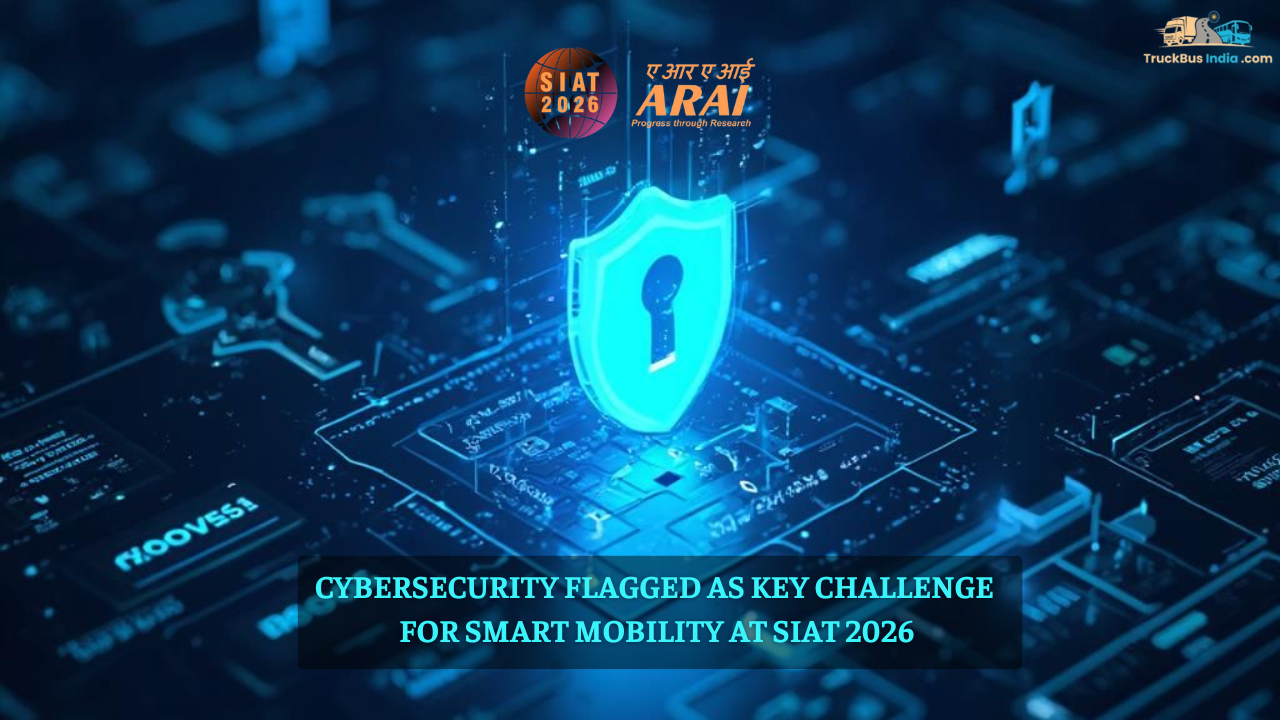
Cybersecurity has been flagged as a major challenge for India’s smart mobility ecosystem, according to experts at the 19th Symposium on International Automotive Technology (SIAT) 2026, held at the Pune International Exhibition and Convention Centre (PIECC), Moshi.
Speaking at the closing ceremony, Dr Reji Mathai, Director of the Automotive Research Association of India (ARAI), emphasised that while the symposium focused on “Innovative Pathways to Safe and Sustainable Mobility,” cybersecurity stood out as a critical issue. “Protecting connected and autonomous vehicles from cyber threats is essential to ensure safety and trust in smart mobility solutions,” he said.
Other Key Challenges in Smart Mobility
In addition to cybersecurity, Dr Mathai highlighted several pressing challenges for the sector:
- Validation of Advanced Driver Assistance Systems (ADAS) using high-level simulations.
- Charging infrastructure and range anxiety for electric vehicles.
- Affordability of smart mobility solutions for mass adoption.
He noted that a multi-pronged approach, including hybrid and fully electric vehicles, smart grid integration to optimise charging times and costs, and vehicle-to-everything (V2X) communication using 5G and dedicated radio technologies, would be critical in addressing these challenges. V2X technology allows vehicles to exchange data with infrastructure and networks, supporting road safety, traffic management, and autonomous driving.
Industry and Government Perspectives
Minister of State for Heavy Industries and Steel, Bhupathi Raju Srinivasa Varma, attending the closing ceremony, highlighted the importance of safer, greener, and cleaner mobility as India targets a $5 trillion economy. He acknowledged ARAI’s key role in certification, research, and technology support for national automotive initiatives.
The event also reinforced the need to build an indigenous automotive technology ecosystem under the Atmanirbhar Bharat initiative, leveraging local resources to develop solutions tailored to Indian conditions.
SIAT 2026 Event Highlights
SIAT 2026 attracted over 2,500 delegates and approximately 13,000 visitors. The symposium featured:
- 64 technical sessions
- Eight plenary presentations
- Two panel discussions
- 248 technical papers, including 33 international papers, evaluated by more than 80 judges
Tata Motors received the Best Paper Award, underscoring its contributions to automotive research. Senior industry and institutional representatives, including Vikram Kasbekar (Hero MotoCorp CTO), Dr G Nagrajan (SAE India President), and Dr N H Walke (SIAT 2026 Convenor), participated actively in discussions.
Looking Ahead
As India accelerates toward electric, connected, and autonomous mobility, SIAT 2026 highlighted that cybersecurity, policy collaboration, and indigenous technology development are vital for sustainable growth. Experts agreed that integrating these elements will be essential for safe, reliable, and scalable mobility solutions in the coming decade.