
News List
Tata Ultra E.7 vs EKA 7T Electric Truck Comparison

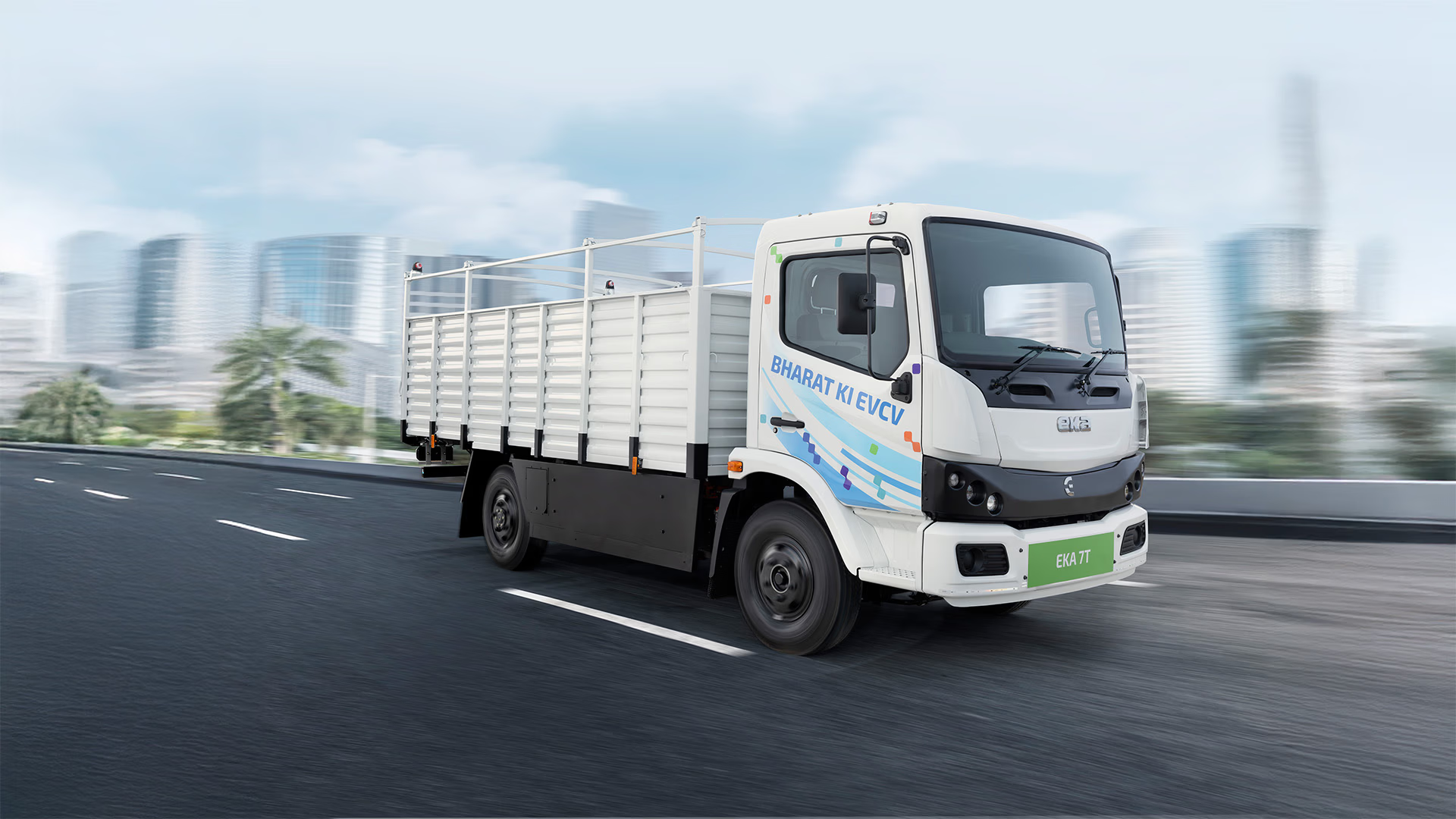
Electric trucks are steadily emerging as a practical alternative to diesel-powered vehicles for short- and medium-haul logistics in India. With lower total cost of ownership and reduced emissions, they are increasingly attractive to fleet operators. Two recent entrants — the Tata Ultra E.7 and the EKA 7T — are competing in the 7-tonne GVW electric truck category, targeting urban and regional transport applications.
Both models are positioned as light commercial electric trucks designed to meet the growing demand for sustainable logistics solutions.
Weight and dimensions: Payload versus deck length
The Tata Ultra E.7 carries a gross vehicle weight of 7,500 kg, slightly higher than the EKA 7T’s 6,950 kg GVW. However, when it comes to payload, the EKA 7T offers an advantage on paper with a payload capacity of 3,500 kg, compared to the Ultra E.7’s 3,100 kg.
Cargo body dimensions set the two apart. Tata Motors offers a longer 14-foot cargo deck on the Ultra E.7, while the EKA 7T comes with a 10.5-foot deck. This makes the Ultra E.7 more suitable for transporting larger and longer goods in fewer trips.
In terms of stability, the Ultra E.7 features a longer wheelbase of 3,550 mm versus 3,320 mm on the EKA 7T. EKA Mobility has disclosed a ground clearance of 260 mm for its truck, whereas Tata Motors has not yet revealed the Ultra E.7’s clearance figures.
Performance: Power, torque and drivability
Performance specifications show distinct strengths for each truck. The Tata Ultra E.7 delivers higher peak power at 240 kW, compared to the EKA 7T’s 200 kW. Torque figures, however, favour EKA Mobility’s offering, which produces a peak torque of 1,800 Nm and continuous torque of 957 Nm. The Ultra E.7 generates 950 Nm of peak torque and 450 Nm of continuous torque.
The EKA 7T offers a top speed of 80 kmph, while Tata Motors has not disclosed the Ultra E.7’s top speed. Gradeability is higher on the Ultra E.7 at 26 per cent, compared to 22 per cent for the EKA 7T, making it better suited for hilly and ghat sections.
Suspension, tyres and braking systems
Tata Ultra E.7 is equipped with parabolic leaf spring suspension with shock absorbers at both ends, aimed at providing smoother ride quality. The EKA 7T uses semi-elliptical leaf springs with helper springs.
In terms of tyres, the Ultra E.7 runs on 17.5-inch radial tubeless tyres, while the EKA 7T features 16-inch tube tyres. Braking systems also differ, with Tata offering hydraulic disc brakes and EKA Mobility opting for drum brakes, prioritising durability and lower maintenance costs.
Battery, range and charging capability
Both electric trucks use LFP battery technology. The EKA 7T comes with a larger 129 kWh battery pack, while the Ultra E.7 offers a 96 kWh battery. Certified range stands at 200 km for the EKA 7T and 180 km for the Ultra E.7, though real-world range figures are yet to be confirmed.
Charging times vary, with the Tata Ultra E.7 taking approximately 1.5 to 2 hours using DC fast charging, compared to around 3 hours for the EKA 7T via CCS2 chargers.
Cabin features and applications
Both trucks offer similar cabin features, including a walk-through cabin, air conditioning, adjustable driver seats, smart digital clusters, connected infotainment systems and ample storage. Tata’s Ultra E.7 additionally offers a crash-tested cabin, low-NVH design and regenerative braking, features not yet confirmed for the EKA 7T.
Which electric truck makes sense?
Designed for applications such as FMCG distribution, e-commerce, courier services, cold chain, LPG cylinder delivery and white goods transport, both trucks promise lower operating costs than ICE vehicles. The Ultra E.7 stands out for longer cargo and better gradeability, while the EKA 7T offers higher payload and longer range. Pricing for both models has not yet been announced, which will play a key role in final purchase decisions.