
News List
Daimler Truck Begins Small-Series Production of H2 Trucks

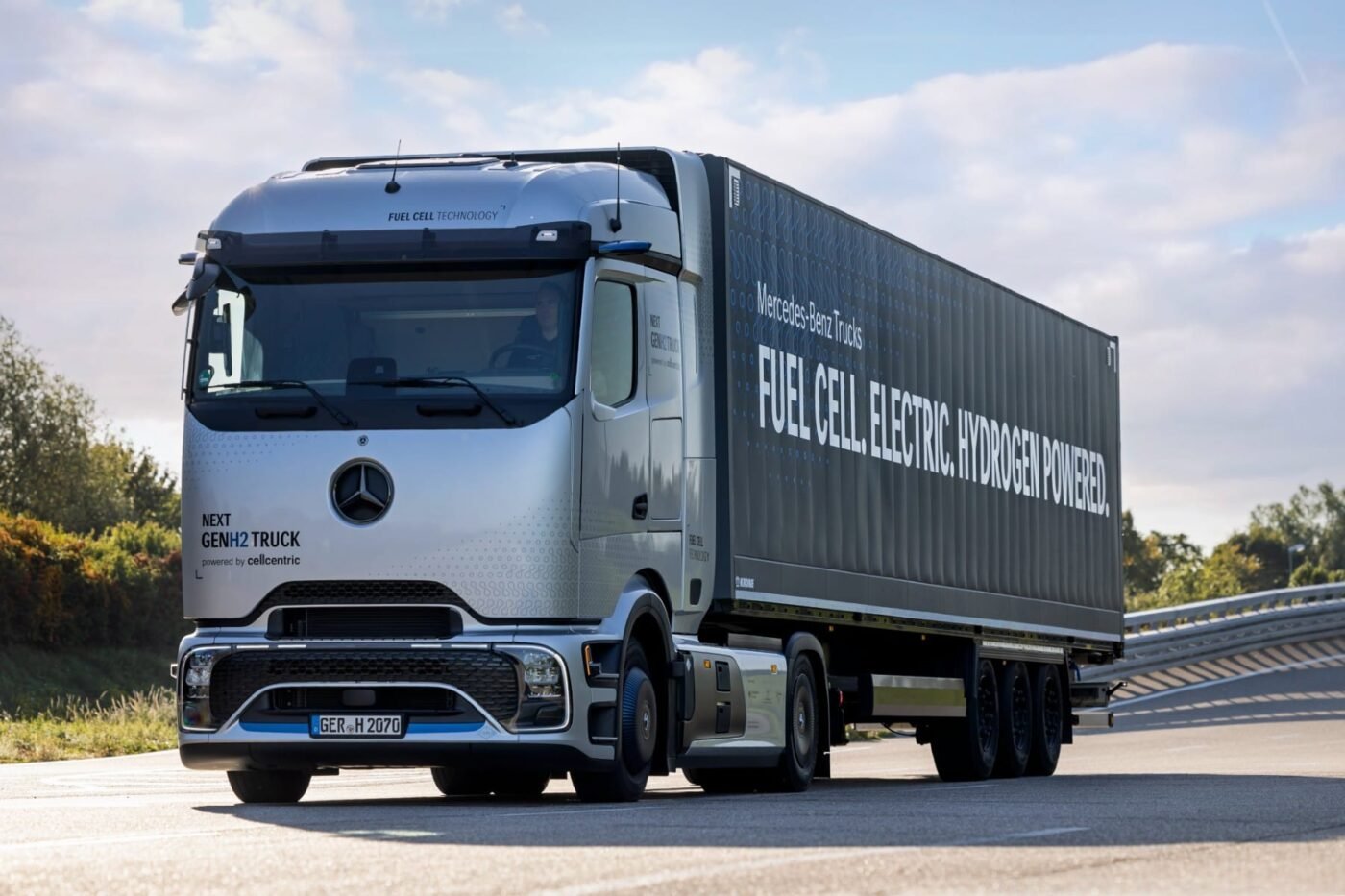
Daimler Truck has taken a major step forward in hydrogen-powered heavy-duty mobility by announcing small-series production of its next-generation fuel cell truck, the Mercedes-Benz NextGenH2 Truck. The German manufacturer plans to build 100 hydrogen-powered semi-trailer tractors at its Wörth plant, with customer deliveries scheduled to begin toward the end of 2026.
The NextGenH2 Truck represents the next evolutionary phase of Daimler Truck’s fuel cell programme after years of testing and real-world trials with first-generation prototypes. While full-scale series production is now expected only in the early 2030s, the limited production run is intended to validate near-production technology under daily long-haul operating conditions.
The updated hydrogen truck integrates several proven components already used in Daimler Truck’s battery-electric flagship, the Mercedes-Benz eActros 600. These include the in-house developed integrated e-axle with a four-speed transmission, the aerodynamically optimised ProCabin, the Multimedia Cockpit Interactive 2, high-voltage architecture, and advanced driver assistance systems. At the same time, the truck retains core hydrogen-specific technologies such as the fuel cell system supplied by Cellcentric, Daimler Truck’s joint venture with Volvo Group, and liquid hydrogen storage.
At the heart of the NextGenH2 Truck is the BZA150 fuel cell system delivering a combined output of 300 kW through two 150 kW units. The hydrogen storage capacity has increased to 85 kg of liquid hydrogen, up from 80 kg previously. Daimler Truck continues to rely on liquid hydrogen due to its higher energy density, enabling long-haul ranges comparable to diesel trucks. The company has previously demonstrated a range of more than 1,000 kilometres on a single refuelling.
The fuel cell system is supported by a newly developed 101 kWh lithium iron phosphate buffer battery, which captures energy during braking and downhill driving. This represents a significant increase from the 70 kWh battery used in earlier prototypes. Power output for the hydrogen truck is rated at up to 340 kW in Economy mode and 370 kW in Power mode.
Several safety and packaging improvements have also been introduced. Daimler Truck has reduced the size of the rear-mounted “Tech Tower,” shortening the wheelbase to exactly four metres, improving trailer compatibility within EU length regulations. New safety systems include enhanced hydrogen leak detection, an integrated cooling system, boil-off management, and reinforced side skirts with crash protection for the hydrogen tanks.
Daimler Truck has cited slow development of hydrogen refuelling infrastructure as the main reason for delaying full-scale production. Currently, liquid hydrogen refuelling is limited to a few specialised locations in Germany, such as Wörth am Rhein and Duisburg. Refuelling takes approximately 10 to 15 minutes.
Earlier customer trials involved companies such as Amazon, DHL Supply Chain, Holcim, Air Products, and Rhenus, covering more than 225,000 kilometres. The NextGenH2 Truck programme is supported by €226 million in funding from the German Federal Ministry of Transport and the states of Rhineland-Palatinate and Baden-Württemberg.
Daimler Truck says the small-series rollout will help prepare hydrogen fuel cell trucks for demanding long-haul operations while supporting the industry’s transition toward zero-emission transport.