
News List
Ashok Leyland shares hit 52-week high

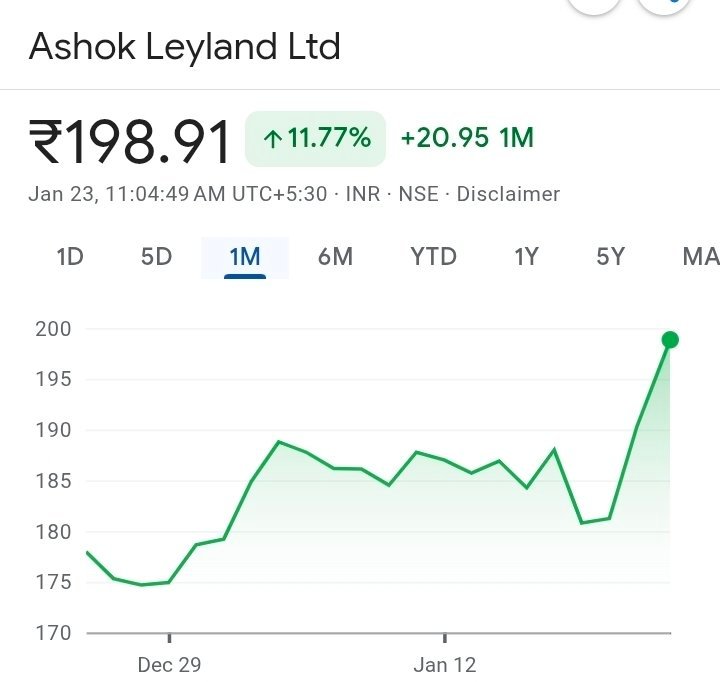
Shares of Ashok Leyland surged sharply in early trade on Friday, January 23, climbing over 3.5% to touch a new 52-week high on the National Stock Exchange. The rally came amid growing investor interest in the company’s Budget 2026–27 expectations, recent product launches, and expanded investment plans.
The stock rose as much as 3.53% during intraday trade to reach ₹197, marking its highest level in the past year. Ashok Leyland, the flagship company of the Hinduja Group, is one of India’s leading manufacturers of commercial vehicles and has remained in focus following recent comments from its top management.
Addressing reporters on Thursday, Managing Director and Chief Executive Officer Shenu Agarwal said the upcoming Union Budget could play a key role in accelerating the replacement of older trucks across the country. He suggested that the government consider offering incentives to encourage truck owners to scrap aging vehicles and transition to newer, more efficient models.
Agarwal highlighted that many trucks currently operating on Indian roads are over a decade old, making them highly polluting, unsafe, and inefficient. However, owners often continue using these vehicles due to the high upfront cost of purchasing new trucks. According to him, targeted incentives—such as cash benefits, tax rebates, reduced registration charges, or discounts on new vehicles—could motivate owners to voluntarily scrap older units.
The comments came on the same day Ashok Leyland reintroduced its Taurus and Hippo range of heavy-duty trucks. The company noted that customers are increasingly recognising the productivity benefits of newer-generation trucks but may require initial financial support to make the switch.
Agarwal also pointed out that GST reforms have already boosted consumption-led freight demand and that a well-structured scrappage incentive scheme could act as another growth trigger. He clarified that scrappage should remain voluntary rather than mandatory and suggested linking incentives to vehicle tonnage. Under such a system, smaller trucks would receive lower benefits, while higher-tonnage vehicles would qualify for larger incentives, creating a balanced approach for both customers and manufacturers.
Beyond environmental gains, Agarwal said newer trucks could help reduce logistics costs by carrying heavier loads at higher speeds while emitting fewer pollutants. He noted that the average age of India’s truck fleet has crossed 10 years, compared to the earlier norm of seven to eight years.
On the investment front, Ashok Leyland has significantly raised its annual capital expenditure to ₹1,000 crore, up from ₹300–₹400 crore earlier. The company is also planning to expand its global footprint by setting up a new manufacturing facility in Saudi Arabia with an initial capacity of around 10,000 units. Agarwal said approvals have been secured and the company is close to finalising the location.
The combination of strong stock performance, product refreshes, and policy-linked expectations has kept Ashok Leyland firmly in investor focus ahead of the Union Budget 2026–27.