
News List
Trucks-on-Trains Reshapes India’s Long-Haul Freight Logistics

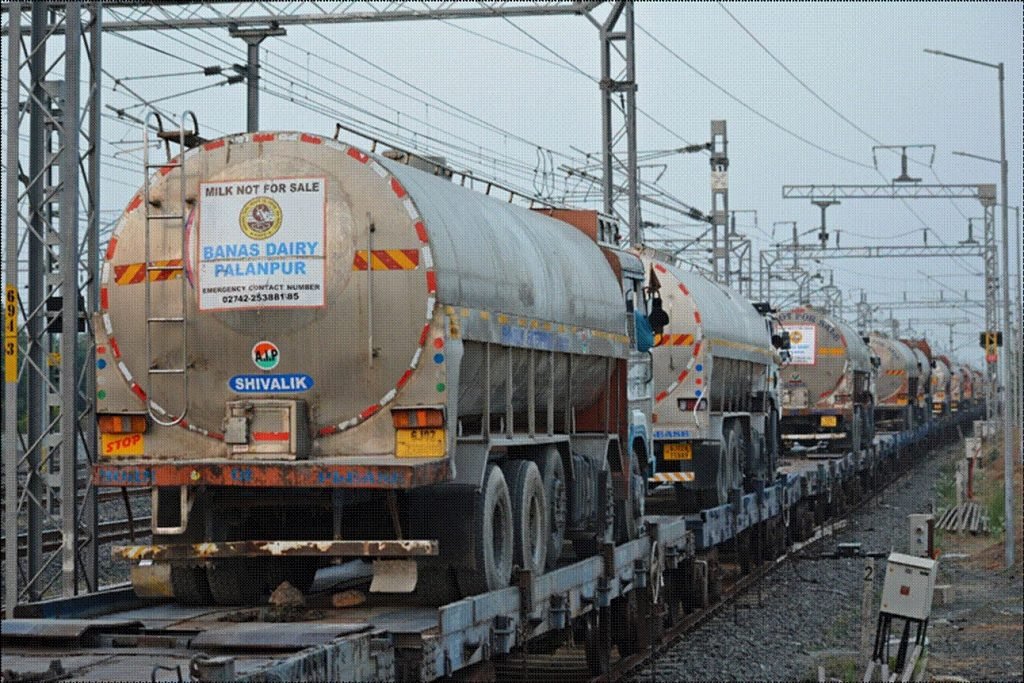
As India’s economy accelerates and freight demand continues to surge, Indian Railways’ Dedicated Freight Corridor (DFC) is triggering a major transformation in the country’s logistics landscape through its Trucks-on-Trains (ToT) service. The multimodal model, which integrates road flexibility with the efficiency of electrified rail corridors, is rapidly emerging as a reliable, cost-effective, and environmentally sustainable alternative to long-haul road transport.
Launched as part of Indian Railways’ broader freight modernisation strategy, the Trucks-on-Trains service enables fully loaded trucks to be transported on specially designed flat wagons along the DFC network. Under this system, trucks use roads only for first- and last-mile connectivity, while the most time-consuming and fuel-intensive leg of the journey is completed by rail. This approach significantly reduces congestion on highways while improving delivery predictability.
Currently, the service operates on the Western Dedicated Freight Corridor between New Rewari and New Palanpur, spanning approximately 636 kilometres. The impact on transit efficiency has been substantial, cutting end-to-end travel time from nearly 30 hours by road to about 12 hours using the integrated road-rail model. With additional DFC sections expected to become operational, the service footprint is likely to expand further.
Indian Railways has positioned Trucks-on-Trains as a commercially viable option for fleet operators. Freight charges are determined through a transparent slab-based pricing structure, with competitive rates linked to truck weight, while empty trucks are carried at lower tariffs. To support critical sectors, milk tankers are exempt from GST, and since January 2024, Open Indent booking has been introduced, allowing customers greater flexibility in logistics planning.
Operational performance data highlights growing adoption. During FY 2025 (April–December), the service handled 545 rakes, moved over 3 lakh tonnes of freight, and generated revenue of approximately USD 4.4 million. New Palanpur accounted for 273 rakes and about USD 2.4 million in revenue, while New Rewari handled 272 rakes, contributing roughly USD 2.0 million. Demand has been particularly strong from western India, with dairy and FMCG emerging as key users. The Gujarat Cooperative Milk Marketing Federation (Amul) has been a major customer following the relaunch of the service under an MoU in June 2023.
Beyond economics, Trucks-on-Trains delivers significant environmental and safety benefits. On the Palanpur–Rewari stretch alone, the service has removed nearly 48,875 trucks from highways for the core journey, saving an estimated 8.9 million litres of diesel and preventing over 230 million kilograms of CO₂ emissions. Reduced highway traffic also lowers accident risks, driver fatigue, and road maintenance costs.
Since inception, the service has completed over 1,955 trips, transported more than one million tonnes of freight, and generated cumulative revenue exceeding USD 15.6 million. With new Flat Multipurpose wagons under development and more terminals planned across the DFC network, Trucks-on-Trains is poised to scale further—signalling a structural shift in how India moves freight efficiently and sustainably.