
News List
Tata Commercial Vehicles Achieves 21% Q3 Growth

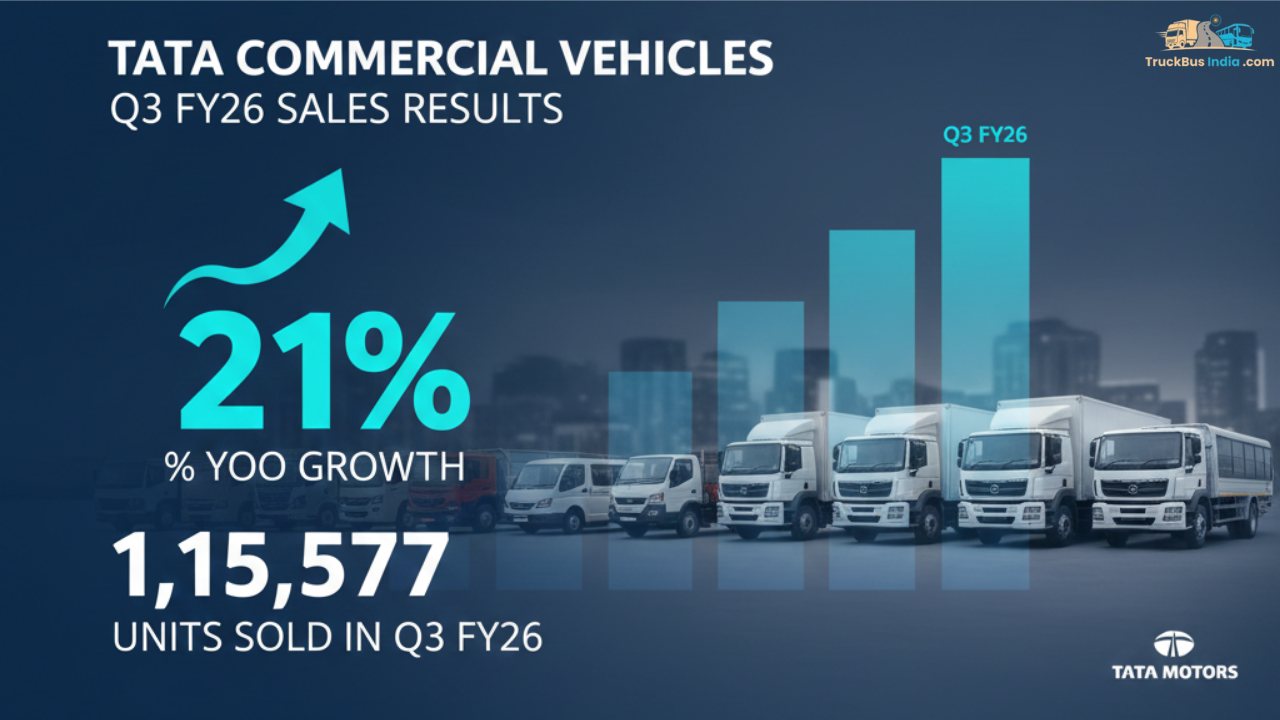
Tata Motors has posted impressive commercial vehicle sales in Q3 FY26, registering a total of 1,15,577 units across domestic and international markets—a 21% increase from the same quarter last year. The growth reflects strong demand across multiple segments, including heavy-duty trucks, pickups, and intermediate commercial vehicles.
Heavy Trucks and Pickups Drive Domestic Growth
Domestic sales remained a key contributor, with 1,07,918 units sold in India, marking an 18% rise over Q3 FY25 figures. Heavy commercial vehicles (HCVs) performed particularly well, with 33,401 trucks delivered, up 23% from 27,130 units a year ago. Tata’s Small Commercial Vehicle (SCV) cargo and pickup category also saw solid performance, growing 15% year-on-year to 43,793 units.
Intermediate Light and Medium Commercial Vehicles (ILMCVs) recorded robust demand as well, with 20,033 units sold in the domestic market, a 26% increase compared to 15,897 units in Q3 FY25. Passenger carriers contributed to the overall growth, posting a 7% rise to 10,691 units. The export market witnessed significant momentum, with 7,659 units shipped overseas, a remarkable 70% increase over the previous year.
MH&ICV Segment Shows Consistent Performance
The Medium, Heavy, and Intermediate Commercial Vehicle (MH&ICV) category, encompassing trucks and buses, also contributed to Tata’s strong quarter. Domestic sales in this segment grew by over 20%, reaching 53,105 units. When combined with international deliveries, MH&ICV sales surged by nearly 24%, from 46,108 units in Q3 FY25 to 57,080 units in Q3 FY26.
Leadership Perspective and Outlook
Girish Wagh, MD and CEO of Tata Motors, attributed the growth to several factors, including sustained demand in core sectors, a rebound in construction and mining activity following monsoon delays, and favorable market conditions fueled by GST reforms and festive demand. He emphasized that the strong performance of SCVs and pickups was pivotal, and that the company’s focused product availability, pricing strategies, and customer engagement efforts helped boost sales.
Looking ahead, Tata Motors expects Q4 FY26 to maintain positive momentum. Government infrastructure initiatives and expansion in various end-use sectors are projected to further drive demand for commercial vehicles, ensuring continued growth across segments.
Conclusion
Tata Motors’ Q3 FY26 results underline the resilience of its commercial vehicle portfolio and strategic market positioning. With strong domestic performance and accelerating exports, the company is well-placed to sustain growth in the coming quarters.