
News List
India’s E-Rickshaw Market Adjusts to L5 Upgrade

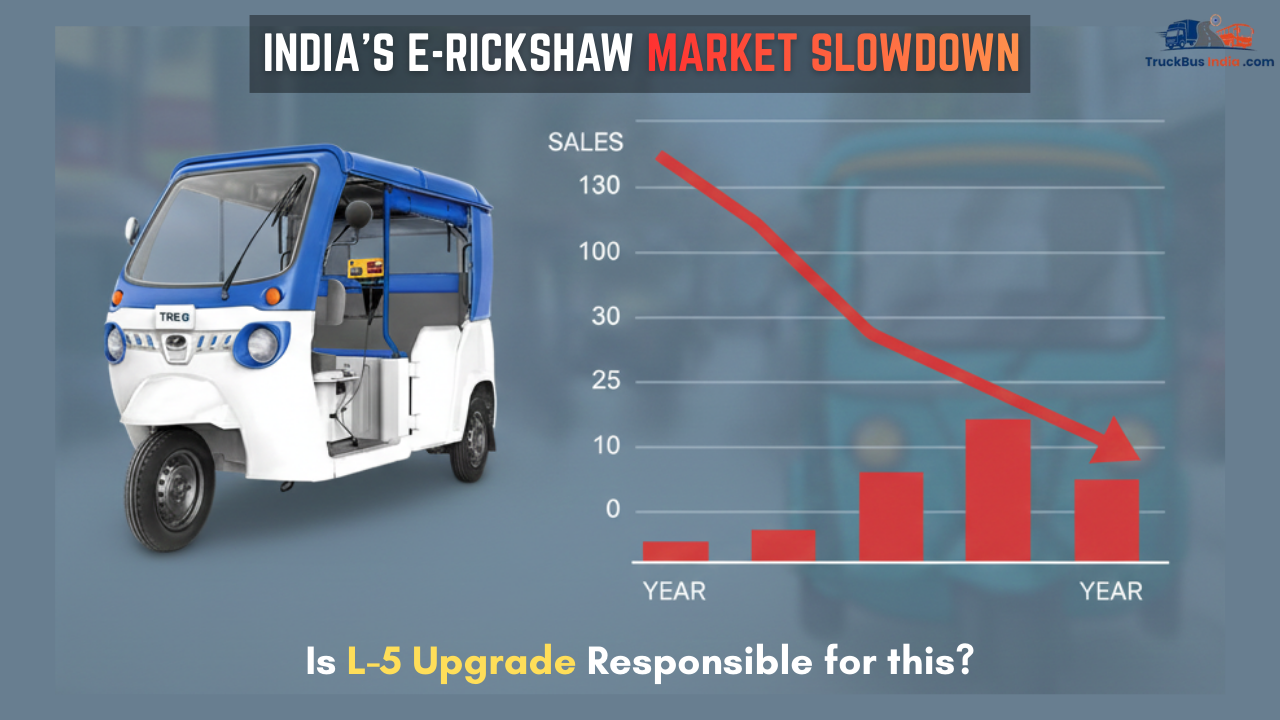
India’s e-rickshaw market is entering a period of adjustment as the L5 regulatory upgrade reshapes production standards, vehicle costs, and buyer preferences. Once a rapidly expanding segment powering last-mile mobility across urban and semi-urban areas, the market is now experiencing a temporary slowdown.
Market Growth Meets Regulatory Shift
Over the past decade, e-rickshaws became a cornerstone of India’s last-mile transport network. Their affordability, low maintenance requirements, and suitability for congested streets enabled rapid adoption in Tier-1, Tier-2, and even rural regions. Monthly sales, which hovered around 60,000 units in FY2019–20, have grown to roughly 115,000–120,000 units today. However, not all segments are growing at the same pace. L5-compliant e-rickshaws and e-carts now account for nearly 45,000 units monthly, signaling a plateau in the previously unregulated low-cost market.
Bajaj Auto’s recent launch of its Riki e-rickshaw in Delhi highlighted the shift. Samardeep Subandh, President of the Intra-City Business Unit, described the current phase as “temporary stagnation,” noting that growth has slowed over the past three to four quarters. Industry observers attribute this cooling to stricter regulations, rising production costs, and changing customer expectations.
The Impact of L5 Upgrades
The L5 category introduced more rigorous vehicle standards, including higher battery specifications, reinforced chassis, and stricter homologation norms. While these upgrades enhance safety, performance, and durability, they also increase manufacturing costs, raising the upfront price for drivers. Many small-scale operators who previously purchased inexpensive e-rickshaws are now transitioning to L5-compliant models, which offer higher range, better load capacity, and longer lifespan—but require a larger initial investment.
Shifts in Financing and Market Structure
Stricter pricing and compliance norms have also affected financing. Loans that were once easy to secure for basic e-rickshaws now demand higher down payments and stricter credit assessments. At the same time, informal manufacturers struggle to meet L5 standards, giving organized OEMs a growing share of the market. This structural shift has temporarily slowed sales but is expected to stabilize the sector in the long term.
Future Outlook
Despite the short-term slowdown, the L5 upgrade is expected to strengthen India’s e-rickshaw market over time. A more regulated and technologically advanced three-wheeler ecosystem will improve safety, reliability, and driver earnings. As financing models adapt and L5 vehicle availability increases, the market is likely to regain momentum, creating a sustainable foundation for future growth.
India’s e-rickshaw segment is transitioning from rapid expansion to strategic consolidation. While sales may appear slower now, the industry’s evolution toward compliance, efficiency, and robustness signals a stronger, more resilient mobility ecosystem ahead.