
News List
Government Ends L5 Electric Three-Wheeler Subsidies Under PM E-DRIVE

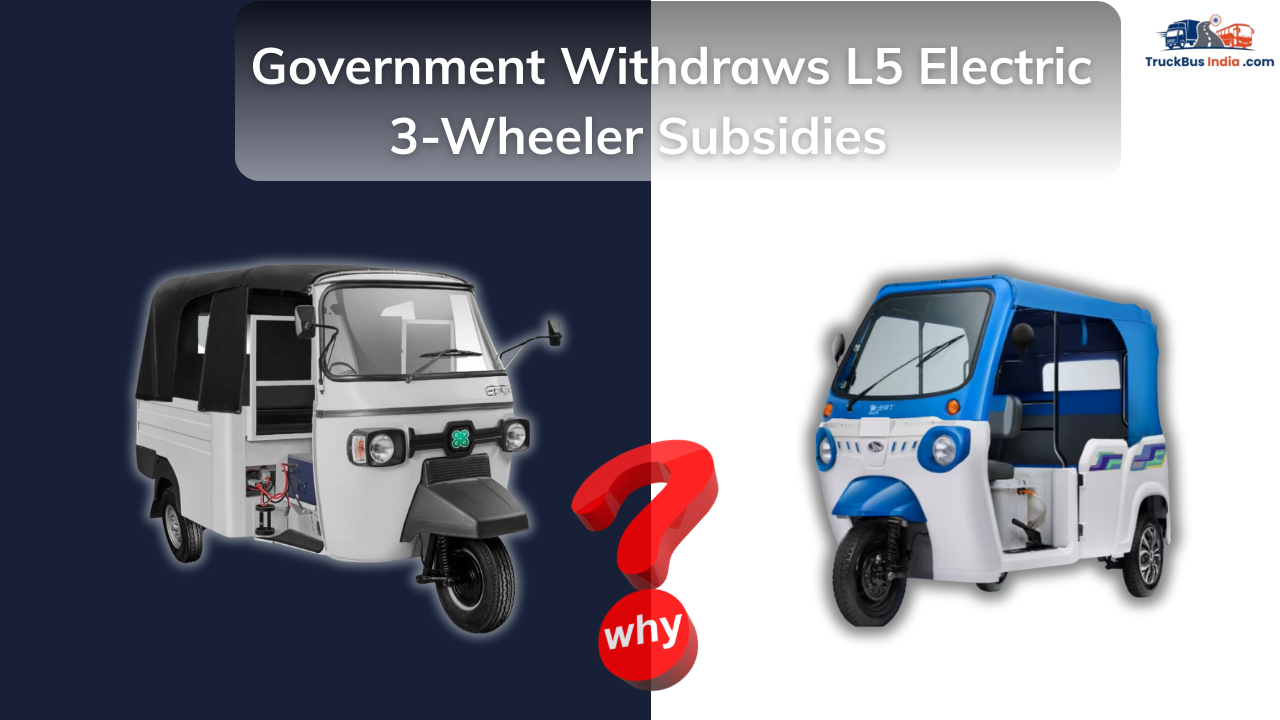
The Union Ministry of Heavy Industries has officially confirmed the withdrawal of demand incentives for L5-category electric three-wheelers under the PM E-DRIVE scheme, following the segment’s rapid adoption and near-completion of its approved targets. The move comes as subsidy-backed sales approached the capped volume well ahead of the scheme’s timeline, signalling strong market maturity in this category.
Under the PM E-DRIVE (PM Electric Drive Revolution in Innovative Vehicle Enhancement) scheme, incentives for L5 electric three-wheelers were limited to a maximum of 2,88,809 units. According to data available on the PM E-DRIVE portal, 2,54,676 vehicles had already availed subsidies by November 4, 2025. This figure rose sharply to 2,85,931 units by December 22, leaving only a marginal buffer before the approved ceiling was exhausted.
The Ministry clarified that the scheme operates under strict fund and volume limits. As outlined in Clause 46 of the PM E-DRIVE notification, incentive claims are discontinued once either the sanctioned vehicle numbers or allocated funds are fully utilised. The L5 electric three-wheeler segment falls squarely within this provision, making further subsidies untenable once the threshold is crossed.
Officials further explained that the L5 sub-component would conclude ahead of schedule if the target volume of 2,88,809 units was achieved by December 26, 2025. Any L5 electric three-wheeler registered after this authorised limit, irrespective of the registration date, will not qualify for demand incentives under the scheme.
The withdrawal of subsidies is expected to create short-term pricing pressure, particularly in the entry-level electric three-wheeler segment where incentives played a key role in keeping upfront costs competitive. Individual buyers and small fleet operators may feel the initial impact, as manufacturers adjust pricing strategies in the absence of central support.
However, industry observers believe demand for electric three-wheelers will remain resilient. Lower running costs, reduced maintenance expenses, and fuel savings continue to give electric models a clear advantage over conventional internal combustion alternatives, especially in urban and semi-urban transport operations. The government has reiterated that incentives were designed to catalyse adoption rather than provide permanent financial support.
With L5 electric three-wheelers reaching a high level of market penetration, public funds are now expected to be redirected towards segments that still require policy backing. In contrast to three-wheelers, electric trucks and buses under the PM E-DRIVE programme are still in early stages of deployment. Demand remains limited as these vehicles undergo testing and evaluation.
To support future adoption, the government has earmarked incentives for up to 14,000 electric buses and 5,643 electric trucks once large-scale deployments begin. Policymakers believe this shift will help accelerate electrification across heavier commercial vehicle categories while allowing mature segments to operate independently.