
News List
Bajaj Riki P4005 vs Kinetic Safar Smart Compared

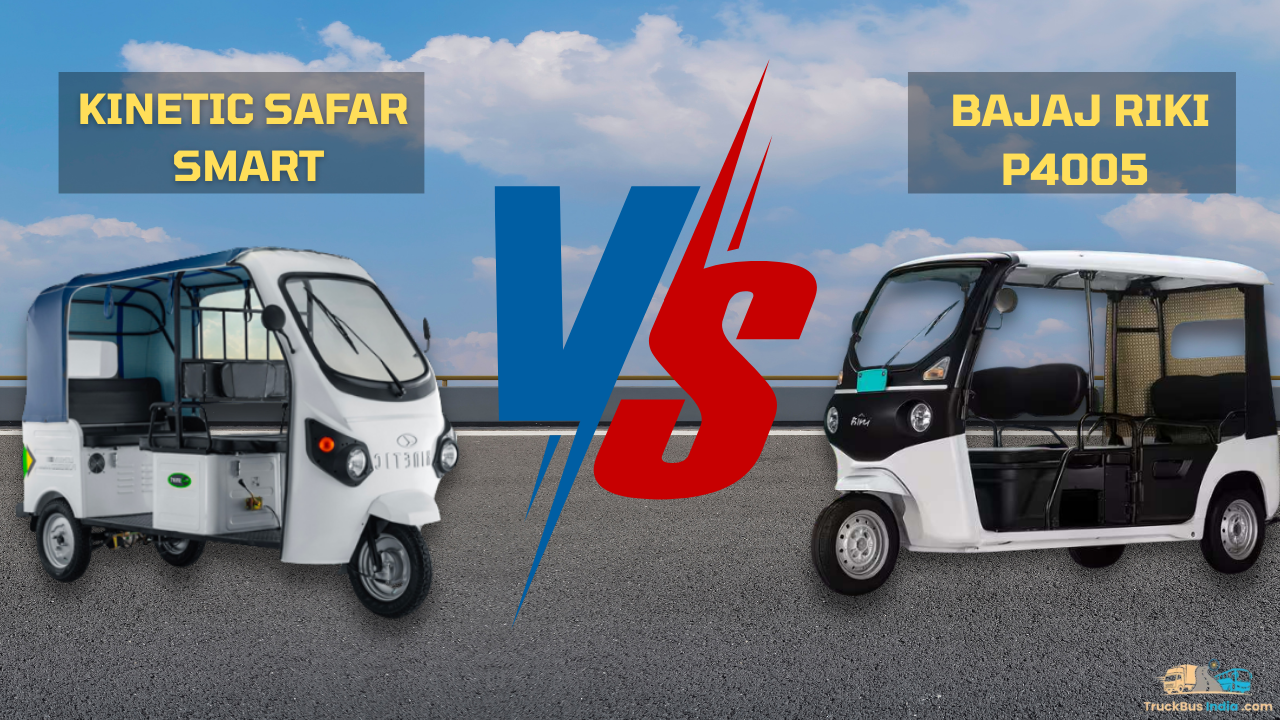
Electric passenger three-wheelers continue to gain momentum in India’s urban and semi-urban transport ecosystem, driven by lower running costs and zero tailpipe emissions. Among the latest entrants in the L3 category are the Bajaj Riki P4005 and the Kinetic Safar Smart. Both electric rickshaws are designed to improve uptime and profitability for last-mile passenger mobility businesses, but they approach performance, comfort and durability differently.
Powertrain And Performance Comparison
The Bajaj Riki P4005 is positioned as the more powerful solution in this comparison. It uses a permanent magnet synchronous motor paired with a lithium-ion battery pack, delivering a maximum power output of 1.99 kW and peak torque of 25 Nm. This setup allows the rickshaw to achieve a claimed driving range of up to 149 km on a full charge, making it suitable for long daily operating hours in city environments.
The Kinetic Safar Smart, on the other hand, relies on a brushless DC motor combined with a lithium-ion phosphate battery. While the power output is lower at 1.2 kW, the vehicle focuses on efficiency and durability, offering a certified range between 80 km and 120 km per charge. Both rickshaws are electronically limited to a top speed of 25 kmph and feature automatic transmissions for ease of operation.
Braking And Safety Performance
In terms of braking, the Bajaj Riki P4005 benefits from a hydraulic drum braking system that provides better modulation and stopping confidence in both dry and wet conditions. This setup enhances safety during passenger-loaded operations, especially in congested urban traffic.
The Kinetic Safar Smart also features drum brakes, but with a mechanically actuated braking system. While this design is simpler and easier to maintain, its braking performance is more effective in dry conditions and slightly less confidence-inspiring on wet surfaces compared to the Riki P4005.
Suspension Setup And Ride Comfort
Suspension is another area where the Bajaj Riki P4005 takes the lead. It features coil springs with hydraulic shock absorbers at the front and an independent semi-trailing arm suspension at the rear, along with an anti-roll bar. This setup improves ride comfort, stability and body control, particularly on smooth urban roads.
The Kinetic Safar Smart uses telescopic suspension with hydraulic dampers at the front and leaf springs with dampers at the rear. While simpler in construction, this configuration handles rough and uneven rural roads more effectively, making it suitable for semi-urban and village operations.
Dimensions, Space And Seating
Both rickshaws offer seating for a driver and four passengers. The Bajaj Riki P4005 measures 2790 mm in length, 995 mm in width and 1700 mm in height, with a wheelbase of 2065 mm. The Kinetic Safar Smart is marginally shorter and narrower but taller, measuring 2780 mm in length, 990 mm in width and 1765 mm in height, with a longer 2130 mm wheelbase and higher ground clearance of 220 mm.
Features And Ownership Perspective
The Bajaj Riki P4005 stands out with a more premium feature set, including a digital instrument cluster, USB and 12V charging ports, provision for speakers, rear passenger doors and well-cushioned seats. It also offers optional accessories such as roof carriers and floor mats. The rickshaw is priced from Rs 1.91 lakh (ex-showroom) and comes with a 3-year or 60,000 km warranty.
The Kinetic Safar Smart, priced from Rs 2.18 lakh (ex-showroom), offers essential features such as a digital display, mobile holder and lockable glove box. Backed by Kinetic’s established service network, it remains a reliable choice for operators prioritising durability and rural usability.
Verdict: Which One Should You Choose?
The Bajaj Riki P4005 is better suited for urban operators seeking higher range, stronger performance and modern features at a lower entry cost. The Kinetic Safar Smart appeals to buyers looking for a rugged, legacy-backed solution with better rough-road capability. Both electric rickshaws deliver strong value, with the final choice depending on operating terrain and business priorities.