
News List
How the GST Reset Brings Balance Back to India’s Commercial Vehicle Market

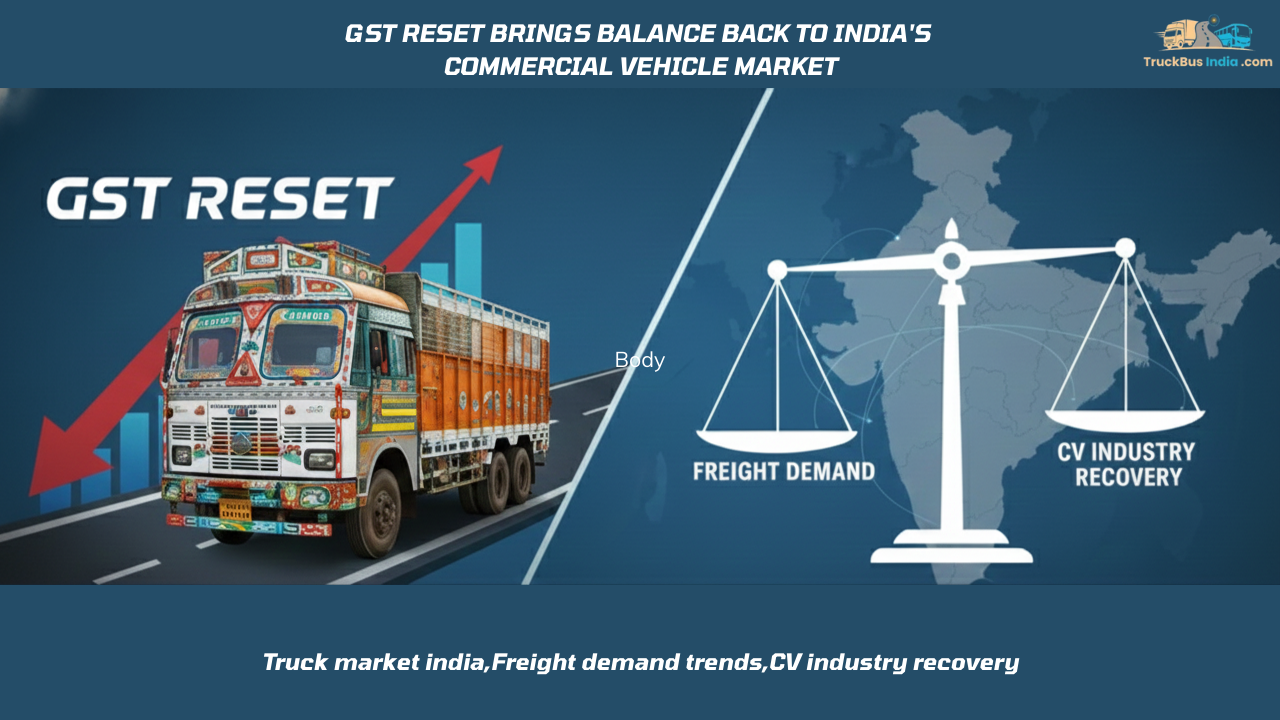
India’s commercial vehicle market is undergoing a meaningful transformation — not just in sales figures, but in the very drivers of demand. After years of distorted buying patterns influenced by tax incentives rather than logistics fundamentals, the government’s recent GST overhaul is helping restore balance to this critical sector of the economy.
The Need for a GST Reset
Historically, India’s commercial vehicle industry experienced repeated cycles of boom and bust tied not to freight trends but to tax‑driven behaviour. Following the rollout of GST in 2017 and especially after COVID‑19, many large fleet operators took advantage of the old GST structure’s quirks — particularly the choice between 5% under reverse charge and 12% under forward charge with input tax credit (ITC).
Large operators often chose the forward charge route to claim ITC on truck purchases, even when underlying freight demand didn’t justify expansion. The result? Fleet sizes ballooned, utilisation declined and freight rates weakened, squeezing profitability — particularly for smaller owner‑operators who once made up the bulk of the market.
What Changed in the GST Structure
To address these imbalances, the government implemented a major GST reset on September 22, 2025. Key aspects include:
- Uniform GST at 18% for commercial vehicles: Trucks, buses and goods carriers previously taxed at 28% now fall under an 18% slab, aligning them with a simplified tax structure.
- Elimination of tax arbitrage: With similar tax rates for different types of buyers and no undue benefits for large fleets, purchasing decisions are expected to be dictated more by freight economics than by tax incentives.
This reset removes the incentive to buy vehicles purely for tax reasons and encourages fleet operators to base decisions on utilisation and demand, which strengthens market discipline.
Impact on Utilisation and Market Dynamics
With the GST reset in place, several important shifts are underway:
- Revival of small operators: Smaller fleet owners, previously crowded out by larger operators taking tax advantages, now find the market more competitive. Lower acquisition costs and higher freight rates make owning and operating trucks more attractive again.
- Focused demand on LCVs and last‑mile logistics: Light commercial vehicles (LCVs) and last‑mile delivery trucks are emerging as segments with significant growth potential. Increased e‑commerce activity and distribution demand boost LCV sales under the new tax regime.
- Replacement demand: A generation of trucks bought during the BS4‑to‑BS6 transition and early GST period (2015–2017) are reaching the end of their useful lives. This replacement cycle offers a baseline of demand even as new purchases align more closely with freight fundamentals.
GST Reset and Freight Demand Trends
The impact of the GST reset has coincided with improving freight trends, which collectively support a healthier commercial vehicle market:
- Stronger retail sales: Data from October 2025 shows India’s commercial vehicle retail volumes rising sharply — with about a 17.7% year‑on‑year increase, driven by GST reforms and demand from logistics and infrastructure segments.
- LCV segment strength: LCVs have seen particularly strong growth, indicating that demand at the last‑mile and distribution levels is vibrant, which helps improve overall freight activity.
- Moderate industry growth forecast: Agencies project moderate growth (3–5% YoY) for commercial vehicle volumes in FY2026, supported in part by the stability offered through GST rationalisation.
These trends suggest that market recovery is being led less by speculative buying and more by genuine freight movement and logistics demand — a healthier signal for long‑term growth.
Broader Benefits of the GST Reset
Beyond just vehicle sales, the GST reset has wider implications for the India commercial vehicle market and the broader economy:
- Improved affordability: Lower taxes mean operators can better manage acquisition costs without heavy discounting by OEMs, which also improves manufacturer margins.
- Simplified tax compliance: A streamlined GST structure reduces complexity and compliance burdens for buyers and manufacturers alike, fostering a clearer business environment.
- Renewed investor confidence: The reset helps establish a clearer demand‑led outlook for the commercial vehicles segment, which could attract more investment and capital into the sector.
Conclusion
The GST reset commercial vehicle market marks a significant turning point for India’s CV industry. By aligning tax policy with underlying freight demand, reducing distortions, and supporting genuine buyer decisions, this reform is fostering a more balanced and sustainable market. While challenges remain, early signs of recovery — especially among smaller fleet operators and key logistics segments — point toward a stronger, demand‑driven future for India’s commercial vehicle ecosystem.